


The Appraisal Gap: What Happens When the Home Appraises Low
You agreed to a price, but the appraisal came in lower. Here is what that gap means, how the math works, and what your options are.
The quick take
An appraisal gap is the difference between the price you agreed to pay and a lower appraised value. The lender bases your loan on the appraisal, so you generally need to cover the difference, renegotiate, or walk away, depending on your contract.
What an appraisal gap is
When you buy with a loan, the lender orders an appraisal. A licensed appraiser estimates what the home is worth. The lender will only lend against the appraised value or the price, whichever is lower. If the appraisal comes in below the price you agreed to pay, the difference is the appraisal gap.
It is more common in competitive markets, in rising markets, with unusual homes, and where few similar homes have sold recently. Redfin reports that roughly 8% of appraisals come in below the contract price.
A simple example
This is a simplified example with round numbers. Your loan type and lender rules can change the math.
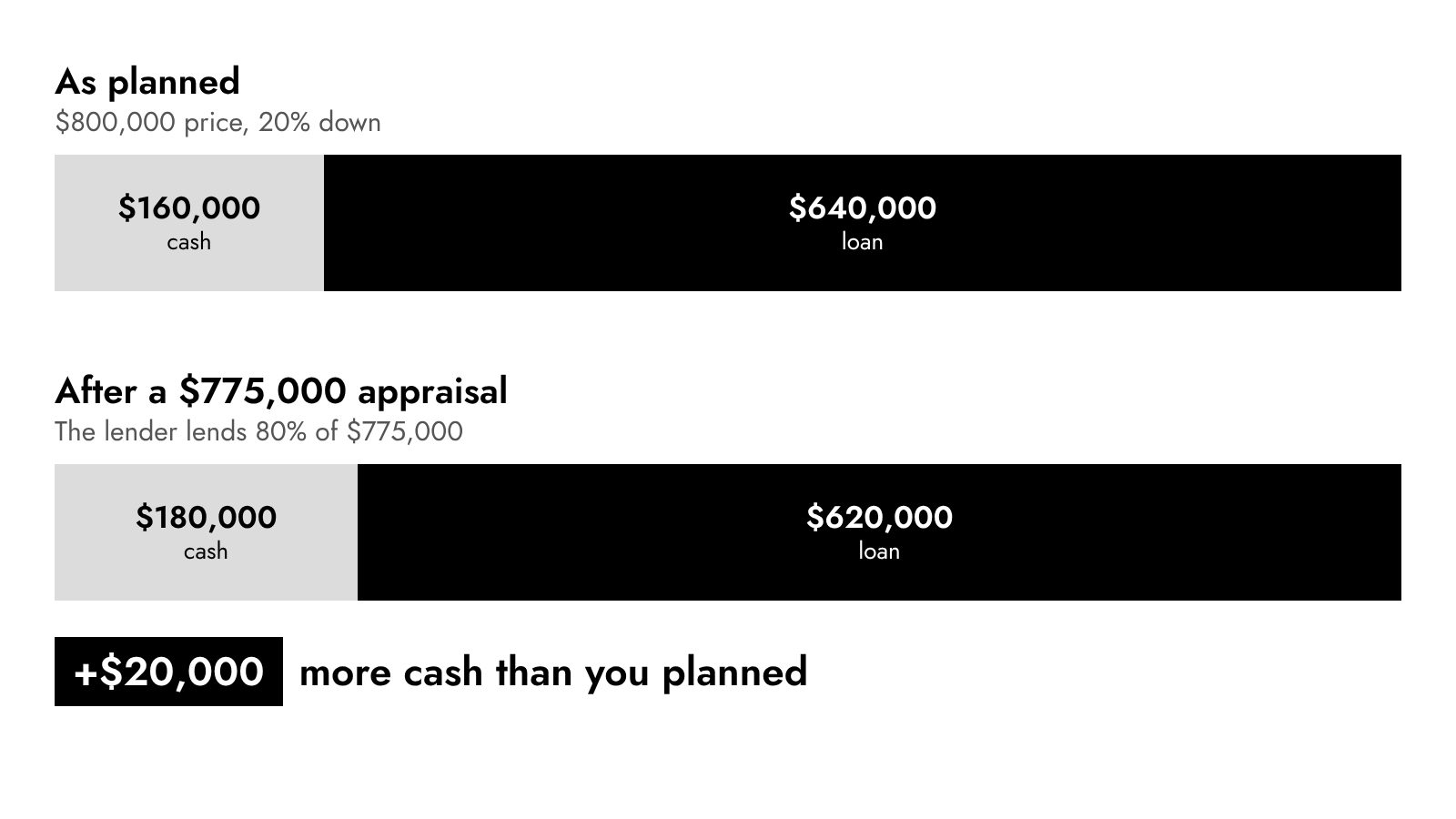
• You agree to buy a home for $800,000 and plan to put 20% down, which is $160,000, with a $640,000 loan.
• The home appraises at $775,000, which is $25,000 below the price.
• The lender will lend 80% of $775,000, or $620,000, instead of $640,000.
• To close at $800,000, you need $180,000 in cash instead of $160,000. That is $20,000 more than you planned.
Your options
Renegotiate: Ask the seller to lower the price to the appraised value, or to meet in the middle. Sellers sometimes agree, especially if the home would otherwise go back on the market.
Cover the gap: Pay the difference in cash from savings or other eligible funds. This keeps the deal alive, and it is a choice about how much you are willing to pay above appraised value.
Challenge the appraisal: Your lender may be able to request a reconsideration of value, if you have strong comparable sales or evidence of errors. There is no guarantee it will change.
Walk away: If your contract has an appraisal or financing contingency and you act on time, you may be able to cancel and recover your earnest money. Without that protection, you may risk the deposit.
Gap clauses in offers
In competitive situations, buyers sometimes include language promising to cover some or all of a low appraisal. It can make an offer more attractive, and it also means you take on the risk. If you consider it, decide the most you are comfortable paying and put that number in writing.
From our experience
We have seen buyers decide, in advance, that they would cover a specific amount over appraisal, and others decide they would not cover any. Both can be the right call. What matters is deciding before you are in the middle of a deal, with the clock ticking.
What this means if you are selling
A low appraisal can slow or break a sale. A well-supported price, with recent comparable sales that fit your home, makes a low appraisal less likely. Your agent can help you prepare, and can talk through what to do if the number comes in short.
Questions to ask your agent
• Does my offer have an appraisal or financing contingency, and when does it expire?
• How much cash could I bring if the appraisal comes in low?
• What comparable sales support this price?
Want the full list of terms?
See our plain-English glossary of real estate terms: www.kellyazzarello.com/jargon
Questions? We are glad to help.
If any of this raises a question about your own situation, reach out. If you need an answer faster, call and we will talk it through.
Kelly Azzarello Real Estate | Compass
Email: kelly@kellyazzarello.com
Phone: (425) 830-6457
Sources and credits
We looked to NWMLS first and then Compass. Neither publishes a plain-language definition of this term, so the points above draw on the sources below, in our own words. General information only, not legal or financial advice. Confirm current details with your agent or lender, since forms and rules change.
Redfin, What Is an Appraisal Gap?
Madrona Group, What Is a Financing Contingency in Washington

Earnest Money: Your Good-Faith Deposit, Explained
Earnest money is not an extra fee. It is a deposit toward your purchase, and it can be at risk if you miss a deadline. Here is how it works
The quick take
Earnest money is a good-faith deposit you make after the seller accepts your offer. It is credited toward your purchase at closing. You can lose it if you walk away for a reason the contract does not protect, so deadlines matter.
What earnest money is
Earnest money is a deposit that shows the seller you are serious. You give it after your offer is accepted, and if the sale closes, it is credited toward the money you owe at closing, usually your down payment and closing costs. It is not an extra fee. It is a part of your purchase money that moves in early.
How much is typical?
There is no legal minimum or maximum in Washington, so the amount is negotiated. The sources we looked at put typical deposits in a range from about 1% to 5% of the purchase price, and in competitive situations a larger deposit can make an offer look stronger. On an $800,000 home, 1% to 5% would be $8,000 to $40,000. Your agent can help you pick an amount that fits your situation.
| Home price | 1% | 2% | 3% | 5% |
|---|---|---|---|---|
| $500,000 | $5,000 | $10,000 | $15,000 | $25,000 |
| $800,000 | $8,000 | $16,000 | $24,000 | $40,000 |
| $1,000,000 | $10,000 | $20,000 | $30,000 | $50,000 |
Examples only. In Washington the amount is negotiated, with no legal minimum or maximum. Your agent can help you choose a number that fits your situation.
When is it due, and who holds it?
The timing is spelled out in your purchase and sale agreement, and it is usually within a couple of days after both sides have signed. Missing that deadline can put you in default, so plan ahead and know how you will pay.
You do not hand the money to the seller. A neutral party holds it, typically the escrow company, or in some cases the buyer’s brokerage in a trust account. Escrow generally cannot release the funds to either side without both parties’ written agreement or a court order.
When you get it back, and when you can lose it
Usually refundable: If you cancel under a contingency in your contract, such as inspection or financing, and you give notice on time and in the right form, your deposit is generally returned.
At risk: If you walk away for a reason the contract does not cover, if you miss a contingency deadline, or if you waived a protection to make your offer more competitive.
The standard Washington purchase and sale form also asks the parties to choose how a buyer default is handled. One option limits the seller’s remedy to keeping the deposit. The other lets the seller pursue additional remedies. Which one is checked in your contract matters, so read that section with your agent.
From our experience
We have seen disputes over a deposit that came down to a missed deadline or a notice that was not delivered correctly. The safest habit is to put every contingency date on a calendar the day your offer is accepted, and to deliver notices exactly as the contract says.
Tips for buyers
• Know the deadline and have the funds ready before you write the offer.
• Put every contingency deadline on your calendar on day one.
• Waiving protections to win an offer also puts your deposit at risk. Talk it through first.
• If there is a disagreement, do not assume you can simply ask for the money back. Both sides usually need to sign off, so get advice early.
This post is general information, not legal advice. For a specific default or dispute, a Washington real estate attorney is the right call.
Want the full list of terms?
See our plain-English glossary of real estate terms: www.kellyazzarello.com/jargon
Questions? We are glad to help.
If any of this raises a question about your own situation, reach out. If you need an answer faster, call and we will talk it through.
Kelly Azzarello Real Estate | Compass
Email: kelly@kellyazzarello.com
Phone: (425) 830-6457
Sources and credits
We looked to NWMLS first and then Compass. Neither publishes a plain-language definition of this term, so the points above draw on the sources below, in our own words. General information only, not legal or financial advice. Confirm current details with your agent or lender, since forms and rules change.

Contingent vs. Pending
You found a home you love and the status says contingent or pending. Is it gone? Here is what the labels mean and what you can still do.
The quick take
Contingent means the seller accepted an offer, but a condition is still open. Pending means the conditions are mostly cleared and the sale is heading to closing. Neither means the door is shut, and the exact label matters more than the word on a portal.
Why this is so confusing
If you have browsed homes on a national website, you have probably seen "contingent" and "pending" used as if they mean the same thing. They do not, and the agent-side listing system shows even more detail than the public portals do. In our area, that system is the Northwest Multiple Listing Service (NWMLS).
NWMLS statuses are labels that agents use to describe where a listing stands. They do not tell you every term of the deal, and the portals that display them can show them differently or a little late. Your agent sees the official status, which is one reason to ask before you give up on a home.
What the labels generally mean
Active: The home is available for showings and offers.
Contingent: An offer has been accepted, but the deal still depends on something. In the NWMLS, this label is commonly described as meaning the buyer first needs to sell their own home. The property may stay on the market, and another buyer can sometimes step in.
Pending Inspection: The buyer is still in the inspection period. This is a stage where deals most often change, because inspection findings can lead to repairs, credits, or a buyer backing out.
Pending: The buyer and seller have a signed agreement and the main conditions have been cleared. The sale is moving toward closing, although it can still fall apart.
Pending Feasibility: Similar to Pending Inspection, but used mostly for land or properties that need studies before anything can be built.
Back on market: A prior sale did not close and the home is available again.
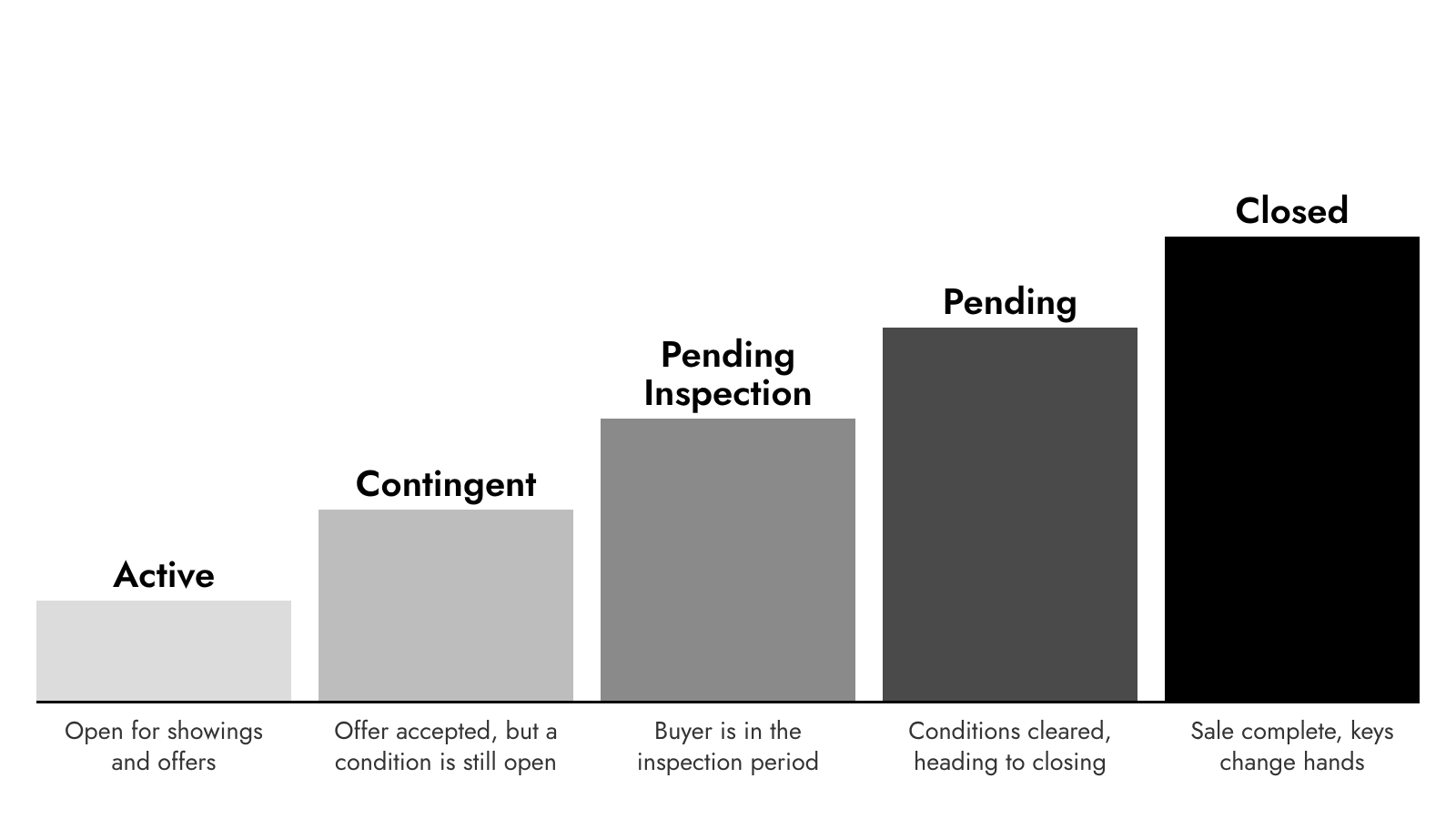
Graphic of the activity ladder. Note that not all steps are included in all transactions.
Because definitions vary a bit from one source to the next, treat this list as a guide and confirm the exact status and terms with your agent.
Can you still make an offer?
Sometimes, yes. Here are the three most common ways:
• A back-up offer. Some sellers will accept offers behind the first buyer. If the first deal fails, the back-up moves up.
• A bump clause. If the first buyer’s offer depends on selling their own home, the seller may keep marketing and give that buyer a deadline to remove the condition or step aside when a better offer arrives.
• Waiting. Deals do fall through, and a home that went contingent or pending can return to active within days.
From our experience
We have watched homes go to pending inspection on a Friday and back to active the following week after the buyer and seller could not agree on repairs. Buyers who stayed in touch with their agent, and who were ready with a pre-approval, were able to move quickly.
What this means if you are buying
• Do not write off a home because of its status. Ask your agent what the status really means for that listing.
• If you want to be in line, ask whether the seller is taking back-up offers and what that would look like.
• Keep your financing pre-approved and current. If a home reopens, you want to be able to move the same day.
What this means if you are selling
Your listing status is part of your marketing. A "pending" label tells other buyers to look elsewhere, while "contingent" can leave the door open to back-up interest. Talk with your agent about which choice fits your goals, and make sure the status is updated promptly when anything changes.
Questions to ask your agent
• What exactly does this status mean on this listing?
• Is the seller accepting back-up offers?
• What condition is still open, and when does it have to be cleared?
• Has this home been on and off the market before?
Want the full list of terms?
See our plain-English glossary of real estate terms: www.kellyazzarello.com/jargon
Questions? We are glad to help.
If any of this raises a question about your own situation, reach out. If you need an answer faster, call and we will talk it through.
Kelly Azzarello Real Estate | Compass
Email: kelly@kellyazzarello.com
Phone: (425) 830-6457
Sources and credits
We looked to NWMLS first and then Compass. Neither publishes a plain-language definition of this term, so the points above draw on the sources below, in our own words. General information only, not legal or financial advice. Confirm current details with your agent or lender, since forms and rules change.
Northwest Multiple Listing Service (NWMLS)
Findwell, Understanding Pending Status for Homes Listed in the Northwest MLS

Because Living Outside City Utilities Means Understanding Septic and Wells
Part of the Why Issaquah? series: Because Living Outside City Utilities Means Understanding Septic and Wells
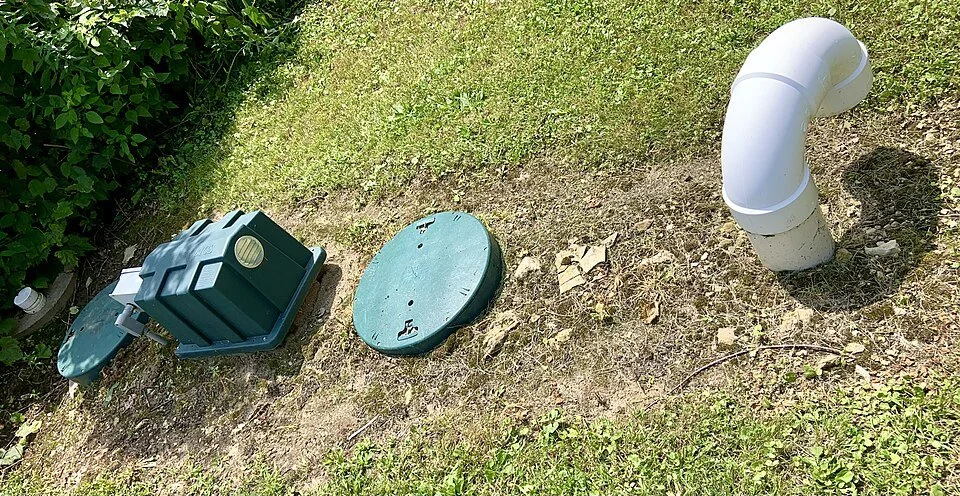
Septic system access
Anywhere outside a city's water and sewer lines, two systems take over: a private well for water, and an on-site septic system for wastewater. Neither is an upgrade or a downgrade. They're simply what a property runs on when there's no municipal main to connect to, and they come with their own rules, their own maintenance, and their own ways a deal can go sideways if nobody checks the details early.
Why These Systems Exist at All
A private well pulls groundwater up from below the property. A septic system treats and disperses wastewater on-site instead of piping it to a treatment plant. Both are standard, well-understood technology, not a compromise. The difference that actually matters for a buyer is that both systems live entirely on the property itself, which means both their capacity and their condition are fixed by whatever was designed, permitted, and installed there, not something a utility company manages on your behalf.
Septic Systems: Sized by Bedrooms, Not Bathrooms
Here's the detail that surprises almost everyone the first time they hear it: septic systems are sized by bedroom count, not bathroom count, and not square footage.
The logic is occupancy, not fixtures. More bedrooms generally means more people living in the home, and more people means more daily wastewater. So King County (and most Washington counties) size the tank and drainfield based on how many bedrooms the house has, or could have, using standard design-flow tables.
A 1-bedroom home is typically designed around a 1,000-gallon tank and 150 gallons per day of flow.
A 3-bedroom home moves up to roughly 450 gallons per day.
A 5-bedroom home requires roughly 750 gallons per day and a larger tank.
This is exactly why you'll sometimes see a home with what looks like ten bathrooms and only four official bedrooms, or the reverse: a home with several bonus rooms, offices, and dens but a surprisingly low bedroom count on paper. Bathrooms don't factor into septic sizing at all. And King County's own guidance is blunt about the bedroom count itself: a den, office, study, loft, bonus room, or any other room with a closet counts as a potential bedroom for septic purposes, regardless of what it's labeled on the floor plan or the listing. Renaming a bedroom doesn't change how the system is sized.
The real-world consequence: if a home is marketed with more bedrooms than its septic system was actually permitted for, that discrepancy can surface during a lender's appraisal and stall or renegotiate a deal. The number that matters is whatever is on file with the county health department as the system's approved design capacity, not what the listing says.
Why a Great Home Site Can Still Be Unbuildable
This is the part that catches buyers off guard on raw land or a teardown: the flat, buildable-looking spot for the house is only half the equation.
Every septic system also needs a reserve drainfield, a second area held in reserve in case the primary drainfield ever fails, plus setbacks from wells, property lines, water bodies, and steep slopes. How much space that actually requires depends on the soil's percolation rate. Poor-draining soil needs a much bigger footprint to handle the same amount of wastewater than good-draining soil does.
Put those together and a parcel can have a perfectly flat, perfectly legal home site, and still fail to qualify for a septic permit, because once every setback and the reserve area are accounted for, there's nowhere left on the lot to put the drainfield. This is exactly what a percolation test and a septic feasibility study are for, and exactly why skipping one on a rural or undeveloped lot is one of the more expensive mistakes a buyer can make.
Wells and Water Rights
In Washington, a private well serving a single home generally doesn't need its own state water-right permit; this is the "exempt well" provision under state law. It comes with real limits, though: exempt wells are capped at 5,000 gallons a day, and wells drilled after January 2018 carry a tighter 950-gallon annual average limit. Separate, uncapped exemptions cover livestock use and watering a lawn or garden under a half acre.
Some properties don't have their own dedicated well at all. A Group B water system is a shared water system serving multiple connections, and it requires its own county approval and a Certificate of Water Availability, separate from a standard private well.
Shared Wells: What to Check Before You're Committed
It's genuinely common in rural subdivisions for two or more properties to share a single well. When that's the case, the well needs a recorded agreement that runs with the land, meaning it binds future owners, not just whoever signed it originally. A real shared-well agreement should cover:
An easement actually granting access to the well and its equipment, recorded against the deed.
How maintenance and repair costs are split among the properties.
Each property's water allocation.
What happens if the well fails and a replacement has to be drilled.
If a property shares a well and there's no recorded agreement, or the deed doesn't actually grant an easement for it, that's a real problem to catch before closing, not after.
Maintenance, Lifespan, and Real Costs
None of this is a one-time cost. Rough, general ranges worth setting expectations around:
Drilling a new well typically runs $3,000 to $15,000, depending mostly on depth.
Installing a new septic system runs roughly $5,000 to $25,000 depending on the type, conventional gravity systems on the lower end, mound or aerobic treatment systems on the higher end for lots with poor soil or high groundwater.
Routine septic pumping is needed every 2 to 5 years, typically $300 to $600 a visit.
A full drainfield replacement, when one eventually fails, can run $20,000 or more.
A well and septic system in good condition, properly sized and properly maintained, can serve a home reliably for decades. The costs above aren't a reason to avoid a property with these systems; they're the numbers to budget for the way you'd budget for a roof or a furnace.
For Buyers & Sellers
Before writing an offer on any property outside city utilities: pull the septic permit and as-built record to confirm the approved bedroom count matches the listing, ask directly whether the well is private or shared and request any recorded agreement if it's shared, and if the lot is raw or undeveloped, get a percolation test and septic feasibility study before assuming the site is buildable at the size you're picturing.
Sellers benefit from having this documentation ready before listing; it answers the first questions a serious buyer's agent will ask, and its absence is one of the most common reasons a rural sale stalls partway through.
Buying or selling a property that runs on well and septic, anywhere in our coverage area? Reach out to Kelly Azzarello Real Estate. We can walk you through exactly what to check before you're under contract.
Kelly Azzarello Real Estate | Compass
📧 kelly@kellyazzarello.com | 📞 (425) 830-6457 | 🌐 kellyazzarello.com
Notes:
General cost ranges are national/regional estimates, not King County-specific quotes; get local contractor estimates before including exact figures in a public-facing version of this post.

How do I buy a house?
Learn how to buy a home in the Seattle area with this expert guide from local brokers. Understand budgeting, credit, down payments, and how to make an offer with confidence.

A Step-by-Step Guide from a Seattle Broker
Buying a home is one of life’s biggest milestones, and one of the most rewarding when you understand how the process works. As seasoned real estate brokers, we’ve helped hundreds of buyers navigate every stage, from the first financial questions to the moment they receive the keys. Here’s what you should know to get started with confidence.
Step 1: Know What You Can Afford
Before you fall in love with a home, it’s important to determine your price range. A good rule of thumb is that your total monthly housing payment (including taxes and insurance) should stay within 25–30% of your gross income. A lender can pre-qualify you for a loan, but we help you translate that number into a realistic budget that fits your lifestyle and long-term goals. It’s not just about what the bank says you can buy, it’s about what feels comfortable for you.
Step 2: Understand Your Financing
Your credit score, down payment, and debt-to-income ratio all play roles in securing your mortgage.
Most loan programs require a minimum credit score of around 620, though stronger credit opens doors to better rates. Many buyers are surprised to learn they don’t need 20% down. There are conventional and government-backed options that start at 3–10%.
We connect clients with trusted local lenders who can explain which programs fit their situation.
Step 3: Plan Your Timeline
How long does it take to buy a home? The honest answer: it depends.
Once you’re pre-approved, most buyers spend one to two months finding the right property, followed by 30–45 days for financing and closing. A skilled agent helps streamline the process by handling details, anticipating issues, and keeping everyone on schedule.
Step 4: Know the Key Terms
Earnest money is a small deposit (usually 1–3% of the purchase price) that shows sellers you’re serious. It’s held in escrow and applied toward your down payment or closing costs once the sale closes. Your down payment is your initial investment in the home. It can come from savings, equity, or even approved gift funds.

Step 5: Making an Offer
Once you’ve found the right home, your agent will help craft a competitive offer that balances price, timing, and terms. We analyze recent comparable sales, assess the seller’s motivation, and position your offer to stand out. It’s important to understand whether the market is calm or competitive. We build strong relationships with local agents and a deep understanding of negotiation strategies can make the difference between getting the home you want and missing out.
Step 6: Move Forward with Confidence
Buying a home doesn’t have to be overwhelming. With clear guidance, trusted partners, and local expertise, the process becomes not just manageable, but exciting. If you’re thinking about buying a home in the Seattle or Tacoma area, we’d love to walk you through your options, answer your questions, and help you make the smartest move possible.
· 📞 Let’s start a conversation today.