


How Are Home Values Doing in Our Area, and Why?
Prices are lower than a year ago, inventory is higher and fewer homes are selling. Here is the data, with dates, and what it means if you are thinking about selling.
As of November 9, 2026: this post uses NWMLS data compiled by InfoSparks (ShowingTime) for median prices, NWMLS monthly reports for August and October 2026, Freddie Mac mortgage rates through November 5, 2026 and NAR data for the third quarter of 2026. Market numbers change often, so contact us for current figures.
This is a very time-sensitive post. While many of the topics here are not specific to the current market, the details are very time-centric and need to be re-analyzed regularly. We highly encourage you to contact us for current market information.
The short answer
Prices in King County are lower than a year ago (down 3.7 percent for houses and 15.9 percent for condos in October), inventory is higher, and fewer homes are selling. National prices have been slightly higher. Here is the data, with dates.
King County
| Measure | August 2026 | October 2026 |
|---|---|---|
| Median sales price | Houses $925,000 (down 5.1% from August 2025) Condos $509,000 (down 7.5%) | Houses $938,863 (down 3.7% from October 2025) Condos $470,700 (down 15.9%) |
| Active listings | 7,703 (up 30.0% from a year earlier) | 7,592 (up 32.8%) |
| Closed sales | 1,791 (down 13.6%) | 1,756 (down 18.1%) |
| Pending sales | 2,101 (down 8.4%) | 1,831 (down 17.8%) |
| Months of inventory | 4.30 | 4.32 |
The ten-year view
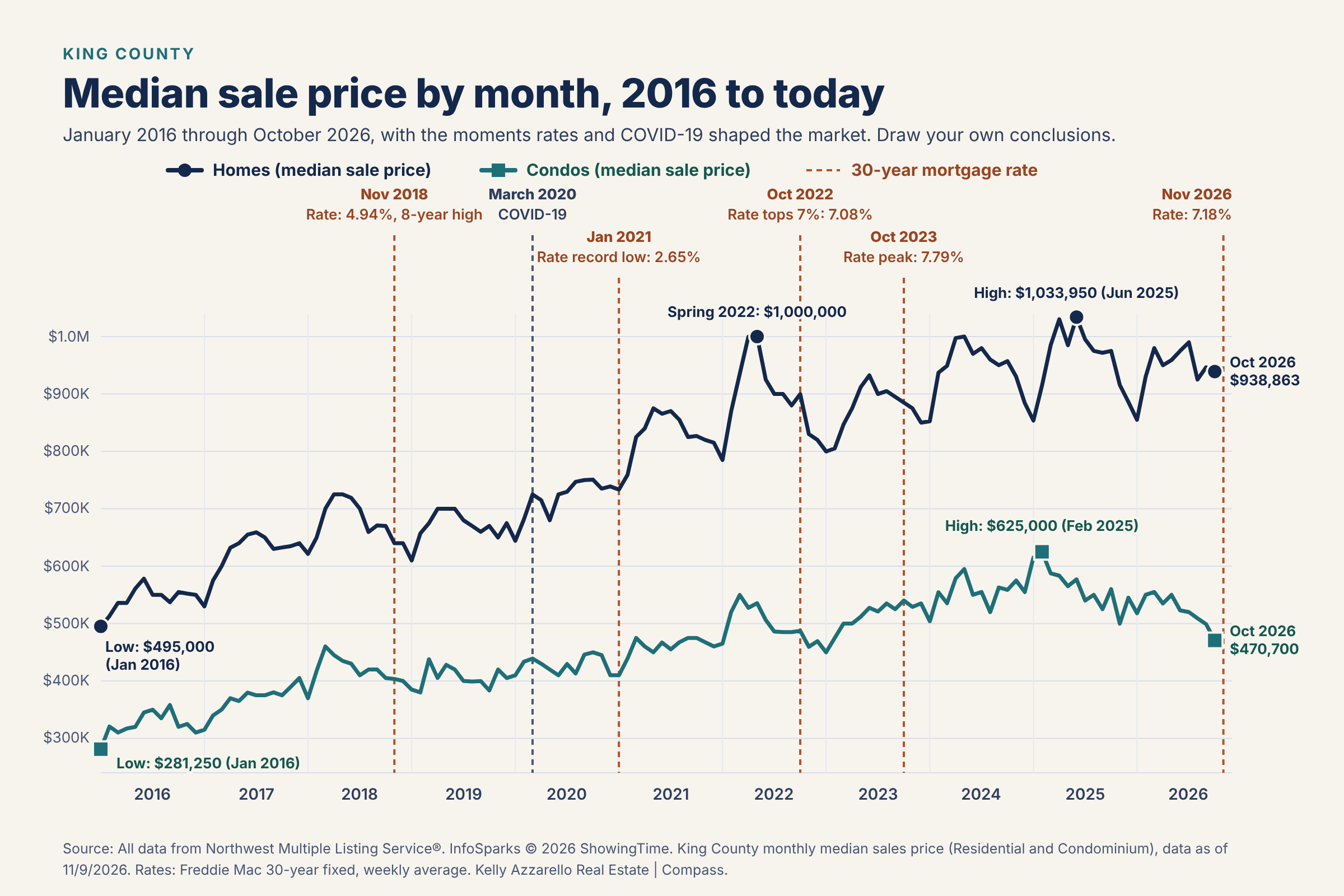
Using Northwest Multiple Listing Service data compiled by InfoSparks (ShowingTime), the King County median sale price for houses peaked at $1,033,950 in June 2025 and was $938,863 in October 2026. For condominiums, the peak was $625,000 in February 2025 and the October 2026 median was $470,700. The lows in this ten-year period were $495,000 for houses and $281,250 for condominiums, both in January 2016.
Source: Northwest Multiple Listing Service, InfoSparks © 2026 ShowingTime, data as of November 9, 2026. Mortgage rates: Freddie Mac.
The Eastside
- In the October 2026 NWMLS report, the Eastside median price for single-family homes was $1.35 million, down 12.9 percent from a year earlier (June 2026: almost $1.6 million, down 3.1 percent).
- In October, the most expensive Eastside submarket, Bellevue west of Interstate 405, had a median of a little more than $3.4 million, up 5.4 percent on only 16 sales (in June it was almost $3.7 million, down 19.8 percent). Small, high-priced markets swing a lot from month to month. Median prices in this area are normally skewed high because of the number of very expensive properties.
- King County's median for houses was $938,863 in October 2026, down 3.7 percent from $975,000 in October 2025, and $925,000 in August 2026, down 5.1 percent from $975,000 in August 2025 (NWMLS data compiled by InfoSparks). King County condos had a median of $470,700 in October 2026, down 15.9 percent from $560,000, and $509,000 in August 2026, down 7.5 percent from $550,000 (InfoSparks). The NWMLS October recap showed about 7.0 months of inventory for condos.
How this compares with the country
NAR reported that the national median existing single-family price was $432,900 in the third quarter of 2026, up 1.7 percent from a year earlier. Our area is running below that trend.
Why it is happening
- Affordability. The Washington Center for Real Estate Research said in the NWMLS October report that interest rates rose even further, with 30-year mortgage rates averaging 7.33 percent in October versus 6.86 percent in September. Rates were 5.98 percent at the end of February 2026, the lowest since September 2022, but they have since risen. Freddie Mac's weekly 30-year fixed average was 7.18 percent on November 5, 2026, its third straight weekly decline from 7.40 percent on October 8 and October 15. That is still up from 6.95 percent on September 17, 6.65 percent on August 20 and 6.22 percent a year earlier.
- More supply. King County had 7,592 active listings at the end of October, up 32.8 percent from a year earlier, which gives buyers more choices and more time to decide.
- Slower sales. In October, King County closed sales were down 18.1 percent and pending sales were down 17.8 percent from a year earlier, which points to cooler demand.
What it means for you
Averages hide a lot. A well-prepared, well-priced home in a strong location can still do well, while a home that is overpriced or in need of work sits. If you are thinking about selling, the useful number is not the county median. It is what comparable homes near you have sold for recently.
City-level numbers
We will cover city specific data in a later post. Stay tuned!
From Our Own Experience
Over the last few years, prices in our market have pulled back. This is somewhat expected, because prices rose so quickly in the early 2020s in response to demand during COVID.
Homes that are priced well continue to sell well. Homes priced on the values of previous years (aspirational pricing) tend to sit longer and often need multiple price reductions before they move.
Buyers have also changed how they behave. They are negotiating harder, which we have not seen in several years, since the market here moved up quickly in the late 2010s. Recent requests include:
- Price adjustments or money back at closing based on inspection results
- Offers far below the listing price
- Seller money applied to interest rate buydowns or closing costs
Many of these requests, especially the inspection requests, are considered “unreasonable” by the other party. Even so, fewer sellers have walked away from deals because of them.
Thinking about selling in the Seattle Area?
Kelly Azzarello Real Estate | Compass
Email: kelly@kellyazzarello.com
Phone: (425) 830-6457
Web: www.kellyazzarello.com
Instagram: instagram.com/kellyazzarello
YouTube: youtube.com/kellyazzarellorealestate
This post is general information about real estate topics. It is not legal, tax or financial advice, and it does not replace a professional inspection. Rules and practices differ by situation and change over time. Check current requirements and talk with a licensed professional, such as an inspector, contractor, attorney or CPA, about your own property.
Sources
- InfoSparks (ShowingTime), Northwest Multiple Listing Service King County monthly median sales price, Residential and Condominium, data as of November 9, 2026
- NWMLS Recaps, October 2026: nwmls.com/wp-content/uploads/2026/11/Recaps-October2026.pdf
- NWMLS Recaps, August 2026: nwmls.com/wp-content/uploads/2026/09/Recaps-August2026.pdf
- NWMLS Market Snapshot, October 2026 (published November 5, 2026): nwmls.com/market-snapshot-october-2026/
- MyNorthwest coverage of the June 2026 NWMLS report (June Eastside figures): mynorthwest.com/lifestyle/425/real-estate-report-inventory-expanding-sales-prices-lower/4254808
- 425 Business, NWMLS October 2026 report (Eastside figures, mortgage rate comments): 425business.com/news/northwest-multiple-listing-service-october-2026-report/article_61c26012-cee7-4bba-bdd1-df6ce5f0790d.html
- NAR, Home Prices Rise in 78% of Metro Areas in Q3 2026 (October 29, 2026): nar.realtor/newsroom/home-prices-rise-78-percent-metro-areas-q3-2026
- Freddie Mac Primary Mortgage Market Survey, rates through November 5, 2026: freddiemac.com/pmms

What Is My Home Worth, and How Is the Listing Price Set?
Value, list price and sale price are rarely the same number. Here is how an agent builds a price from comparable sales, and how you can help your number.
Value, price and list price are three different things
Value is what a typical buyer would pay for your home in today's market.
List (aka Listing) price is where you and your agent decide to start. It’s what is listed in the MLS and associated sites, and is a critical part of the selling process.
Sale price is what a buyer actually agrees to pay.
Ideally these three are close, but they are almost never the same number. The gap between them depends on pricing strategy and how the market is moving.
Note: You will also hear about an appraised value (a lender's appraiser's opinion, ordered for the buyer's loan) and an assessed value (the county's number for property tax). Both are different from the three numbers above. We explain how they compare in our post, Appraisal, Sale Price, CMA, Comps and Assessed Value: Which Number Is Which?
Where online estimates fit
Automated online estimates from any of the websites out there are only a quick starting point. They do not know your updates, property condition, a recent sale next door that is not yet in their data, or what a view or a lot is really worth.
Treat these as a rough range, not a figure to price from.
How an agent builds a price
An agent prepares a comparative market analysis (CMA), which looks at three groups of homes.
- Recent sales. Similar homes in your area that closed recently. Agents adjust for differences in size, age, lot, condition and features.
- Pending sales. Homes under contract show where buyers are willing to commit right now.
- Active listings. These are your competition, and a stale listing that has not sold tells you what buyers are not willing to pay.
The agent then adjusts for the market's direction: inventory, how long homes take to sell, and how close sales prices are to list prices. For reference, NWMLS reported that single-family homes sold in 2024 closed at 100.2 percent of list price on average (NWMLS 2024 Annual Review). NWMLS also reported 99.6 percent for all of 2025. In the NWMLS local market update for King County, single-family homes closed at 99.6 percent of list price in June 2026, down from 100.5 percent in June 2025, and at 100.2 percent for the first half of 2026 compared with 101.7 percent a year earlier. Condos closed at 98.3 percent in June 2026. (Source: Northwest MLS Local Market Update, King County, June 2026.)
The agent will then make data-supported modifications to the price on some of the key features of the home. Here are three examples:
- If the house next door sold recently but only has a 2-car garage and your home has a 3-car garage, this is where the agent will make an adjustment higher.
- If that same home has a remodeled kitchen, but yours does not, then the adjustment will be lower.
- Now let’s say your home has a primary suite on the first floor, and the home next door has a 2nd floor primary suite, then the agent will likely adjust the price higher again.
All of this leads to having an agent that understands the market, the homes, and the desires of the buyers in the area. An agent who only represents sellers may not understand the buyer’s viewpoint as well and will likely set the initial price (and negotiations) differently.
Do you have a say?
Yes. The listing price is your decision. Your agent recommends a price and explains why. A good conversation covers the comparable sales behind the number, whether to price at, below or above the likely value, how long you can wait, and what you will do if there are no offers in the first few weeks.
What pricing too high or too low can do
- Too high: fewer showings, a listing that sits, price cuts that signal trouble, and often a lower final price than if you had priced right at the start.
- Too low: you may leave money on the table, though a lower price may draw more offers and sometimes a stronger result.
What you can do to help your number
- Gather records of improvements and maintenance.
- Fix condition problems that would pull value down.
- Ask to see the comparable sales and ask why each one was chosen.
Put yourself in the buyer's shoes; while they may have different tastes and needs, you can do a lot to help your home's sale value by providing your agent with additional information on schools, parks, activities, transit options, etc. Keep a running list (use a phone to notate these as they are discussed or thought about).
Note that an appraisal is a different thing. A lender's appraiser values the home for the buyer's loan, usually after you have a contract and before closing.
Related reading: When Should I Sell My Home? | Who Can I Call to Find Out What to Do (and Not Do) Before Selling? | How Are Home Values Doing in Our Area, and Why?
From our experience
We have seen a great run up in home prices in the northwest over the last few years. We are now in a correction, and that’s expected. Home prices ebb and flow over time, especially when other economic indicators are present.
Right now we have a number of clients who want to use "aspirational" pricing because at some point their house may have been worth that price. Unfortunately that isn’t realistic and we need to clearly understand the market today and what may affect the price in the future, not to predict but to be prepared should we need to adjust.
Here are a few things to consider when you’re pricing your home:
- How long can you afford to wait to sell to “get your price”?
- When interest rates are higher, the buyers have to consider lower priced homes. When interest rates were lower, they could afford higher priced homes. The former pushed prices down, the latter pushes prices up.
- The value of your home in any given market is not personal. It is not about the memories you’ve made in that home.
- It’s not what you ‘have to get’ for your home that determines the price.
The truth is that the price your home commands is the value that a buyer sees in your home. Not a neighbor, not two years ago or two years in the future.
It doesn’t happen often, but we sometimes have to part ways with clients. Most of the time it is because they have unrealistic expectations, and while our business is to provide a service to any and all of our clients, we are a business. We won’t sacrifice a client's money for our own purposes, but we also can’t sacrifice our business or our other clients' transactions because someone has unrealistic expectations.
In February we made the decision to walk away from a listing. It was a developer (flipper) who had a price in mind for the home, because he felt he had to get a certain amount of profit from it.
As of November 1, that home was still on the market.
The market sets the price. We can provide info and background to price things well within the current market climate. We cannot predict the price.
Thinking about selling in the Seattle Area?
Kelly Azzarello Real Estate | Compass
Email: kelly@kellyazzarello.com
Phone: (425) 830-6457
Web: www.kellyazzarello.com
Instagram: instagram.com/kellyazzarello
YouTube: youtube.com/kellyazzarellorealestate
This post is general information about real estate topics. It is not legal, tax or financial advice, and it does not replace a professional inspection. Rules and practices differ by situation and change over time. Check current requirements and talk with a licensed professional, such as an inspector, contractor, attorney or CPA, about your own property.
Appraisal, Sale Price, CMA, Comps and Assessed Value: Which Number Is Which?
Five terms, five different numbers, and five different people behind them. Here is what each one means, who is responsible for it, and who pays.
The quick take
Five terms get mixed up constantly, and each one answers a different question. The sale price is what the buyer and seller agree on. An appraisal is a licensed appraiser’s opinion of value for the lender. A CMA is your agent’s opinion of what a home is likely to sell for. Comps are the recent sales those opinions are built from. The assessed value is the county’s number for property tax. They are often different numbers for the same house, and that is normal.
Why these get confused
All five are about “what a home is worth,” so people use them interchangeably. But they are made by different people, for different reasons, at different times. A buyer can hear all five in a single week: a CMA before making an offer, a sale price when the offer is accepted, an appraisal from the lender, the assessed value on the county tax notice, and comps in every conversation along the way.
The five terms side by side
| Term | Who creates it | Who pays | What it is used for |
|---|---|---|---|
| Sale price | Buyer and seller, through negotiation, with their agents | The buyer pays it to the seller at closing | The deal itself, and the basis for some closing costs and the excise tax |
| Appraisal | A licensed appraiser, working independently. The lender orders it | Usually the buyer, as part of the loan costs | Tells the lender how much the home supports as collateral |
| CMA (comparative market analysis) | A real estate agent or broker, for their client | Usually no charge as part of working with an agent | Pricing a listing, and deciding what to offer |
| Comps (comparable sales) | Pulled from MLS and public records by whoever needs them | Usually no charge | The evidence behind a CMA, an appraisal and often an assessment |
| Assessed value | The county assessor, on the county’s own schedule | No one pays for the value. The owner pays property tax based on it | Calculating the property tax bill |
Sale price
The sale price is the one number that is actually a decision. It is whatever the buyer and seller agree to in the purchase contract. It can be above or below the list price, the CMA, the appraisal and the assessed value. Nobody tells the parties what it must be, and no one can set it for them. Your agent advises, but the buyer and seller make the call. Because it is a negotiated price, it is also the number that becomes recorded history for the home and the next set of comps.
The sale price also drives money. It sets some of the closing costs, and it is the basis for the Washington real estate excise tax, which the seller pays at closing. A higher price means a higher excise tax bill. We cover how that works in our Closing terminology post.
Appraisal
An appraisal is a formal opinion of value written by a licensed appraiser, usually when a buyer is using a loan. The lender orders it, because the lender needs to know the home supports the loan amount if something goes wrong later. Appraisers are expected to work independently, and your agent, the seller and the buyer do not choose the number.
Who orders it: The lender. Buyers do not normally pick the appraiser.
Who pays: Usually the buyer, as part of the costs of getting the loan.
Who does it: A licensed appraiser. It is a formal report, and it relies on comps adjusted for differences in size, condition and features.
What you get: Under federal rules, the lender must give you a free copy of the appraisal promptly, and no later than three business days before closing. Ask for it and read it.
No loan, no appraisal: A buyer paying all cash is not required by a lender to get one, though some buyers order one anyway.
The appraisal is where the other numbers meet reality. If it comes in below the sale price, the buyer faces an appraisal gap. Read more in our post The Appraisal Gap: What Happens When the Home Appraises Low.
CMA (comparative market analysis)
A CMA is an agent’s opinion of what a home is likely to sell for, built from recent comps and the current competition. It is more informal than an appraisal. A good CMA looks at condition, updates, lot, view and timing, and often gives a range rather than a single number.
Who does it: A real estate agent or broker, usually for a seller who is pricing a listing or a buyer who is deciding what to offer.
Who pays: Usually no one. Agents typically prepare it as part of working with you. Ask if you are unsure.
What it is not: An appraisal. A lender does not use it in place of one, and it is an opinion, not a guarantee.
Comps (comparable sales)
Comps are recent sales of homes similar to yours in size, age, condition and location. They are the raw material. Agents use them to build a CMA, appraisers use them to support an appraisal, and owners use them to challenge an assessed value. Because someone has to decide which sales are truly similar, two people can look at the same neighborhood and choose different comps. That is one reason their numbers can differ.
No single person is responsible for comps. Whoever is making the opinion chooses them, and a good professional can explain why those sales were picked and what was adjusted.
Assessed value
The assessed value is the county’s estimate of the property’s value, used to calculate property tax. In King County, the Assessor sets it each year and mails a value notice. Each property’s share of the property tax bill is based on its assessed value. It is not an opinion of what the home would sell for today, and it does not decide the sale price or the appraisal.
Who does it: The county assessor, not your agent, lender or an appraiser you hire.
Who pays: No one pays for the value. The owner pays property tax, which is calculated from it.
If you disagree: You can appeal to the King County Board of Equalization. The petition is due by the later of July 1 of the assessment year or 60 days from the mailing date on your value notice. Check your notice for the exact date, because it is strictly enforced.
One house, five numbers
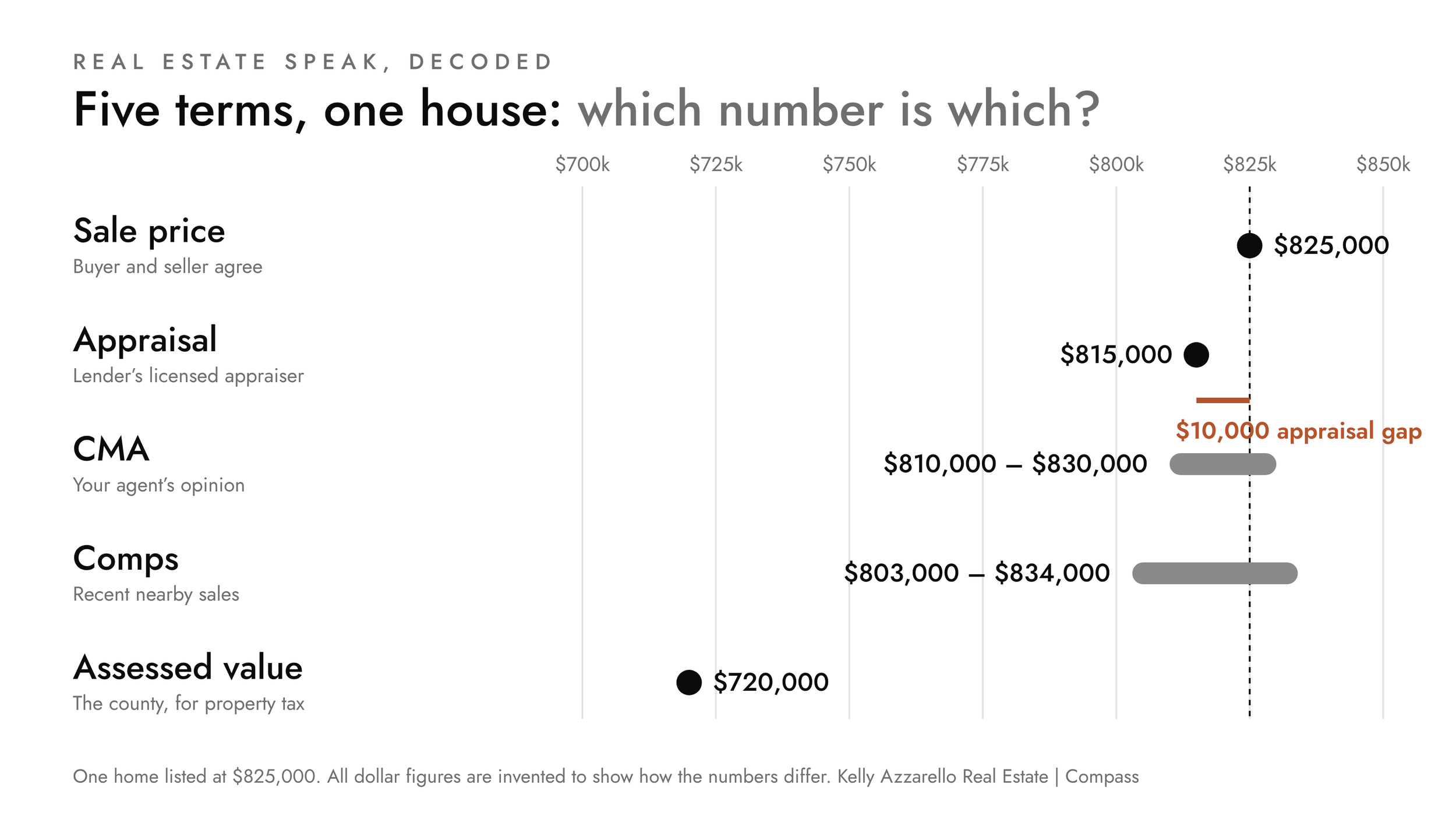
Take a home that is listed for $825,000. Here is how all five might look. These numbers are invented to show how they differ.
- The county assessed value on the tax notice is $720,000.
- The listing agent’s CMA suggests a range of $810,000 to $830,000, based on comps from the last few months.
- Those comps are four recent nearby sales between $803,000 and $834,000.
- The buyer and seller agree on a sale price of $825,000.
- The lender’s appraisal comes in at $815,000, using its own comps.
Nothing is wrong here. Each number answers a different question. The $10,000 difference between the sale price and the appraisal is an appraisal gap, and that is the one that affects the deal, because the lender will lend based on the lower figure.
Who is responsible for what
| Question | Answer |
|---|---|
| Who decides the sale price? | The buyer and the seller, together |
| Who decides the appraised value? | The appraiser, independently. The lender orders it |
| Who prepares the CMA? | The agent or broker, for their client |
| Who chooses the comps? | Whoever is making the opinion: the agent, the appraiser or the owner |
| Who sets the assessed value? | The county assessor |
| Who pays for the appraisal? | Usually the buyer, as part of the loan costs |
| Who pays for the CMA? | Usually no one, as part of working with an agent |
| Who pays property tax based on the assessed value? | The owner |
| Who pays excise tax based on the sale price? | The seller, at closing |
From our experience
We have seen owners surprised that their county tax value was well below what their home sold for, and buyers surprised that an appraisal came in under their agreed price. In both cases the numbers were doing their jobs. They just had different jobs.
What this means if you are buying
- Use the CMA and the comps to decide what to offer. Do not use the assessed value as a guide to the price.
- Expect the lender to order an appraisal, and plan for what you would do if it comes in below the sale price.
- Ask for your free copy of the appraisal and read it.
- Remember that the assessed value is not the same as what your property tax will be, and that it can change after you buy.
What this means if you are selling
- Ask your agent for a CMA with the comps behind it, so you can see why a price makes sense.
- Do not price your home from the assessed value. It serves a different purpose.
- Be ready for the appraisal. If it lands below your sale price, the buyer may ask to renegotiate or bring more cash.
- Remember that your sale price sets your excise tax, so ask your agent for an estimate of what you will net.
- Keep records of updates and improvements. They help an agent and an appraiser see what makes your home different from the comps.
Questions to ask your agent
- Which comps did you choose, and why those?
- How is your CMA different from what an appraiser will do?
- How likely is it that this home appraises at the sale price?
- What is the assessed value, and does it matter for this decision?
Want the full list of terms?
See our plain-English glossary of real estate terms: www.kellyazzarello.com/jargon
Questions? We are glad to help.
If any of this raises a question about your own situation, reach out. If you need an answer faster, call and we will talk it through.
Kelly Azzarello Real Estate | Compass
Email: kelly@kellyazzarello.com
Phone: (425) 830-6457
Web: www.kellyazzarello.com
Sources and credits
We looked to NWMLS first and then Compass. Neither publishes a plain-language comparison of these terms, so the points above draw on the sources below, in our own words. All dollar figures are invented examples. General information only, not legal or financial advice. Confirm current details with your agent, lender or the county, since rules change.
- Northwest Multiple Listing Service (NWMLS)
- Freedom Mortgage, Comparative Market Analysis
- Consumer Financial Protection Bureau, Delivery of appraisals under the ECOA Valuations Rule
- King County Board of Equalization, Appeal Property Tax
- Manaky, Property Tax Appeals in King County
- Washington Department of Revenue, Real Estate Excise Tax

The Appraisal Gap: What Happens When the Home Appraises Low
You agreed to a price, but the appraisal came in lower. Here is what that gap means, how the math works, and what your options are.
The quick take
An appraisal gap is the difference between the price you agreed to pay and a lower appraised value. The lender bases your loan on the appraisal, so you generally need to cover the difference, renegotiate, or walk away, depending on your contract.
What an appraisal gap is
When you buy with a loan, the lender orders an appraisal. A licensed appraiser estimates what the home is worth. The lender will only lend against the appraised value or the price, whichever is lower. If the appraisal comes in below the price you agreed to pay, the difference is the appraisal gap.
It is more common in competitive markets, in rising markets, with unusual homes, and where few similar homes have sold recently. Redfin reports that roughly 8% of appraisals come in below the contract price.
A simple example
This is a simplified example with round numbers. Your loan type and lender rules can change the math.
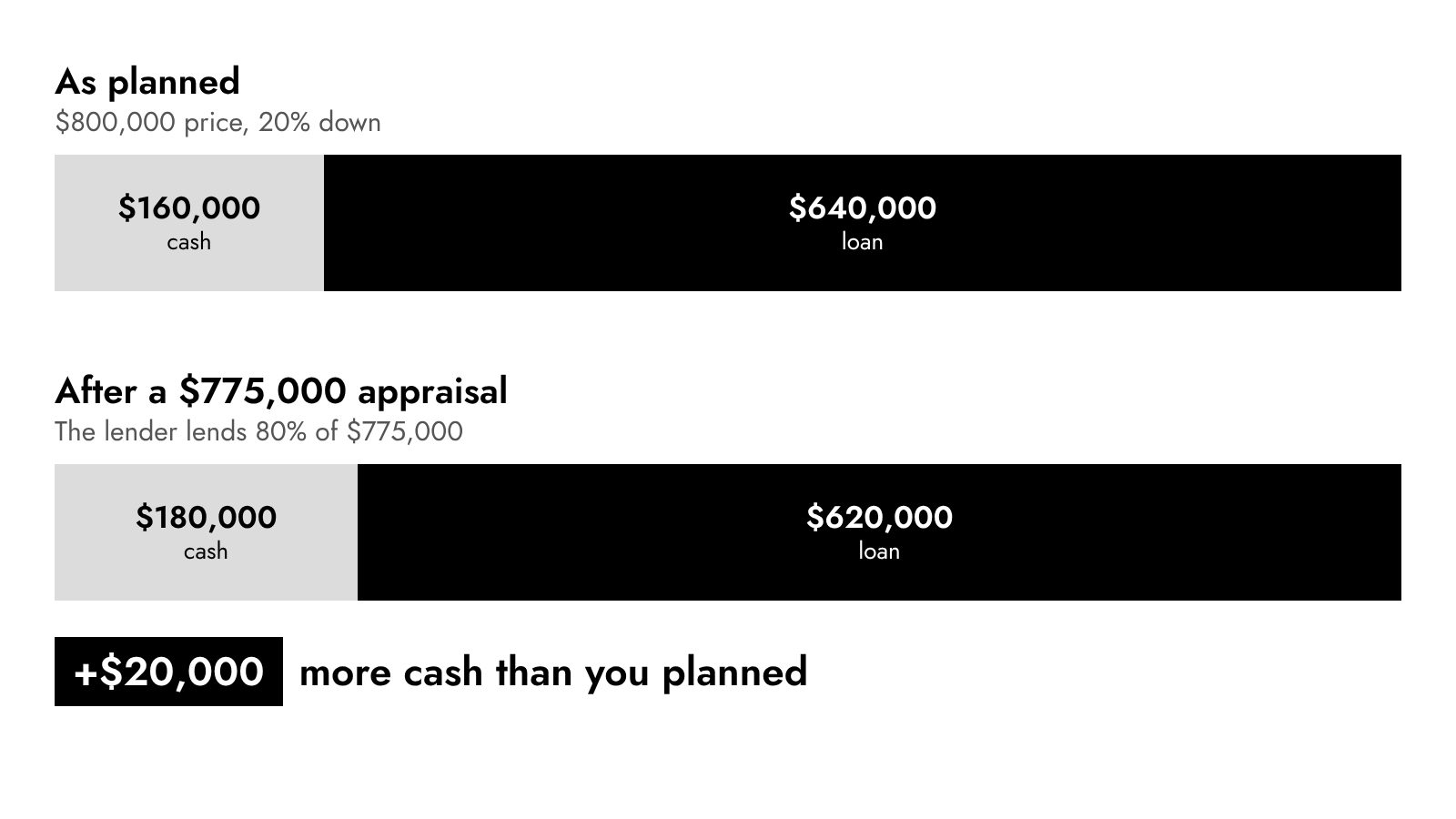
• You agree to buy a home for $800,000 and plan to put 20% down, which is $160,000, with a $640,000 loan.
• The home appraises at $775,000, which is $25,000 below the price.
• The lender will lend 80% of $775,000, or $620,000, instead of $640,000.
• To close at $800,000, you need $180,000 in cash instead of $160,000. That is $20,000 more than you planned.
Your options
Renegotiate: Ask the seller to lower the price to the appraised value, or to meet in the middle. Sellers sometimes agree, especially if the home would otherwise go back on the market.
Cover the gap: Pay the difference in cash from savings or other eligible funds. This keeps the deal alive, and it is a choice about how much you are willing to pay above appraised value.
Challenge the appraisal: Your lender may be able to request a reconsideration of value, if you have strong comparable sales or evidence of errors. There is no guarantee it will change.
Walk away: If your contract has an appraisal or financing contingency and you act on time, you may be able to cancel and recover your earnest money. Without that protection, you may risk the deposit.
Gap clauses in offers
In competitive situations, buyers sometimes include language promising to cover some or all of a low appraisal. It can make an offer more attractive, and it also means you take on the risk. If you consider it, decide the most you are comfortable paying and put that number in writing.
From our experience
We have seen buyers decide, in advance, that they would cover a specific amount over appraisal, and others decide they would not cover any. Both can be the right call. What matters is deciding before you are in the middle of a deal, with the clock ticking.
What this means if you are selling
A low appraisal can slow or break a sale. A well-supported price, with recent comparable sales that fit your home, makes a low appraisal less likely. Your agent can help you prepare, and can talk through what to do if the number comes in short.
Questions to ask your agent
• Does my offer have an appraisal or financing contingency, and when does it expire?
• How much cash could I bring if the appraisal comes in low?
• What comparable sales support this price?
Want the full list of terms?
See our plain-English glossary of real estate terms: www.kellyazzarello.com/jargon
Questions? We are glad to help.
If any of this raises a question about your own situation, reach out. If you need an answer faster, call and we will talk it through.
Kelly Azzarello Real Estate | Compass
Email: kelly@kellyazzarello.com
Phone: (425) 830-6457
Sources and credits
We looked to NWMLS first and then Compass. Neither publishes a plain-language definition of this term, so the points above draw on the sources below, in our own words. General information only, not legal or financial advice. Confirm current details with your agent or lender, since forms and rules change.
Redfin, What Is an Appraisal Gap?
Madrona Group, What Is a Financing Contingency in Washington