


What Do I Have to Do, and in What Order, to Sell My Home?
Selling goes from a decision, to preparation, to listing, to an accepted offer, to closing. Here are the ten steps in order, and the best time to bring in an agent.
The short version
Selling goes from a decision, to preparation, to listing, to an accepted offer, to closing. Bring in an agent at the beginning, before you spend money on repairs or decide on timing, because the agent can tell you what is worth doing and in what order.
The key milestones
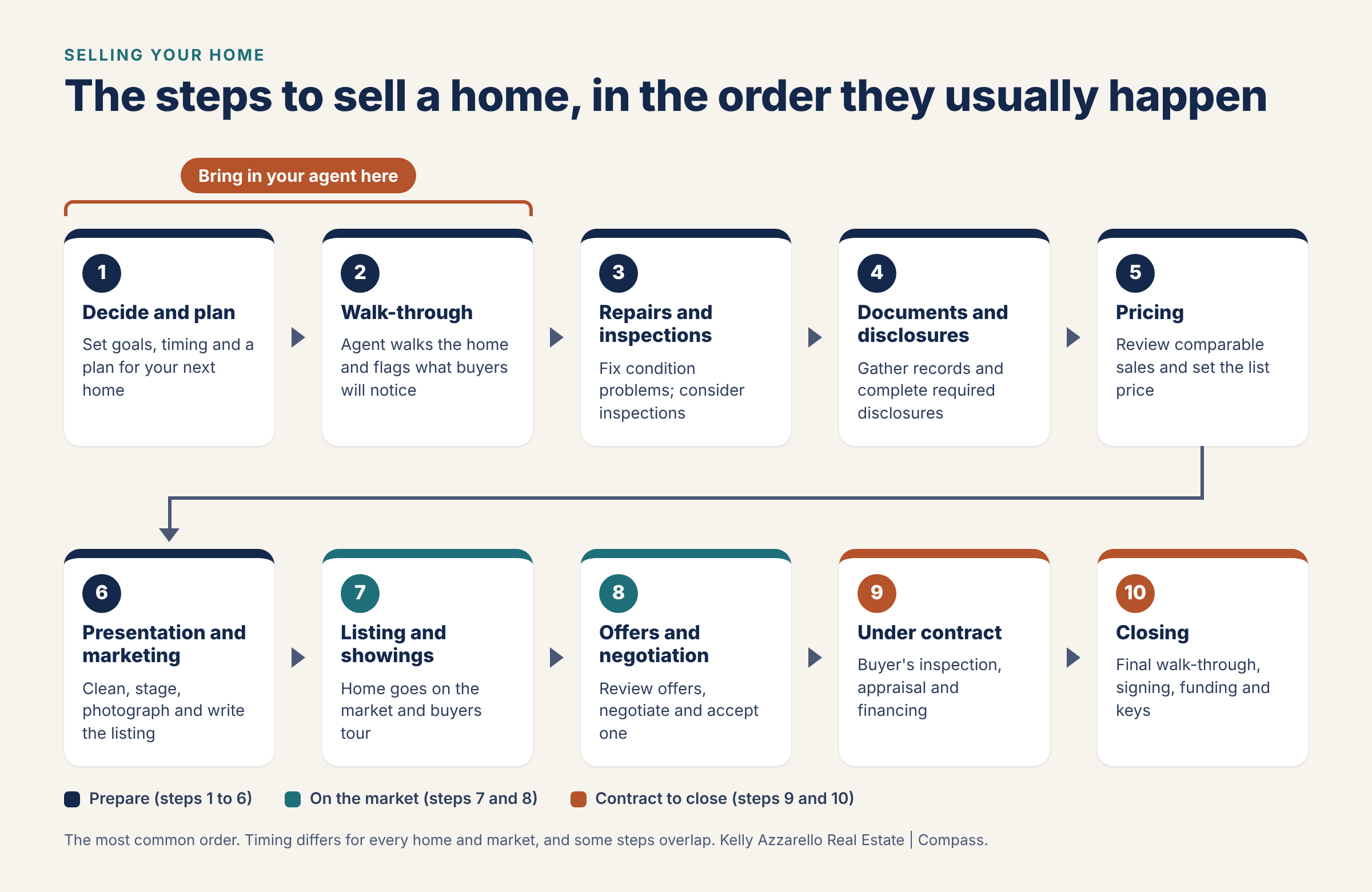
| Step | What happens | Who is involved |
|---|---|---|
| 1. Decide and plan | Set goals, timing, a rough net figure and a plan for your next home | You, agent, CPA, lender |
| 2. Walk-through | Agent walks the home and lists what buyers will notice | You, agent |
| 3. Repairs and inspections | Fix condition problems; consider a pre-listing inspection and specialty inspections | You, contractors, inspectors |
| 4. Documents and disclosures | Gather records, HOA documents and complete required disclosures | You, agent |
| 5. Pricing | Review comparable sales and set a list price | You, agent |
| 6. Presentation and marketing | Clean, stage, photograph, write the listing | You, agent, photographer |
| 7. Listing and showings | Home goes on the market; buyers tour | You, agent |
| 8. Offers and negotiation | Review offers, negotiate price and terms, accept one | You, agent |
| 9. Under contract | Buyer's inspection, appraisal and financing; negotiate repairs or credits | Buyer, you, agents, lender |
| 10. Closing | Final walk-through, signing, funding, handing over keys | You, title and escrow, agents |
When to get an agent involved
At step 1 or 2. An agent can help you decide whether to sell now, what to fix and what to leave, what your home may sell for, and how to time your next move. Getting advice after you have already started major projects is the most common way sellers spend money that does not pay back.
While it is better to have more time to plan and prepare, we have been able to prepare and get a home on the market in less than 14 days.
Common mistakes
- Starting large projects before getting advice.
- Listing before the home is ready, then trying to fix problems while it is on the market.
- Setting a price based on what you need rather than what comparable homes sold for.
- Waiting until the inspection to learn about problems you could have found yourself.
Thinking about selling in the Seattle Area?
Kelly Azzarello Real Estate | Compass
Email: kelly@kellyazzarello.com
Phone: (425) 830-6457
Web: www.kellyazzarello.com
Instagram: instagram.com/kellyazzarello
YouTube: youtube.com/kellyazzarellorealestate
This post is general information about real estate topics. It is not legal, tax or financial advice, and it does not replace a professional inspection. Rules and practices differ by situation and change over time. Check current requirements and talk with a licensed professional, such as an inspector, contractor, attorney or CPA, about your own property.

What Is My Home Worth, and How Is the Listing Price Set?
Value, list price and sale price are rarely the same number. Here is how an agent builds a price from comparable sales, and how you can help your number.
Value, price and list price are three different things
Value is what a typical buyer would pay for your home in today's market.
List (aka Listing) price is where you and your agent decide to start. It’s what is listed in the MLS and associated sites, and is a critical part of the selling process.
Sale price is what a buyer actually agrees to pay.
Ideally these three are close, but they are almost never the same number. The gap between them depends on pricing strategy and how the market is moving.
Note: You will also hear about an appraised value (a lender's appraiser's opinion, ordered for the buyer's loan) and an assessed value (the county's number for property tax). Both are different from the three numbers above. We explain how they compare in our post, Appraisal, Sale Price, CMA, Comps and Assessed Value: Which Number Is Which?
Where online estimates fit
Automated online estimates from any of the websites out there are only a quick starting point. They do not know your updates, property condition, a recent sale next door that is not yet in their data, or what a view or a lot is really worth.
Treat these as a rough range, not a figure to price from.
How an agent builds a price
An agent prepares a comparative market analysis (CMA), which looks at three groups of homes.
- Recent sales. Similar homes in your area that closed recently. Agents adjust for differences in size, age, lot, condition and features.
- Pending sales. Homes under contract show where buyers are willing to commit right now.
- Active listings. These are your competition, and a stale listing that has not sold tells you what buyers are not willing to pay.
The agent then adjusts for the market's direction: inventory, how long homes take to sell, and how close sales prices are to list prices. For reference, NWMLS reported that single-family homes sold in 2024 closed at 100.2 percent of list price on average (NWMLS 2024 Annual Review). NWMLS also reported 99.6 percent for all of 2025. In the NWMLS local market update for King County, single-family homes closed at 99.6 percent of list price in June 2026, down from 100.5 percent in June 2025, and at 100.2 percent for the first half of 2026 compared with 101.7 percent a year earlier. Condos closed at 98.3 percent in June 2026. (Source: Northwest MLS Local Market Update, King County, June 2026.)
The agent will then make data-supported modifications to the price on some of the key features of the home. Here are three examples:
- If the house next door sold recently but only has a 2-car garage and your home has a 3-car garage, this is where the agent will make an adjustment higher.
- If that same home has a remodeled kitchen, but yours does not, then the adjustment will be lower.
- Now let’s say your home has a primary suite on the first floor, and the home next door has a 2nd floor primary suite, then the agent will likely adjust the price higher again.
All of this leads to having an agent that understands the market, the homes, and the desires of the buyers in the area. An agent who only represents sellers may not understand the buyer’s viewpoint as well and will likely set the initial price (and negotiations) differently.
Do you have a say?
Yes. The listing price is your decision. Your agent recommends a price and explains why. A good conversation covers the comparable sales behind the number, whether to price at, below or above the likely value, how long you can wait, and what you will do if there are no offers in the first few weeks.
What pricing too high or too low can do
- Too high: fewer showings, a listing that sits, price cuts that signal trouble, and often a lower final price than if you had priced right at the start.
- Too low: you may leave money on the table, though a lower price may draw more offers and sometimes a stronger result.
What you can do to help your number
- Gather records of improvements and maintenance.
- Fix condition problems that would pull value down.
- Ask to see the comparable sales and ask why each one was chosen.
Put yourself in the buyer's shoes; while they may have different tastes and needs, you can do a lot to help your home's sale value by providing your agent with additional information on schools, parks, activities, transit options, etc. Keep a running list (use a phone to notate these as they are discussed or thought about).
Note that an appraisal is a different thing. A lender's appraiser values the home for the buyer's loan, usually after you have a contract and before closing.
Related reading: When Should I Sell My Home? | Who Can I Call to Find Out What to Do (and Not Do) Before Selling? | How Are Home Values Doing in Our Area, and Why?
From our experience
We have seen a great run up in home prices in the northwest over the last few years. We are now in a correction, and that’s expected. Home prices ebb and flow over time, especially when other economic indicators are present.
Right now we have a number of clients who want to use "aspirational" pricing because at some point their house may have been worth that price. Unfortunately that isn’t realistic and we need to clearly understand the market today and what may affect the price in the future, not to predict but to be prepared should we need to adjust.
Here are a few things to consider when you’re pricing your home:
- How long can you afford to wait to sell to “get your price”?
- When interest rates are higher, the buyers have to consider lower priced homes. When interest rates were lower, they could afford higher priced homes. The former pushed prices down, the latter pushes prices up.
- The value of your home in any given market is not personal. It is not about the memories you’ve made in that home.
- It’s not what you ‘have to get’ for your home that determines the price.
The truth is that the price your home commands is the value that a buyer sees in your home. Not a neighbor, not two years ago or two years in the future.
It doesn’t happen often, but we sometimes have to part ways with clients. Most of the time it is because they have unrealistic expectations, and while our business is to provide a service to any and all of our clients, we are a business. We won’t sacrifice a client's money for our own purposes, but we also can’t sacrifice our business or our other clients' transactions because someone has unrealistic expectations.
In February we made the decision to walk away from a listing. It was a developer (flipper) who had a price in mind for the home, because he felt he had to get a certain amount of profit from it.
As of November 1, that home was still on the market.
The market sets the price. We can provide info and background to price things well within the current market climate. We cannot predict the price.
Thinking about selling in the Seattle Area?
Kelly Azzarello Real Estate | Compass
Email: kelly@kellyazzarello.com
Phone: (425) 830-6457
Web: www.kellyazzarello.com
Instagram: instagram.com/kellyazzarello
YouTube: youtube.com/kellyazzarellorealestate
This post is general information about real estate topics. It is not legal, tax or financial advice, and it does not replace a professional inspection. Rules and practices differ by situation and change over time. Check current requirements and talk with a licensed professional, such as an inspector, contractor, attorney or CPA, about your own property.

When Should I Sell My Home?
Is there a best month to sell your home? Here is King County data by month for 2025 and 2026, and the questions that matter more than the calendar.
There are two questions here: Make certain you understand which is being asked.
- The first question is whether you should sell your home. This is a very personal decision and is something you will likely think about over a long period of time. While significant changes in your life (job transfers, family issues or needs, aging) may happen, most of our clients have been considering selling their home for a significant amount of time.
- The second question is the one we’ll address in detail below: “What month or time of year should I sell my home?” There is historical data to support certain months being better for selling (improved sale price, fewer days on market, etc.). There are also times when putting your home on the market is NOT going to provide an optimal result because fewer people are looking for homes.
There is no single best month
People often ask when the market peaks. The better question is when selling works for your life, your finances and your home, and whether the market gives you a fair shot at the price you need. Three groups of factors decide that.
What the data says about timing
Here is what happened month by month in King County, based on Northwest MLS (NWMLS) data for houses and condominiums combined. New listings are homes that came on the market during the month. Pending sales are homes that went under contract. Closed sales are homes that finished the sale. The first three columns are 2025, a full year. The next three are 2026 so far.
Note on the last column: it is the median days on market for King County, from NWMLS data compiled by InfoSparks (ShowingTime), data as of November 9, 2026. The median is the middle home: half were faster and half took longer, so a few very slow homes do not skew it.
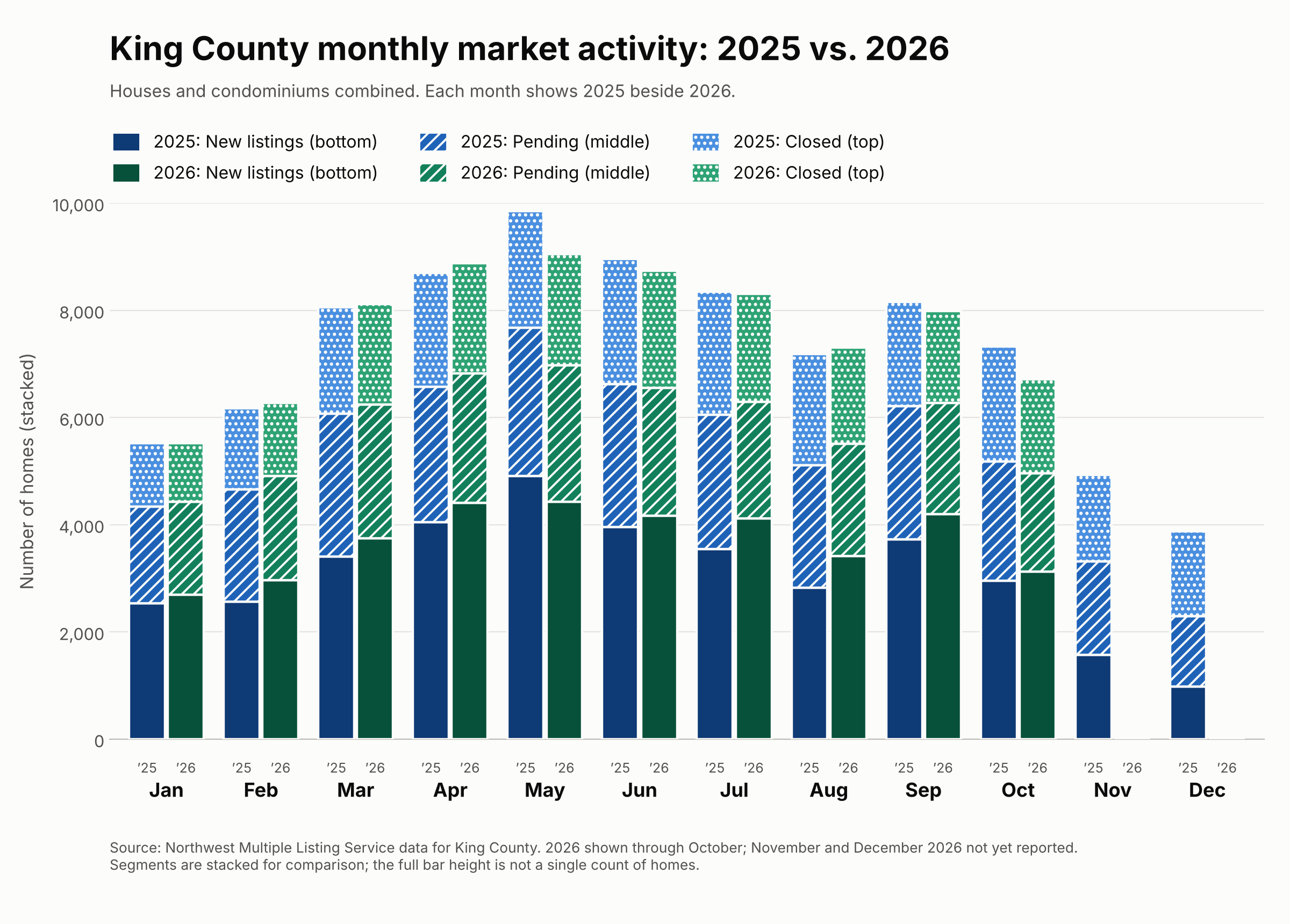
King County, houses and condominiums combined, by month
| Month | New listings 2025 | Pending 2025 | Closed 2025 | New listings 2026 | Pending 2026 | Closed 2026 | Median days on market (2025 / 2026) |
|---|---|---|---|---|---|---|---|
| January | 2,533 | 1,810 | 1,181 | 2,694 | 1,735 | 1,099 | 31 / 42 |
| February | 2,571 | 2,087 | 1,516 | 2,968 | 1,945 | 1,364 | 9 / 16 |
| March | 3,408 | 2,662 | 1,991 | 3,750 | 2,493 | 1,878 | 7 / 10 |
| April | 4,052 | 2,524 | 2,127 | 4,414 | 2,416 | 2,053 | 6 / 10 |
| May | 4,909 | 2,768 | 2,180 | 4,429 | 2,549 | 2,074 | 7 / 10 |
| June | 3,960 | 2,668 | 2,332 | 4,165 | 2,390 | 2,183 | 10 / 13 |
| July | 3,552 | 2,506 | 2,296 | 4,124 | 2,168 | 2,022 | 13 / 15 |
| August | 2,822 | 2,294 | 2,073 | 3,416 | 2,101 | 1,791 | 18 / 20 |
| September | 3,725 | 2,487 | 1,952 | 4,204 | 2,072 | 1,714 | 21 / 22 |
| October | 2,953 | 2,228 | 2,144 | 3,132 | 1,831 | 1,756 | 18 / 18 |
| November | 1,573 | 1,742 | 1,613 | not yet | not yet | not yet | 22 / not yet |
| December | 987 | 1,310 | 1,582 | not yet | not yet | not yet | 31 / not yet |
| January to October total | 34,485 | 24,034 | 19,792 | 37,296 | 21,700 | 17,934 | — |
| 2025 full year total | 37,045 | 27,086 | 22,987 |
What to notice
- Spring is the busiest season on both sides. In 2025, new listings peaked in May (4,909) and pending sales peaked in May (2,768). Closed sales peaked in June (2,332), after contracts written in the spring.
- Winter has far fewer listings, but buyers do not disappear. In November 2025, 1,573 homes were listed and 1,742 went under contract. In December, 987 were listed and 1,310 went under contract. In May, by comparison, 4,909 were listed and 2,768 went under contract. Fewer competing listings does not automatically mean a better price, so the count of listings is only one input.
- So far in 2026 the pattern is different. In every month from January through October, fewer homes went under contract and fewer closed than in the same month of 2025, while new listings were higher in nine of the ten months (May was lower). For January through October combined, new listings were up about 8 percent, pending sales were down about 10 percent and closed sales were down about 9 percent (calculated from the table).
- Homes took longer to sell in 2026. The median days on market was higher than in the same month of 2025 in every month through September, and equal in October (18 days). For example, April was 10 days versus 6, June was 13 versus 10 and August was 20 versus 18. The seasonal pattern shows in both years: the median was shortest in spring (6 to 10 days from March through May) and longest in winter (31 days in December 2025 and 42 in January 2026).
- The data does not point to a single best month. Early in the year provides sellers with less competition as there are few listings and many buyers start their search in the beginning of the year. Spring has the most buyers and the most competing listings. Late fall and winter have fewer of both. Which tradeoff favors you depends on your home, your price and your timeline.
Sources: NWMLS 2025 Annual Statistical Review and Highlights, King County (nwmls.com/wp-content/uploads/2026/01/King-AnnualReview2025.pdf); NWMLS monthly recaps and King County breakouts, January to October 2026 (nwmls.com); InfoSparks (ShowingTime), NWMLS median days on market, King County, data as of November 9, 2026. 2026 figures run through October. November and December 2026 are not yet available.
Some guidelines that will help you make better decisions
Your life
- A job change, retirement, a growing or shrinking household, or a health or care need often sets the date for you.
- Where you will live next, and how long you will need to move, matters as much as the sale itself.
- If you need the proceeds to buy your next home, build in time for both transactions.
Your finances
- Equity. After a sale you pay off your mortgage and selling costs. Ask for a net sheet that shows what you would actually take home.
- Taxes. Generally, if you have owned and lived in the home for a total of 24 months in the five years before the sale, you can exclude up to $250,000 of profit, or $500,000 if married filing jointly. Rules have conditions, so check with a CPA. For the details, see IRS Publication 523.
- Carrying costs. Every month you wait has mortgage, tax, insurance and upkeep costs.
The market
- Inventory and pace. More homes for sale and slower sales give buyers more leverage. See our post, How Are Home Values Doing in Our Area, and Why?, for current numbers.
- Interest rates. Rates affect what buyers can pay. Waiting for a better rate is a bet, not a plan.
- Season. Spring is typically busy, but a well-prepared and well-priced home can sell at other times, and there may be fewer competing listings in off-peak months.
Your home
- A major repair coming up, such as a roof, sewer line or crawl space problem, is better handled before listing than discovered by a buyer.
- If you are not ready to prepare the home, waiting a few months to do it right can pay for itself.
A simple timing check
Ask yourself: When do I need to be out? How long will preparation take? What do I need to net? What are comparable homes doing right now? A walk-through with an agent turns those questions into a plan.
Related reading: What Is My Home Worth, and How Is the Listing Price Set? | I Found a Home I Love for Retirement, but I Don't Know if Mine Will Sell
From Our Own Experience
Trying to time the real estate market is like trying to time the stock market: You’ll never get it exactly right. However, there are times when there are advantages to selling your home. We have had good success with clients who can sell their homes in the early part of the calendar year. We believe that this is due to the following:
- Pent up buyer demand that releases in the new year (after the holidays)
- Buyers who have goals to buy in the new year
- Buyers who wish to take advantage of the fiscal, investment or tax benefits of owning a home (holiday gatherings and discussions often focus on these; parents often being key in these discussions)
While seller-centric, we have also encountered sellers who want to have “one last holiday” in their home before putting it on the market.
Thinking about selling in the Seattle Area?
Kelly Azzarello Real Estate | Compass
Email: kelly@kellyazzarello.com
Phone: (425) 830-6457
Web: www.kellyazzarello.com
Instagram: instagram.com/kellyazzarello
YouTube: youtube.com/kellyazzarellorealestate
This post is general information about real estate topics. It is not legal, tax or financial advice, and it does not replace a professional inspection. Rules and practices differ by situation and change over time. Check current requirements and talk with a licensed professional, such as an inspector, contractor, attorney or CPA, about your own property.
Tax: Tax treatment depends on your individual circumstances and changes over time. Consult a CPA or tax professional about your situation.

As I'm Looking at Retirement, How Do I Access the Equity in My Home?
For many homeowners, the home is the largest asset they own. Here are four ways to access that equity as you approach retirement, and what to ask before you choose.
Important: Before you take any action, always discuss your situation with your own professionals, such as your accountant, investment advisor, attorney, trustees, and any other advisors you work with. This post is general information only and is not advice for your situation.
The situation
For many homeowners, their home is the largest single asset they own. As they look forward to retirement, it raises a practical question:
How do you turn some of that equity into income or flexibility without giving up more than you intend?
There are several routes to consider and you should consider all of them carefully before moving forward. To see how much of your overall wealth is tied up in your home, read How Much of Your Wealth Is in Your Home?
Option 1: Sell and move to a smaller or less expensive home
Selling frees the most equity. You can buy a smaller home, buy in an area that is “further out” and lower cost, or rent.
For many this is doable because they no longer need to commute to an office and the time that that takes out of their day.
On the down-side, costs include selling and moving expenses and, depending on your situation, taxes on the gain from the sale. Generally, up to $250,000 of profit ($500,000 for married couples filing jointly) can be excluded if you meet the ownership and use rules. Check with a CPA.
How the home sale exclusion works (example for illustration only, not tax advice). Taxable gain is generally the sale price, less selling costs, less what you paid for the home and spent on capital improvements, less the exclusion. The exclusion generally requires that you owned the home and lived in it as your main home for at least 2 of the last 5 years. Check IRS Publication 523 and talk with a CPA. If you are timing a sale around your plans, see When Should I Sell My Home? If you want to buy your next home before this one sells, see I Found a Home I Love for Retirement, but I Don't Know if Mine Will Sell.
| Sale price | Selling costs | Purchase price and capital improvements | Exclusion | Potential taxable gain |
|---|---|---|---|---|
| $1,500,000 | − $90,000 | − $700,000 | − $500,000 (married, filing jointly) | = $210,000 |
Option 2: Sell and rent
The up side:
- Renting avoids maintenance and ownership costs and keeps proceeds invested or available.
- If you are still working you can rent near your place of employment in the interim before you’re ready to buy.
The down side
- Rents can rise and you’ll need to accommodate this in your planning.
- You remove the opportunity for equity growth if the market goes up.
Our caution
We’ve heard from many potential sellers who are trying to “time the market.” While this does work out from time to time, it is not something we recommend unless you have very specific needs.
If you are considering this we highly recommend that you reach out to us and we can help you through your decision, identifying the pros and cons so you can make an informed decision.
Option 3: Stay and borrow against the home
For those that don’t want to leave where they live now, there are options. These generally allow you to be able to participate in any equity appreciation.
| Option | How it works | Pros | Cons |
|---|---|---|---|
| Cash-out refinance | Replaces your current mortgage with a larger one, and you take the difference in cash. | One monthly payment. Can be a fixed rate. Large lump sum. | Gives up your current rate, which is a real cost if it is low. Closing costs. Larger balance. You must qualify on income and credit. |
| Home equity line of credit (HELOC) | A revolving line with a variable rate. You draw what you need. | Borrow only what you need. Interest on what you draw. Keeps your existing mortgage. | Variable rate. The lender can reduce or freeze the line. Qualifying can be harder in retirement. Your home is collateral. |
| Home equity loan | A lump sum with a fixed payment, on top of your existing mortgage. | Fixed rate and payment. Keeps your existing mortgage. | A second monthly payment. Closing costs. Qualifying can be harder in retirement. Your home is collateral. |
| Reverse mortgage | Generally for homeowners 62 and older. You receive funds without monthly mortgage payments, and the loan is repaid when you move out or pass away. | No monthly mortgage payment. You stay in the home. | Costs and fees. The balance grows over time. You still pay taxes, insurance and upkeep. Less equity left for heirs. Federally insured versions require counseling with an approved counselor. Rules and limits change; see the HUD and CFPB links in this post. |
As always, we are available to help you through this thought process to find the right strategy and balance for you.
Option 4: Stay but earn from the home to offset costs
Renting a room or an accessory unit can add income, subject to local rules, zoning, permits and your insurance.
It is not unusual for people to utilize the extra space that empty nesters have to help offset other expenses. Consider family (children, parents, relatives), family friends, etc. This is especially beneficial if you are planning to purchase a home elsewhere but want to keep a “landing pad” in your current neighborhood until you’re ready to sell.
Questions to ask before you choose
- How long do I want to stay in this home, and what does aging in place require?
- How much income do I need, and for how long?
- What happens to the loan or the sale proceeds if my health or plans change?
- What are the tax effects, and how does this affect any benefits I receive?
- What do I want to leave to my family?
What not to do
- Do not borrow against the home to cover ongoing spending without a plan for repayment.
- Do not sign anything you do not understand, and be cautious with unsolicited offers.
- Do not decide in a rush. Get a net sheet and talk with a financial advisor and CPA first.
Want to investigate on your own? These are good places to start:
What others in our area are doing
In our experience, we have seen variations on all of these potential solutions. Each one has positives and negatives. We’ve seen and talked with clients who didn’t understand some of these, and eventually decided to move forward with ones they dismissed previously. Please consider each of them carefully; even if you think they are not the right ones they might actually be.
From Our Own Experience
A long time family friend is currently planning to move to a warmer climate for retirement. Their home holds a lot of equity, and they're looking to get a certain amount of that at the sale. Through great planning they were able to afford to purchase their second home, plus their primary home is already paid off, giving them options since they are in a good position to keep their primary home with an adult child living there until the home sells.
Whether or not the home sells at their target price, they have a great plan in place until it does:
- The rent the child pays helps offset utilities and taxes
- Someone is living within the home, which reduces the possibility of catastrophic issues going unnoticed (e.g., water leaks, frozen pipes, etc.)
- They can come back and visit (there are grandchildren in the area) in a comfortable, known location
While the future is unknown for all of us, these clients are set up for whichever way things go.
Every situation is different and we’re here to help walk you through the options.
Thinking about selling in the Seattle Area?
Kelly Azzarello Real Estate | Compass
Email: kelly@kellyazzarello.com
Phone: (425) 830-6457
Web: www.kellyazzarello.com
Instagram: instagram.com/kellyazzarello
YouTube: youtube.com/kellyazzarellorealestate
This post is general information about real estate topics. It is not legal, tax or financial advice, and it does not replace a professional inspection. Rules and practices differ by situation and change over time. Check current requirements and talk with a licensed professional, such as an inspector, contractor, attorney or CPA, about your own property.
Financial: Financing terms, rates and eligibility vary by lender and borrower. Talk with a lender or financial advisor before making decisions.
Tax: Tax treatment depends on your individual circumstances and changes over time. Consult a CPA or tax professional about your situation.