
What Is a Sewer Scope?
Part 1: What Is a Sewer Scope Inspection?
And why a flushing toilet isn't proof your sewer line is fine
We once encountered an issue in a transaction that perfectly illustrates this. An offer came in contingent on an inspection and a sewer scope, and the scope uncovered a break in the main sewer line running out to the street. Because the pipe was buried, nobody involved had any idea it was there.
That's the thing about sewer lines. They're out of sight, and they can be failing long before you notice anything.
A working toilet doesn't mean a healthy sewer line
A toilet that flushes only tells you that waste leaves the bathroom. A sewer line can be cracked, offset, invaded by roots, or partly collapsed and still drain most of the time. Symptoms tend to show up slowly, or not at all until the day it fails.
What a sewer scope is
A sewer scope (also called a sewer camera inspection or sewer line video inspection) is a video check of the pipe that carries wastewater from your house to the city sewer main or septic system. A technician feeds a waterproof camera on a flexible cable through a cleanout and records what it sees.
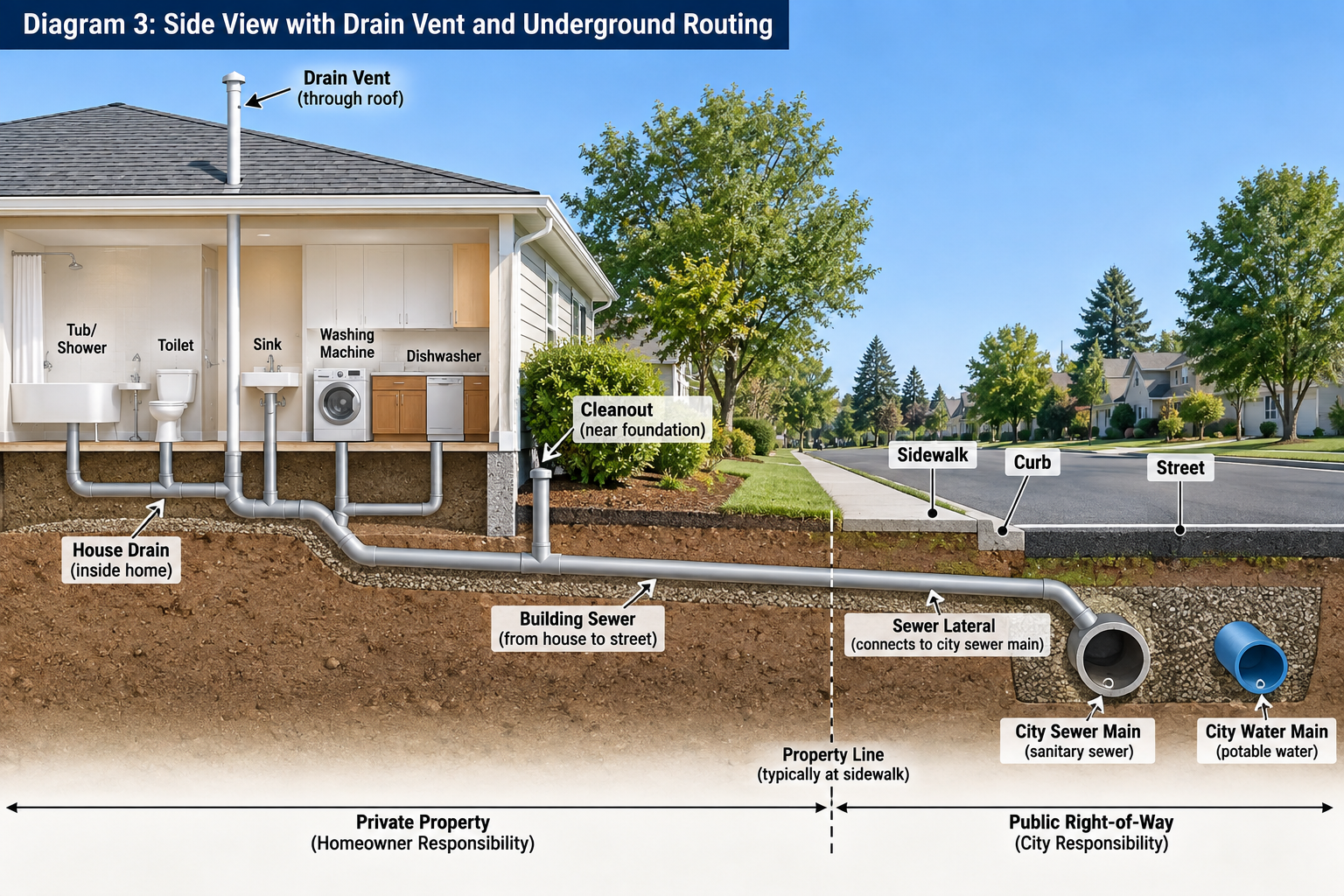
Side view of a home illustrating the sewer line connections.
It can reveal:
• Cracked, broken, or separated pipe
• Tree roots growing into joints
• Bellies, which are sags where waste and water collect
• Crushed or collapsed sections
• Deteriorating clay, cast iron, or Orangeburg (tar paper) pipe
• Heavy buildup or blockages
Is it part of a home inspection?
Usually not. Industry standards treat the buried sewer line as outside the scope of a typical home inspection, so it's a separate service you have to request. Not every inspector offers it, which we'll cover in the next post.
What does it cost?
Most published 2026 guides put a sewer scope at roughly $125 to $500 when there's an accessible cleanout, and often $100 to $250 when it's added to a home inspection. That's a small line item compared to what it can uncover.
Who should consider one?
• Homes more than about 20 to 30 years old
• Properties with mature trees near the sewer line
• Homes with older clay, cast iron, or Orangeburg pipe
• Homes with slow drains, gurgling, odors, or unusually wet or green patches in the yard
• Any home without a record of a recent scope, especially when nobody can vouch for its history
• Anyone who may sell someday. Knowing early gives you choices, instead of a surprise in the middle of a sale
Quick facts
What it is
A camera inspection of the main sewer line from your house to the street or septic system
How long it takes
Usually under an hour
Typical cost
About $125 to $500, or $100 to $250 as an add-on to a home inspection
In a standard home inspection?
Usually not. It is a separate service you request
Ask for
The video and a written report
Next in this series
• Post 2: Who Can Scope Your Sewer Line, an Inspector or a Plumber?
• Post 3: The Sewer Scope Found a Problem. Costs and Your Options
If something turns up, we can help
Hopefully you'll never need to reline or replace a sewer line. For most homeowners, it's a once-in-a-lifetime event. For us, as agents, it isn't. We see situations like this and have experience helping people through them.
We work with contractors, suppliers, and vendors regularly. We can't recommend specific companies, but we can help you work out what kind of professional you need, what questions to ask, and how to compare bids, so you find the right fit for your situation.
Whether you're selling soon or someday, we're glad to be a resource.
Kelly Azzarello Real Estate | Compass
kelly@kellyazzarello.com | (425) 830-6457 | www.kellyazzarello.com
[YouTube placeholder: link to video]
Cost ranges are general estimates drawn from published 2026 cost guides and vary by property, region, and contractor. This post is general information, not legal advice.