

Appraisal, Sale Price, CMA, Comps and Assessed Value: Which Number Is Which?
Five terms, five different numbers, and five different people behind them. Here is what each one means, who is responsible for it, and who pays.
The quick take
Five terms get mixed up constantly, and each one answers a different question. The sale price is what the buyer and seller agree on. An appraisal is a licensed appraiser’s opinion of value for the lender. A CMA is your agent’s opinion of what a home is likely to sell for. Comps are the recent sales those opinions are built from. The assessed value is the county’s number for property tax. They are often different numbers for the same house, and that is normal.
Why these get confused
All five are about “what a home is worth,” so people use them interchangeably. But they are made by different people, for different reasons, at different times. A buyer can hear all five in a single week: a CMA before making an offer, a sale price when the offer is accepted, an appraisal from the lender, the assessed value on the county tax notice, and comps in every conversation along the way.
The five terms side by side
| Term | Who creates it | Who pays | What it is used for |
|---|---|---|---|
| Sale price | Buyer and seller, through negotiation, with their agents | The buyer pays it to the seller at closing | The deal itself, and the basis for some closing costs and the excise tax |
| Appraisal | A licensed appraiser, working independently. The lender orders it | Usually the buyer, as part of the loan costs | Tells the lender how much the home supports as collateral |
| CMA (comparative market analysis) | A real estate agent or broker, for their client | Usually no charge as part of working with an agent | Pricing a listing, and deciding what to offer |
| Comps (comparable sales) | Pulled from MLS and public records by whoever needs them | Usually no charge | The evidence behind a CMA, an appraisal and often an assessment |
| Assessed value | The county assessor, on the county’s own schedule | No one pays for the value. The owner pays property tax based on it | Calculating the property tax bill |
Sale price
The sale price is the one number that is actually a decision. It is whatever the buyer and seller agree to in the purchase contract. It can be above or below the list price, the CMA, the appraisal and the assessed value. Nobody tells the parties what it must be, and no one can set it for them. Your agent advises, but the buyer and seller make the call. Because it is a negotiated price, it is also the number that becomes recorded history for the home and the next set of comps.
The sale price also drives money. It sets some of the closing costs, and it is the basis for the Washington real estate excise tax, which the seller pays at closing. A higher price means a higher excise tax bill. We cover how that works in our Closing terminology post.
Appraisal
An appraisal is a formal opinion of value written by a licensed appraiser, usually when a buyer is using a loan. The lender orders it, because the lender needs to know the home supports the loan amount if something goes wrong later. Appraisers are expected to work independently, and your agent, the seller and the buyer do not choose the number.
Who orders it: The lender. Buyers do not normally pick the appraiser.
Who pays: Usually the buyer, as part of the costs of getting the loan.
Who does it: A licensed appraiser. It is a formal report, and it relies on comps adjusted for differences in size, condition and features.
What you get: Under federal rules, the lender must give you a free copy of the appraisal promptly, and no later than three business days before closing. Ask for it and read it.
No loan, no appraisal: A buyer paying all cash is not required by a lender to get one, though some buyers order one anyway.
The appraisal is where the other numbers meet reality. If it comes in below the sale price, the buyer faces an appraisal gap. Read more in our post The Appraisal Gap: What Happens When the Home Appraises Low.
CMA (comparative market analysis)
A CMA is an agent’s opinion of what a home is likely to sell for, built from recent comps and the current competition. It is more informal than an appraisal. A good CMA looks at condition, updates, lot, view and timing, and often gives a range rather than a single number.
Who does it: A real estate agent or broker, usually for a seller who is pricing a listing or a buyer who is deciding what to offer.
Who pays: Usually no one. Agents typically prepare it as part of working with you. Ask if you are unsure.
What it is not: An appraisal. A lender does not use it in place of one, and it is an opinion, not a guarantee.
Comps (comparable sales)
Comps are recent sales of homes similar to yours in size, age, condition and location. They are the raw material. Agents use them to build a CMA, appraisers use them to support an appraisal, and owners use them to challenge an assessed value. Because someone has to decide which sales are truly similar, two people can look at the same neighborhood and choose different comps. That is one reason their numbers can differ.
No single person is responsible for comps. Whoever is making the opinion chooses them, and a good professional can explain why those sales were picked and what was adjusted.
Assessed value
The assessed value is the county’s estimate of the property’s value, used to calculate property tax. In King County, the Assessor sets it each year and mails a value notice. Each property’s share of the property tax bill is based on its assessed value. It is not an opinion of what the home would sell for today, and it does not decide the sale price or the appraisal.
Who does it: The county assessor, not your agent, lender or an appraiser you hire.
Who pays: No one pays for the value. The owner pays property tax, which is calculated from it.
If you disagree: You can appeal to the King County Board of Equalization. The petition is due by the later of July 1 of the assessment year or 60 days from the mailing date on your value notice. Check your notice for the exact date, because it is strictly enforced.
One house, five numbers
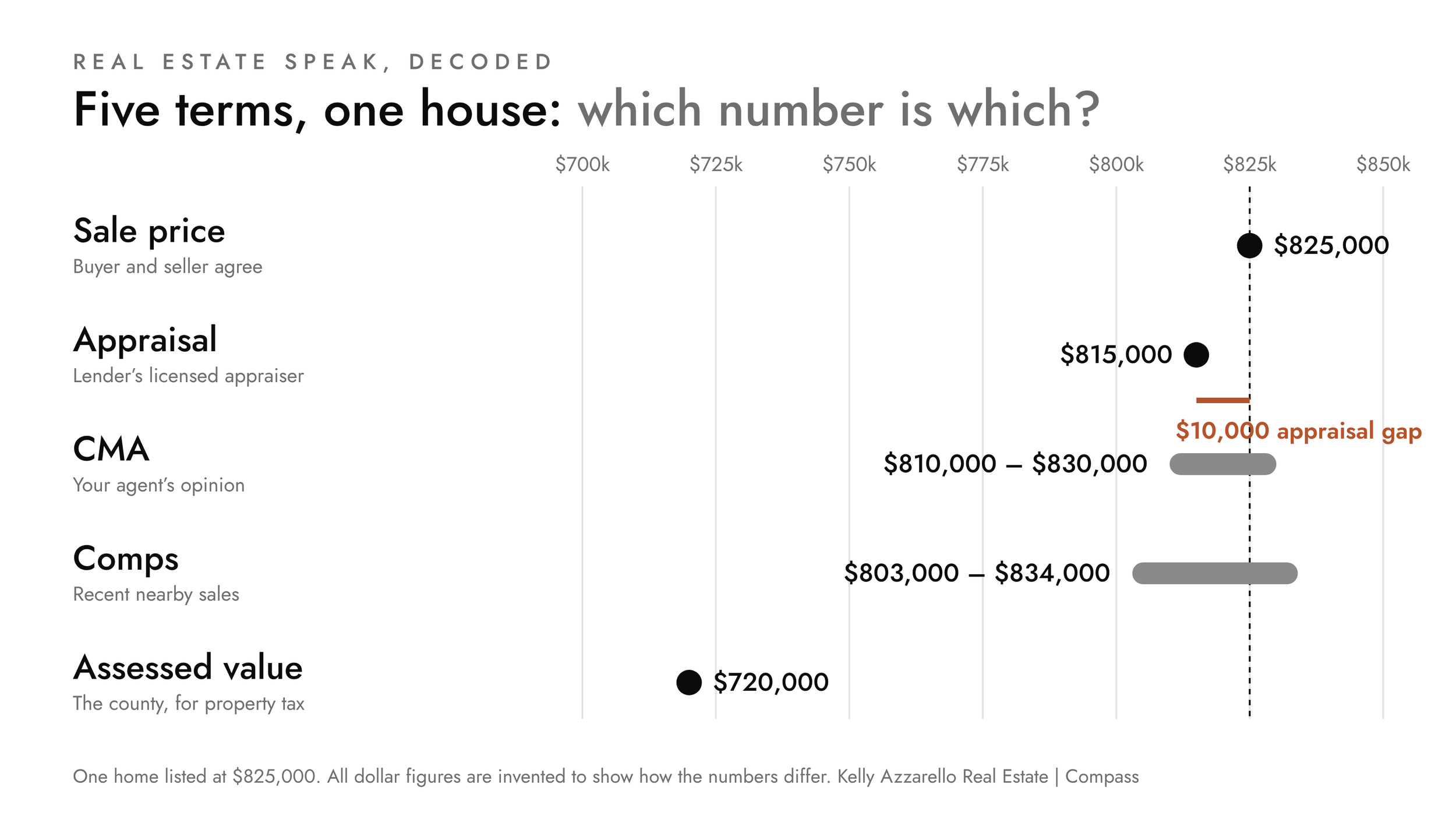
Take a home that is listed for $825,000. Here is how all five might look. These numbers are invented to show how they differ.
- The county assessed value on the tax notice is $720,000.
- The listing agent’s CMA suggests a range of $810,000 to $830,000, based on comps from the last few months.
- Those comps are four recent nearby sales between $803,000 and $834,000.
- The buyer and seller agree on a sale price of $825,000.
- The lender’s appraisal comes in at $815,000, using its own comps.
Nothing is wrong here. Each number answers a different question. The $10,000 difference between the sale price and the appraisal is an appraisal gap, and that is the one that affects the deal, because the lender will lend based on the lower figure.
Who is responsible for what
| Question | Answer |
|---|---|
| Who decides the sale price? | The buyer and the seller, together |
| Who decides the appraised value? | The appraiser, independently. The lender orders it |
| Who prepares the CMA? | The agent or broker, for their client |
| Who chooses the comps? | Whoever is making the opinion: the agent, the appraiser or the owner |
| Who sets the assessed value? | The county assessor |
| Who pays for the appraisal? | Usually the buyer, as part of the loan costs |
| Who pays for the CMA? | Usually no one, as part of working with an agent |
| Who pays property tax based on the assessed value? | The owner |
| Who pays excise tax based on the sale price? | The seller, at closing |
From our experience
We have seen owners surprised that their county tax value was well below what their home sold for, and buyers surprised that an appraisal came in under their agreed price. In both cases the numbers were doing their jobs. They just had different jobs.
What this means if you are buying
- Use the CMA and the comps to decide what to offer. Do not use the assessed value as a guide to the price.
- Expect the lender to order an appraisal, and plan for what you would do if it comes in below the sale price.
- Ask for your free copy of the appraisal and read it.
- Remember that the assessed value is not the same as what your property tax will be, and that it can change after you buy.
What this means if you are selling
- Ask your agent for a CMA with the comps behind it, so you can see why a price makes sense.
- Do not price your home from the assessed value. It serves a different purpose.
- Be ready for the appraisal. If it lands below your sale price, the buyer may ask to renegotiate or bring more cash.
- Remember that your sale price sets your excise tax, so ask your agent for an estimate of what you will net.
- Keep records of updates and improvements. They help an agent and an appraiser see what makes your home different from the comps.
Questions to ask your agent
- Which comps did you choose, and why those?
- How is your CMA different from what an appraiser will do?
- How likely is it that this home appraises at the sale price?
- What is the assessed value, and does it matter for this decision?
Want the full list of terms?
See our plain-English glossary of real estate terms: www.kellyazzarello.com/jargon
Questions? We are glad to help.
If any of this raises a question about your own situation, reach out. If you need an answer faster, call and we will talk it through.
Kelly Azzarello Real Estate | Compass
Email: kelly@kellyazzarello.com
Phone: (425) 830-6457
Web: www.kellyazzarello.com
Sources and credits
We looked to NWMLS first and then Compass. Neither publishes a plain-language comparison of these terms, so the points above draw on the sources below, in our own words. All dollar figures are invented examples. General information only, not legal or financial advice. Confirm current details with your agent, lender or the county, since rules change.
- Northwest Multiple Listing Service (NWMLS)
- Freedom Mortgage, Comparative Market Analysis
- Consumer Financial Protection Bureau, Delivery of appraisals under the ECOA Valuations Rule
- King County Board of Equalization, Appeal Property Tax
- Manaky, Property Tax Appeals in King County
- Washington Department of Revenue, Real Estate Excise Tax
Should I Get a Pre-Listing Inspection Before I Sell?
A pre-listing inspection gives you the same kind of report a buyer's inspector would write, before a buyer is waiting for your answer. Pros, cons and when it is worth it.What a pre-listing inspection is
A pre-listing inspection is a home inspection you order before you list the home. It gives you the same kind of report a buyer's inspector would write, before a buyer is waiting for your answer.
Our default is to have homes pre-inspected before they are put on the market. The thinking is simple: knowing is better than being surprised by bad news. We have discovered many issues thanks to pre-inspections that would otherwise have surfaced during the buyer's inspection period, potentially losing the sale and having to put the home back on the market.
Addressing what you find can be done in three ways:
· Fix it before the buyer asks. Pay for the repair before or during listing.
· Offer money back at closing. Instead of repairing it, you give the buyer a credit and they arrange the fix themselves. Lender limits on credits vary by loan type, so check with your agent first.
· Lower the price. If the roof is near the end of its usable life, you price the home below what it would be with a new roof. The buyer sees the issue already reflected in the price.
If you don't have a seller pre-inspection, consider keeping some funds in reserve in case the buyer's inspection finds something. The same three options apply, but you will be working through them during the buyer's inspection period instead of on your own schedule.
Pros and cons
| Pros | Cons |
|---|---|
| You find problems first, with time to get quotes and choose a contractor. | It costs money up front, and you pay whether or not you sell. |
| You avoid rushed repairs and "emergency" pricing after a buyer's inspection. | What you learn becomes something you know. If it is a material issue, it may need to be disclosed on the seller disclosure statement (Form 17). |
| It helps you complete the disclosure statement accurately. | Buyers may still do their own inspection, so it does not replace theirs. |
| You can price the home with the real condition in mind. | Findings can lead to repair costs you hoped to avoid. |
| A clean report can build buyer confidence and reduce surprises. | A report can age. If conditions change, it may need an update. |
| It can make negotiation smoother, because both sides see the same facts. | Some buyers may ask for more because they see the list. |
When it is most worth doing
· Older homes, or homes with deferred maintenance.
· Crawl spaces or attics that no one has checked in years (see The Number One Thing We Recommend Before You List: Inspect the Crawlspace).
· Estate and parent-sale situations, where the seller does not know the home's history (see [LINK to Topic 17: What Do I Have to Disclose When I Sell My Home, and What If the Home Is in an Estate?] and [LINK to Topic 19: Selling a Parent's Home After a Move for Aging Issues]).
· Homes with known or suspected moisture, pest, sewer or roof concerns.
· Sellers who need to move quickly and cannot afford a sale that falls through due to inspection issues.
Think about specialty inspections
A general inspector may recommend more specific inspections, such as a sewer scope, a pest inspection, a chimney inspection or a crawl space review. These answer one specific type of issue, and often require a special license or experience.
How to use the report
1. Read it with your agent. Sort items into safety, major condition and minor.
2. Find and correct causes first. Fix the leak before replacing the stained drywall.
3. Decide what to fix, what to disclose and what to price in. Get written estimates for items you will not fix before listing. Form 17 must be completed by the seller, not the agent.
4. Keep receipts and warranties for any work done, and be ready to share them.
5. Decide whether to share the report. Ask your agent how this works, and how it affects your disclosures.
What not to do
· Do not order an inspection and then ignore what it finds.
· Do not hide a known problem. Disclose material issues that are current, or that were recent and corrected, where Form 17 asks. Insurance claims, such as fire, water damage or an accident that damaged the home, are common examples, but not the only ones.
· Do not hire a friend (or contractor) as the inspector. Use a qualified, licensed inspector.
· Do not use a report that is old or no longer matches the home. Treat it as out of date when anything significant has changed since it was written (a leak, storm damage, a repair or remodel, a long vacancy) or when enough time has passed that a buyer could reasonably question it.
From Our Own Experience
An estate listing we had did not have a seller pre-inspection. It was an older home, but "everything worked" and the estate representative felt it was not necessary to pre-inspect, to list it "as is", and to price it accordingly.
The buyer's offer was accepted with an inspection contingency, which included a sewer scope. Unfortunately the sewer scope found that the sewer main had collapsed in two places. The house was unsellable without these being corrected, and that took time, inspections, planning, and money. While the fix would have been the same, and might have cost slightly less if found in a pre-inspection, it would have been far less stressful. The home would probably still have gone on the market at the planned time.
There is no blanket solution or direction here. It is far more important to understand the potential impacts than it is to always do (or not do) something like a pre-inspection. The sellers need to be comfortable with their choices, as well as understand that the buyers may identify not having a pre-inspection as a risk and will offer and negotiate accordingly.
Thinking about selling in the Seattle Area?
Kelly Azzarello Real Estate | Compass
kelly@kellyazzarello.com | (425) 830-6457
Instagram: instagram.com/kellyazzarello
YouTube: youtube.com/kellyazzarellorealestate
Disclaimer
This post is general information about real estate topics. It is not legal, tax or financial advice, and it does not replace a professional inspection. Rules and practices differ by situation and change over time. Check current requirements and talk with a licensed professional, such as an inspector, contractor, attorney or CPA, about your own property.

What Do I Have to Disclose When I Sell My Home, and What If the Home Is in an Estate?
Selling a home in the Seattle area means completing a Seller Disclosure Statement. Here is what it covers, what counts as "known," and how an estate sale can be different.
Part 1: Selling your own home
The Seller Disclosure Statement (NWMLS Form 17)
In Washington, a seller of improved residential property usually gives the buyer a Seller Disclosure Statement. It asks about the home's title, water, sewer and septic, structure, systems and fixtures, environmental matters, the homeowners association and other topics.
Timing. Unless you and the buyer agree otherwise, the statement is due within five business days after mutual acceptance.
The buyer's right to rescind. The buyer has three business days after receiving the statement to rescind, in a separately signed written statement, unless you both agree otherwise in writing.
What you must answer. Answer every question. The seller must complete Form 17, not the agent. Once it is done, your agent uploads it with the other forms, and it is available to buyers' agents and their clients. Write "NA" where a question clearly does not apply, and explain every "yes" answer on an attached sheet. The statement is signed and dated.
It is based on what you know. The disclosure reflects your actual knowledge when you complete it. It is not a warranty, and it is not part of the contract.
What counts as "known"
Form 17 asks about material issues that are current, and about those that were recent and have since been corrected. Examples include leaks, past water in the crawl space, pest damage, a failed inspection item, unpermitted work and insurance claims, such as fire, water damage or an accident that damaged the home. These are examples, not a complete list. Where the form asks, answer for what you know, whether or not you fixed it. Receipts, reports and warranties show buyers what was done and when.
Other disclosures to ask about
Lead-based paint for homes built before 1978. Federal rules require sellers of most pre-1978 housing to disclose known lead-based paint and lead-based paint hazards, give the buyer any available records and reports, provide the EPA pamphlet "Protect Your Family From Lead in Your Home," and include a lead warning statement in the contract. The buyer must also be allowed a 10-day period to inspect for lead, which the buyer can waive or change in writing. Sellers are not required to test.
HOA or condominium documents and fees, if the home is in an association. Form 17 asks about the association, its dues and any pending special assessments. When a condominium is sold, the buyer also receives a resale certificate from the association (RCW 64.34.425 for older condominiums, RCW 64.90.640 for communities under the newer common interest ownership act), and the buyer has a short window to cancel after receiving it. Order it early, because the association can take time.
Changes before closing. If you learn something that makes an earlier answer inaccurate, tell your agent right away. Washington law (RCW 64.06.040) requires the seller to amend the statement and deliver it to the buyer if the seller learns of new information, or an adverse change occurs, that makes an earlier answer inaccurate. No amendment is needed if the seller fixes the problem so the answer is accurate again at least three business days before closing. Otherwise the buyer can accept the amendment or rescind within three business days. The seller's duty ends at closing.
Family burial ground question (new January 1, 2027). A new Washington law adds a question to Form 17 asking whether the property includes a family burial ground, mausoleum or columbarium. Many homes that are listed now, or being prepared to list, may still be on the market or go under contract after January 1, 2027, so sellers should plan for this question and ask their agent which version of the form applies.
What not to do
Do not leave questions blank or answer "no" when you are unsure. Say what you know, or say you do not know.
Do not cover or paint over a problem and then say nothing about it.
Do not rely on "as is" language to avoid disclosing what you know. Ask your attorney how it applies to you.
Do not guess. If you are not sure, a pre-listing inspection can give you facts to work from.
Part 2: Selling a home in an estate
When the owner has died, the person selling is usually a personal representative (executor) or a trustee. That person often has never lived in the home and may not know its history.
Who signs matters. The person with legal authority signs, and some estates require notices or court steps before a sale. Talk with the estate attorney first.
Disclosure may be different. Washington's disclosure law (RCW 64.06.010) exempts a transfer made by the personal representative of a decedent's estate. A trustee of a living trust or a guardian is not named in that list, so ask your attorney whether Form 17 is required, and how to complete it if it is. Do not assume the answer.
Even if a form is not required, buyers will still ask. If you know about problems, say so. A pre-listing inspection (see Topic 22 [link]) gives an estate seller facts to share instead of guesses.
Share what you know, and say what you do not know. Family members who lived in or maintained the home may know its history. Ask them, and keep notes and records.
Contents and condition. See our post on preparing an estate home for sale (Topic 26 [link]).
From Our Own Experience
It is important to understand disclosure when you are selling a home. The law is very specific and you could open yourself up to legal action if you do not disclose required information correctly and completely.
While we can help you through the forms, we are not allowed to fill them out for you, and if you have questions we suggest you contact your attorney to clarify.
It is important to understand disclosure when you are selling a home. The law is very specific and you could open yourself up to legal action if you do not disclose required information correctly and completely.
While we can help you through the forms, we are not allowed to fill them out for you, and if you have questions we suggest you contact your attorney to clarify.
Thinking about selling in The Seattle Area?
Kelly Azzarello Real Estate | Compass
kelly@kellyazzarello.com | (425) 830-6457
Instagram: instagram.com/kellyazzarello
YouTube: youtube.com/kellyazzarellorealestate
Sources
Washington Legislature, RCW 64.06 (seller disclosure statements), including 64.06.010 (exempt transfers), 64.06.020 (Form 17 content) and 64.06.040 (amending the statement): app.leg.wa.gov/RCW/default.aspx?cite=64.06
Northwest Multiple Listing Service (NWMLS), Form 17, Seller Disclosure Statement, Improved Property (NWMLS forms library, members only): nwmls.com
U.S. Department of Housing and Urban Development, The Lead Disclosure Rule: hud.gov/program_offices/healthy_homes/enforcement/disclosure
EPA and HUD, Requirements for Disclosure of Known Lead-Based Paint and/or Lead-Based Paint Hazards in Housing, 40 CFR Part 745 (Federal Register, March 6, 1996): govinfo.gov/content/pkg/FR-1996-03-06/html/96-5243.htm
Washington Legislature, RCW 64.90.640 (resale certificate) and RCW 64.34.425 (condominium resale certificate): app.leg.wa.gov/RCW
Disclaimer
This post is general information about real estate topics. It is not legal, tax or financial advice, and it does not replace a professional inspection. Rules and practices differ by situation and change over time. Check current requirements and talk with a licensed professional, such as an inspector, contractor, attorney or CPA, about your own property.
Legal: Disclosure duties depend on your facts, the type of sale and who is selling. This is not legal advice. Please discuss your situation with your own attorney before you list.

Who Can I Call to Find Out What to Do (and Not Do) Before Selling?
Before you spend money on a sale, start with an agent walk-through. Here is who else can help, what each one does, and what we can and cannot do.
Start with an agent walk-through
Before you spend money, ask an agent to walk through the home with you. An agent sees the home the way buyers will, knows what is likely to come up in an inspection, and can help you decide what to fix, what to leave and in what order.
For more on understanding maintenance or issues before listing, see [LINK to Topic 22: Should I Get a Pre-Listing Inspection?].
For more on which improvements are worth making, see [LINK to Topic 05: What Improvements Should I Make Before Selling?].
At the walk-through, we provide you with:
1. A comparative market analysis at the time of the walk through
2. Ideas for using your home, furnishings and resources to improve the sale
3. Rough cost estimates, plus a list of vendors you can contact to refine them
4. A timeline for getting to market
5. Guidance on what to disclose on the Form 17 seller disclosure, whether or not an issue is repaired
Who else can help, and with what
In Washington, a real estate broker cannot refer or recommend a specific vendor with the expectation that you must use that vendor. You always choose, not us. What we can do is give you a list of possibilities to consider and help you compare them, based on our experiences. Bring this up when we meet.
A home inspector. A pre-listing inspection finds problems before a buyer's inspector does. See our post on whether to get one. [LINK to Topic 22]
Specialty inspectors. A sewer scope, a pest inspection, a chimney inspection or a crawl space review each answer a specific question.
Licensed contractors and tradespeople. They give estimates and do the repairs. Check licenses and registration through the Washington Department of Labor and Industries (lni.wa.gov).
A stager or photographer. They help with the presentation of your home, and are critical as they provide seasoned opinions on how the home will look online AND in person.
A CPA or tax professional. Ask about taxes on the sale, records of improvements, and anything unusual about your situation.
An attorney. For estates, trusts, divorces, title questions or anything legally complicated.
Your mortgage lender. To get a payoff figure, and to plan financing for your next home.
Your HOA or property manager. For HOA documents, rules and fees, if they apply.
Your insurance agent. Especially if the home will be vacant while it is listed.
What we can and cannot do
As agents we work with contractors, suppliers and vendors regularly, and we have helped clients through large repairs. We can help you compare bids and ask the right questions, but who you hire is always your decision.
What not to do
Do not start large projects before getting advice. Some updates cost more than they return.
Do not rely on friends and relatives who are used to the home. They stop seeing problems too.
Do not hire the first contractor available without checking license and insurance.
From Our Own Experience
A big part of what we do is help sellers understand and prepare before they list. Here are some examples, with details changed to protect privacy:
- The Retirees Who Plan Ahead: A couple bought their retirement home last year and plan to sell their current home in our area next spring. We met with them, identified what should stay with the house when they list, asked them to collect information on their updates and upgrades, and began confirming that the title is clear so the home is ready to sell.
- The Estate: When a client's mother passed away, the client asked us to help list the property as an estate sale. The family wanted time to sort through the house and get it ready. Although the house was sold "as is," we still wanted to present a property with charm and value. We helped them identify painters, stagers, cleaners, and other trades to prepare the property and get it on the market. It sold within a week of listing.
- The Couple Heading Back Home: This couple's children are grown, and they have found a property in their native country. We have had ongoing discussions to help identify and prepare for listing their property early in the coming year. This work included assessing what maintenance items to invest in, what to do to improve curb appeal, how to "thin out" their current furnishings to make the home more appealing, and a short consulting meeting with our stager to plan.
Thinking about selling in the Seattle Area?
Kelly Azzarello Real Estate | Compass
kelly@kellyazzarello.com | (425) 830-6457
Instagram: instagram.com/kellyazzarello
YouTube: youtube.com/kellyazzarellorealestate
Disclaimer
This post is general information about real estate topics. It is not legal, tax or financial advice, and it does not replace a professional inspection. Rules and practices differ by situation and change over time. Check current requirements and talk with a licensed professional, such as an inspector, contractor, attorney or CPA, about your own property.

“As-Is”: What It Does and Does Not Mean
As-is" does not mean "no inspection" and it does not mean "no negotiating." Here is what the phrase really means in Washington.
The quick take
As-is generally means the seller does not plan to make repairs or give credits. It does not stop you from inspecting the home, and it does not erase the seller’s disclosure duties. It does mean you take the home in its current condition.
What "as-is" usually means
When a listing says "as-is," the seller is telling you they do not plan to make repairs or give credits for the condition of the home. You are buying it the way it stands today, and any work that comes up after that is yours to handle.
What it does not mean
• It does not mean you cannot inspect. You can still hire an inspector, and we generally recommend it.
• It does not necessarily mean you cannot negotiate. A seller may still agree to a price change after you learn what is wrong, especially if the home would otherwise go back on the market.
• It does not automatically cancel the seller’s legal duties. In Washington, most residential sellers must provide a Seller Disclosure Statement, known as Form 17.
The seller disclosure still matters
Form 17 asks the seller to answer questions about the property, such as roof, plumbing, and known defects. Some sellers are exempt, such as estate sales, bank-owned properties, trustees, and some new construction. Exempt sellers may still provide a disclosure voluntarily. When a disclosure is required and the buyer receives it, the buyer generally has three business days to rescind the agreement. Details depend on the contract, so review the timing with your agent.
Keep in mind that Form 17 only covers what the seller knows. It does not replace an inspection.
Washington is a "buyer beware" state
Buyers of resale homes generally do not get a warranty from the seller, and it can be hard to hold a seller responsible for a defect unless they misrepresented it. That is why inspection matters, and why waiving an inspection can leave you with limited recourse if something turns up later.
From our experience
We have seen as-is homes that were true opportunities, and others where the inspection found problems that changed the buyer’s plan. Buyers who budgeted for surprises, and who knew their walk-away number before they wrote an offer, were the most comfortable either way.
If you are buying an as-is home
• Inspect the home, and consider specialists such as a sewer scope or a roof or foundation expert if the inspector suggests it.
• Read the seller disclosure carefully, if there is one, and note the three-day window.
• Set aside a repair budget before you offer, and decide what you will do if the number is higher than expected.
• Ask us about the home’s history and about nearby sales.
If you are selling as-is
Selling as-is can simplify things when you do not want to manage repairs, and it can attract buyers who are comfortable with projects. It works best when the price reflects the condition. A pre-listing inspection can help you set expectations, and your agent can walk you through your disclosure duties.
Want the full list of terms?
See our plain-English glossary of real estate terms: www.kellyazzarello.com/jargon
Questions? We are glad to help.
If any of this raises a question about your own situation, reach out. If you need an answer faster, call and we will talk it through.
Sources and credits
We looked to NWMLS first and then Compass. Neither publishes a plain-language definition of this term, so the points above draw on the sources below, in our own words. General information only, not legal or financial advice. Confirm current details with your agent or lender, since forms and rules change.
Madrona Group, What Is Form 17 in Washington

The Appraisal Gap: What Happens When the Home Appraises Low
You agreed to a price, but the appraisal came in lower. Here is what that gap means, how the math works, and what your options are.
The quick take
An appraisal gap is the difference between the price you agreed to pay and a lower appraised value. The lender bases your loan on the appraisal, so you generally need to cover the difference, renegotiate, or walk away, depending on your contract.
What an appraisal gap is
When you buy with a loan, the lender orders an appraisal. A licensed appraiser estimates what the home is worth. The lender will only lend against the appraised value or the price, whichever is lower. If the appraisal comes in below the price you agreed to pay, the difference is the appraisal gap.
It is more common in competitive markets, in rising markets, with unusual homes, and where few similar homes have sold recently. Redfin reports that roughly 8% of appraisals come in below the contract price.
A simple example
This is a simplified example with round numbers. Your loan type and lender rules can change the math.
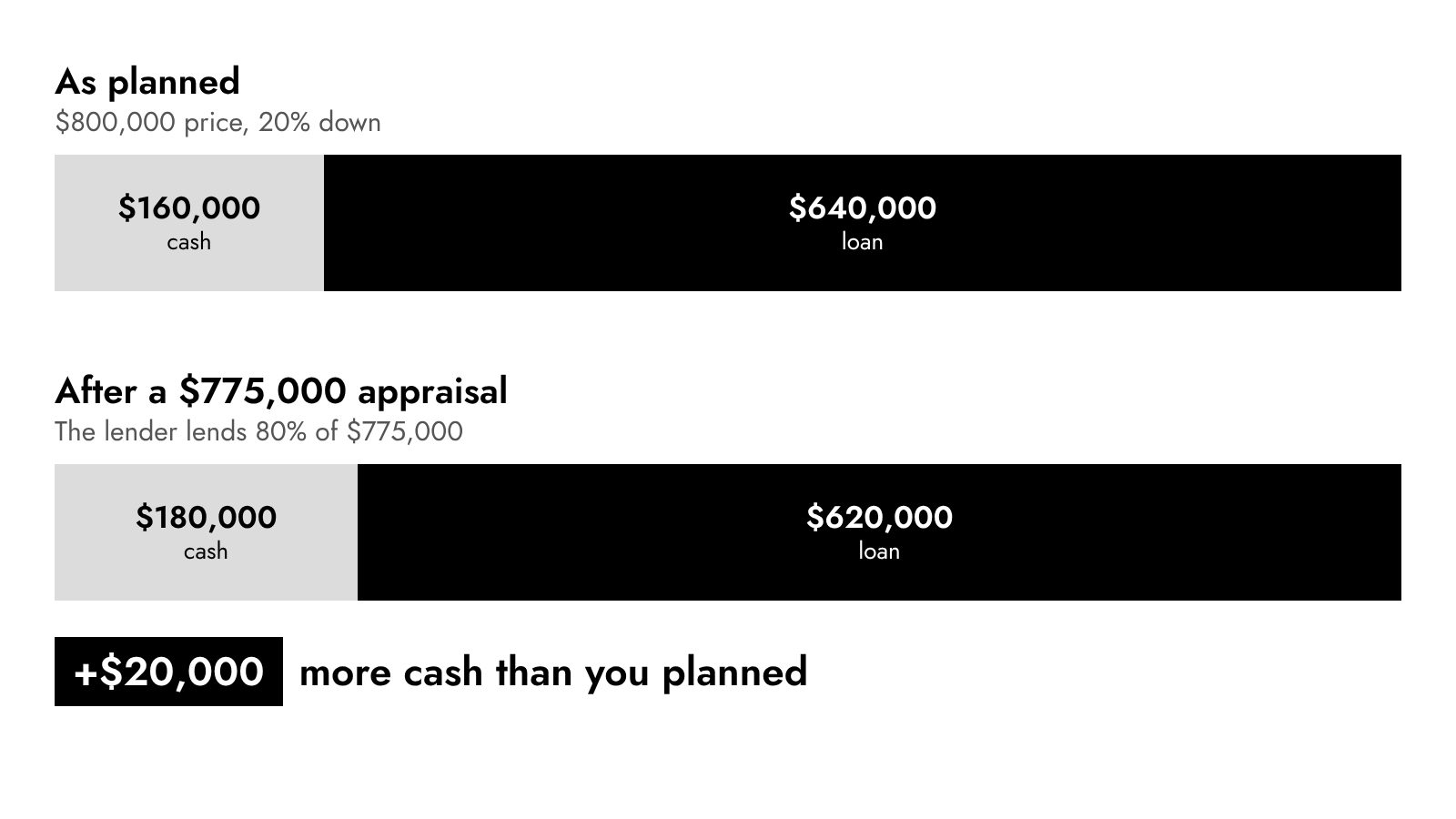
• You agree to buy a home for $800,000 and plan to put 20% down, which is $160,000, with a $640,000 loan.
• The home appraises at $775,000, which is $25,000 below the price.
• The lender will lend 80% of $775,000, or $620,000, instead of $640,000.
• To close at $800,000, you need $180,000 in cash instead of $160,000. That is $20,000 more than you planned.
Your options
Renegotiate: Ask the seller to lower the price to the appraised value, or to meet in the middle. Sellers sometimes agree, especially if the home would otherwise go back on the market.
Cover the gap: Pay the difference in cash from savings or other eligible funds. This keeps the deal alive, and it is a choice about how much you are willing to pay above appraised value.
Challenge the appraisal: Your lender may be able to request a reconsideration of value, if you have strong comparable sales or evidence of errors. There is no guarantee it will change.
Walk away: If your contract has an appraisal or financing contingency and you act on time, you may be able to cancel and recover your earnest money. Without that protection, you may risk the deposit.
Gap clauses in offers
In competitive situations, buyers sometimes include language promising to cover some or all of a low appraisal. It can make an offer more attractive, and it also means you take on the risk. If you consider it, decide the most you are comfortable paying and put that number in writing.
From our experience
We have seen buyers decide, in advance, that they would cover a specific amount over appraisal, and others decide they would not cover any. Both can be the right call. What matters is deciding before you are in the middle of a deal, with the clock ticking.
What this means if you are selling
A low appraisal can slow or break a sale. A well-supported price, with recent comparable sales that fit your home, makes a low appraisal less likely. Your agent can help you prepare, and can talk through what to do if the number comes in short.
Questions to ask your agent
• Does my offer have an appraisal or financing contingency, and when does it expire?
• How much cash could I bring if the appraisal comes in low?
• What comparable sales support this price?
Want the full list of terms?
See our plain-English glossary of real estate terms: www.kellyazzarello.com/jargon
Questions? We are glad to help.
If any of this raises a question about your own situation, reach out. If you need an answer faster, call and we will talk it through.
Kelly Azzarello Real Estate | Compass
Email: kelly@kellyazzarello.com
Phone: (425) 830-6457
Sources and credits
We looked to NWMLS first and then Compass. Neither publishes a plain-language definition of this term, so the points above draw on the sources below, in our own words. General information only, not legal or financial advice. Confirm current details with your agent or lender, since forms and rules change.
Redfin, What Is an Appraisal Gap?
Madrona Group, What Is a Financing Contingency in Washington

Earnest Money: Your Good-Faith Deposit, Explained
Earnest money is not an extra fee. It is a deposit toward your purchase, and it can be at risk if you miss a deadline. Here is how it works
The quick take
Earnest money is a good-faith deposit you make after the seller accepts your offer. It is credited toward your purchase at closing. You can lose it if you walk away for a reason the contract does not protect, so deadlines matter.
What earnest money is
Earnest money is a deposit that shows the seller you are serious. You give it after your offer is accepted, and if the sale closes, it is credited toward the money you owe at closing, usually your down payment and closing costs. It is not an extra fee. It is a part of your purchase money that moves in early.
How much is typical?
There is no legal minimum or maximum in Washington, so the amount is negotiated. The sources we looked at put typical deposits in a range from about 1% to 5% of the purchase price, and in competitive situations a larger deposit can make an offer look stronger. On an $800,000 home, 1% to 5% would be $8,000 to $40,000. Your agent can help you pick an amount that fits your situation.
| Home price | 1% | 2% | 3% | 5% |
|---|---|---|---|---|
| $500,000 | $5,000 | $10,000 | $15,000 | $25,000 |
| $800,000 | $8,000 | $16,000 | $24,000 | $40,000 |
| $1,000,000 | $10,000 | $20,000 | $30,000 | $50,000 |
Examples only. In Washington the amount is negotiated, with no legal minimum or maximum. Your agent can help you choose a number that fits your situation.
When is it due, and who holds it?
The timing is spelled out in your purchase and sale agreement, and it is usually within a couple of days after both sides have signed. Missing that deadline can put you in default, so plan ahead and know how you will pay.
You do not hand the money to the seller. A neutral party holds it, typically the escrow company, or in some cases the buyer’s brokerage in a trust account. Escrow generally cannot release the funds to either side without both parties’ written agreement or a court order.
When you get it back, and when you can lose it
Usually refundable: If you cancel under a contingency in your contract, such as inspection or financing, and you give notice on time and in the right form, your deposit is generally returned.
At risk: If you walk away for a reason the contract does not cover, if you miss a contingency deadline, or if you waived a protection to make your offer more competitive.
The standard Washington purchase and sale form also asks the parties to choose how a buyer default is handled. One option limits the seller’s remedy to keeping the deposit. The other lets the seller pursue additional remedies. Which one is checked in your contract matters, so read that section with your agent.
From our experience
We have seen disputes over a deposit that came down to a missed deadline or a notice that was not delivered correctly. The safest habit is to put every contingency date on a calendar the day your offer is accepted, and to deliver notices exactly as the contract says.
Tips for buyers
• Know the deadline and have the funds ready before you write the offer.
• Put every contingency deadline on your calendar on day one.
• Waiving protections to win an offer also puts your deposit at risk. Talk it through first.
• If there is a disagreement, do not assume you can simply ask for the money back. Both sides usually need to sign off, so get advice early.
This post is general information, not legal advice. For a specific default or dispute, a Washington real estate attorney is the right call.
Want the full list of terms?
See our plain-English glossary of real estate terms: www.kellyazzarello.com/jargon
Questions? We are glad to help.
If any of this raises a question about your own situation, reach out. If you need an answer faster, call and we will talk it through.
Kelly Azzarello Real Estate | Compass
Email: kelly@kellyazzarello.com
Phone: (425) 830-6457
Sources and credits
We looked to NWMLS first and then Compass. Neither publishes a plain-language definition of this term, so the points above draw on the sources below, in our own words. General information only, not legal or financial advice. Confirm current details with your agent or lender, since forms and rules change.

Contingent vs. Pending
You found a home you love and the status says contingent or pending. Is it gone? Here is what the labels mean and what you can still do.
The quick take
Contingent means the seller accepted an offer, but a condition is still open. Pending means the conditions are mostly cleared and the sale is heading to closing. Neither means the door is shut, and the exact label matters more than the word on a portal.
Why this is so confusing
If you have browsed homes on a national website, you have probably seen "contingent" and "pending" used as if they mean the same thing. They do not, and the agent-side listing system shows even more detail than the public portals do. In our area, that system is the Northwest Multiple Listing Service (NWMLS).
NWMLS statuses are labels that agents use to describe where a listing stands. They do not tell you every term of the deal, and the portals that display them can show them differently or a little late. Your agent sees the official status, which is one reason to ask before you give up on a home.
What the labels generally mean
Active: The home is available for showings and offers.
Contingent: An offer has been accepted, but the deal still depends on something. In the NWMLS, this label is commonly described as meaning the buyer first needs to sell their own home. The property may stay on the market, and another buyer can sometimes step in.
Pending Inspection: The buyer is still in the inspection period. This is a stage where deals most often change, because inspection findings can lead to repairs, credits, or a buyer backing out.
Pending: The buyer and seller have a signed agreement and the main conditions have been cleared. The sale is moving toward closing, although it can still fall apart.
Pending Feasibility: Similar to Pending Inspection, but used mostly for land or properties that need studies before anything can be built.
Back on market: A prior sale did not close and the home is available again.
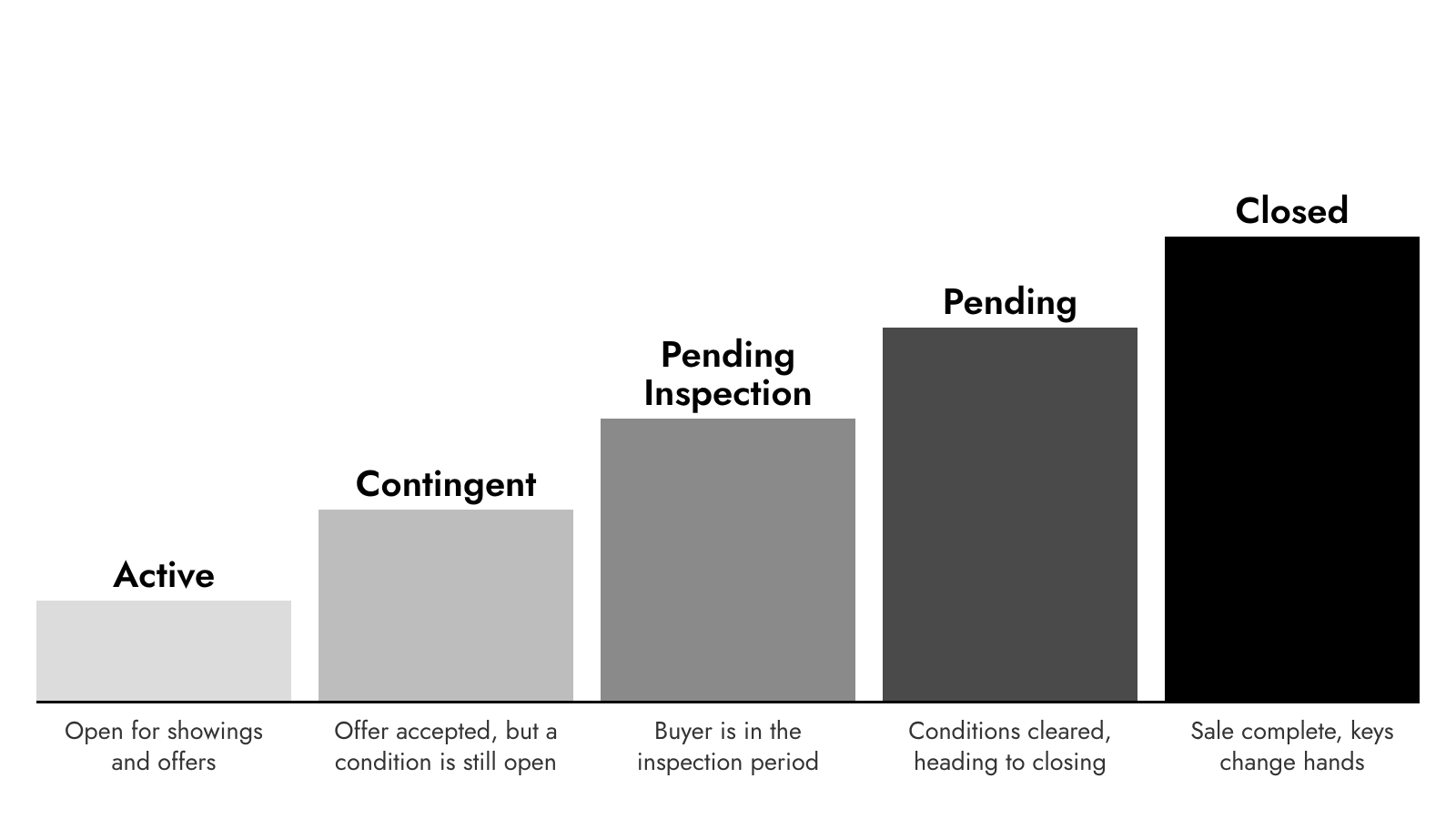
Graphic of the activity ladder. Note that not all steps are included in all transactions.
Because definitions vary a bit from one source to the next, treat this list as a guide and confirm the exact status and terms with your agent.
Can you still make an offer?
Sometimes, yes. Here are the three most common ways:
• A back-up offer. Some sellers will accept offers behind the first buyer. If the first deal fails, the back-up moves up.
• A bump clause. If the first buyer’s offer depends on selling their own home, the seller may keep marketing and give that buyer a deadline to remove the condition or step aside when a better offer arrives.
• Waiting. Deals do fall through, and a home that went contingent or pending can return to active within days.
From our experience
We have watched homes go to pending inspection on a Friday and back to active the following week after the buyer and seller could not agree on repairs. Buyers who stayed in touch with their agent, and who were ready with a pre-approval, were able to move quickly.
What this means if you are buying
• Do not write off a home because of its status. Ask your agent what the status really means for that listing.
• If you want to be in line, ask whether the seller is taking back-up offers and what that would look like.
• Keep your financing pre-approved and current. If a home reopens, you want to be able to move the same day.
What this means if you are selling
Your listing status is part of your marketing. A "pending" label tells other buyers to look elsewhere, while "contingent" can leave the door open to back-up interest. Talk with your agent about which choice fits your goals, and make sure the status is updated promptly when anything changes.
Questions to ask your agent
• What exactly does this status mean on this listing?
• Is the seller accepting back-up offers?
• What condition is still open, and when does it have to be cleared?
• Has this home been on and off the market before?
Want the full list of terms?
See our plain-English glossary of real estate terms: www.kellyazzarello.com/jargon
Questions? We are glad to help.
If any of this raises a question about your own situation, reach out. If you need an answer faster, call and we will talk it through.
Kelly Azzarello Real Estate | Compass
Email: kelly@kellyazzarello.com
Phone: (425) 830-6457
Sources and credits
We looked to NWMLS first and then Compass. Neither publishes a plain-language definition of this term, so the points above draw on the sources below, in our own words. General information only, not legal or financial advice. Confirm current details with your agent or lender, since forms and rules change.
Northwest Multiple Listing Service (NWMLS)
Findwell, Understanding Pending Status for Homes Listed in the Northwest MLS

Real Estate Speak, Decoded: Start Here
New to real estate language? Start here. Kelly Azzarello Real Estate explains the terms, the process and the risks in plain English.
Unless you’re part of the real estate industry, or your family is, chances are there is a lot of terminology that is not familiar.
A big part of the value we provide our clients is explaining the words, the process, and the risks and rewards available in the real estate arena.
This series will walk you through not only the terms, but some stories behind what we’ve learned from our experiences in the business.
If you have any questions or suggestions, let us know and we’ll figure it out.
But if you need an answer faster, reach out and we’ll have a conversation about it.

What’s Next? #2: Should You Stay or Should You Go? Finding the Right Fit
Staying or Moving | Kelly Azzarello Real Estate
One of the most common questions we hear from homeowners isn't when should we move.
It's something simpler — and often harder.
Should we stay? Or should we move at all?
For many people, that question lingers quietly in the background for years. Not because anything is wrong, but because life keeps changing. And this conversation isn't about pushing toward a move — it's about making sure your home still supports the life you want to live.
There Is No Universal Right Answer
What works perfectly for one person might feel completely wrong for someone else.
Some people stay in the same home for decades and never look back. Others reach a point where the home that once felt perfect begins to feel like more than they want to manage. The goal isn't to choose what sounds good on paper — it's to understand what actually fits your life today, and where it may be headed.
When Staying Makes Sense
For many homeowners, staying put truly is the right choice.
You may love your neighborhood. You may have strong community ties. Your home may still function well for how you live day to day. In those cases, planning might simply mean making small adjustments — improving comfort, safety, or accessibility — or just confirming that staying aligns with your long-term goals.
Planning doesn't always lead to moving. Sometimes it leads to confidence — confidence that you're exactly where you should be.
When Moving Enters the Conversation
For others, the question of moving begins to surface gradually.
Maybe the home feels larger than you need. Maybe maintenance takes more time and energy than it used to. Maybe daily routines involve stairs, layouts, or features that no longer feel as easy to navigate.
These thoughts don't mean you're behind. They don't mean change needs to happen now. They're simply signals worth paying attention to — because ignoring them often leads to rushed decisions later.
Planning Creates Options
When you explore staying versus moving early, you give yourself options.
You can look at different paths without committing to any of them. You can understand what a move could look like, what staying could require, and what trade-offs matter most to you.
Planning early keeps the decision flexible. It allows you to move forward calmly, instead of reacting when circumstances force the issue.
Reframing the Question
Let's look at this differently.
This isn't about choosing between right and wrong. It isn't about giving something up. It isn't about rushing into change.
It's about fit. Does your home fit your life today? Will it continue to fit in the years ahead? When you frame it this way, the decision becomes less emotional and more empowering.
Ready to Think It Through?
We've put together a simple planning guide designed to help you think through the staying vs. moving question — to organize what matters most to you and see your options more clearly, without pressure and without timelines.
You can access it at KellyAzzarello.com. And if you'd like to talk through your specific needs, questions, or goals, we're here to help.
📞 425.830.6457 | KellyAzzarello.com