
Because Gilman Village Turned Old Barns Into a Shopping District
Part of the Why Issaquah? series: Because Gilman Village Turned Old Barns Into a Shopping District
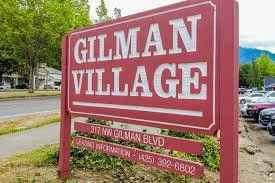
In 1972, Safeway announced plans to demolish three old buildings on Front Street to build a new grocery store. One of them held The Country Mouse, an arts-and-crafts shop run by Betty Konarski and Marilyn Gray. Konarski suggested an alternative to local developer Marvin Mohl: move the buildings rather than lose them. Mohl, who owned nearby land, did exactly that, relocating the structures onto seven wooded acres just east of downtown.
Today, that idea has grown into Gilman Village: more than 40 independent shops and restaurants tucked into a maze of boardwalks, pergolas, and century-old structures that feel nothing like a standard shopping center, because they aren't one. The Country Mouse itself closed in the late 1980s, but its role in saving the buildings is still the reason Gilman Village exists at all.
Two Downtowns, One Walkable City
Gilman Village sits alongside historic Olde Town Issaquah, the city's original downtown core along Front Street, where brewpubs, boutiques, and long-standing local restaurants line a genuinely walkable street grid. Between the two, Issaquah offers something a lot of Eastside cities are still trying to build from scratch: an authentic, pedestrian-scaled downtown with real history behind it, not a recently-built "lifestyle center" designed to look old.
For buyers who want newer, more conventional retail, Issaquah has that too. Issaquah Commons brings Trader Joe's, Target, and REI under one roof, and Grand Ridge Plaza up on the Highlands adds a movie theater and 50-plus businesses. But it's the older, quirkier core that tends to show up in a buyer's "why we picked Issaquah" story.
The Selling Point Buyers Don't Always Say Out Loud
Walkable, character-driven downtowns are in short supply on the Eastside, and buyers coming from cities, or from more spread-out, drive-everywhere suburbs, notice immediately when a place has one. Gilman Village and Olde Town give Issaquah a genuine sense of "there's somewhere to walk to," which matters just as much for weekday errands as it does for a Saturday afternoon.
For Buyers & Sellers
If a listing sits within an easy walk of Gilman Village or Front Street, that walkability is worth featuring prominently. It's one of the more differentiating features you can offer versus comparable homes in Sammamish or the Issaquah Highlands. Buyers relocating from walkable cities in particular respond to "stroll to dinner" language.
Want to see which streets put you within strolling distance of Gilman Village and downtown Issaquah? We know this stretch of town block by block. Reach out to Kelly Azzarello Real Estate and we'll show you around.

Because the Highlands Is Basically Its Own City
Part of the Why Issaquah? series: Because the Highlands Is Basically Its Own City
Why Issaquah? Because the Highlands Is Basically Its Own City
Climb out of the valley onto the Sammamish Plateau and something shifts.
The Issaquah Highlands doesn't feel like a neighborhood tacked onto an older city. It feels like a place that was planned from scratch, because it was.
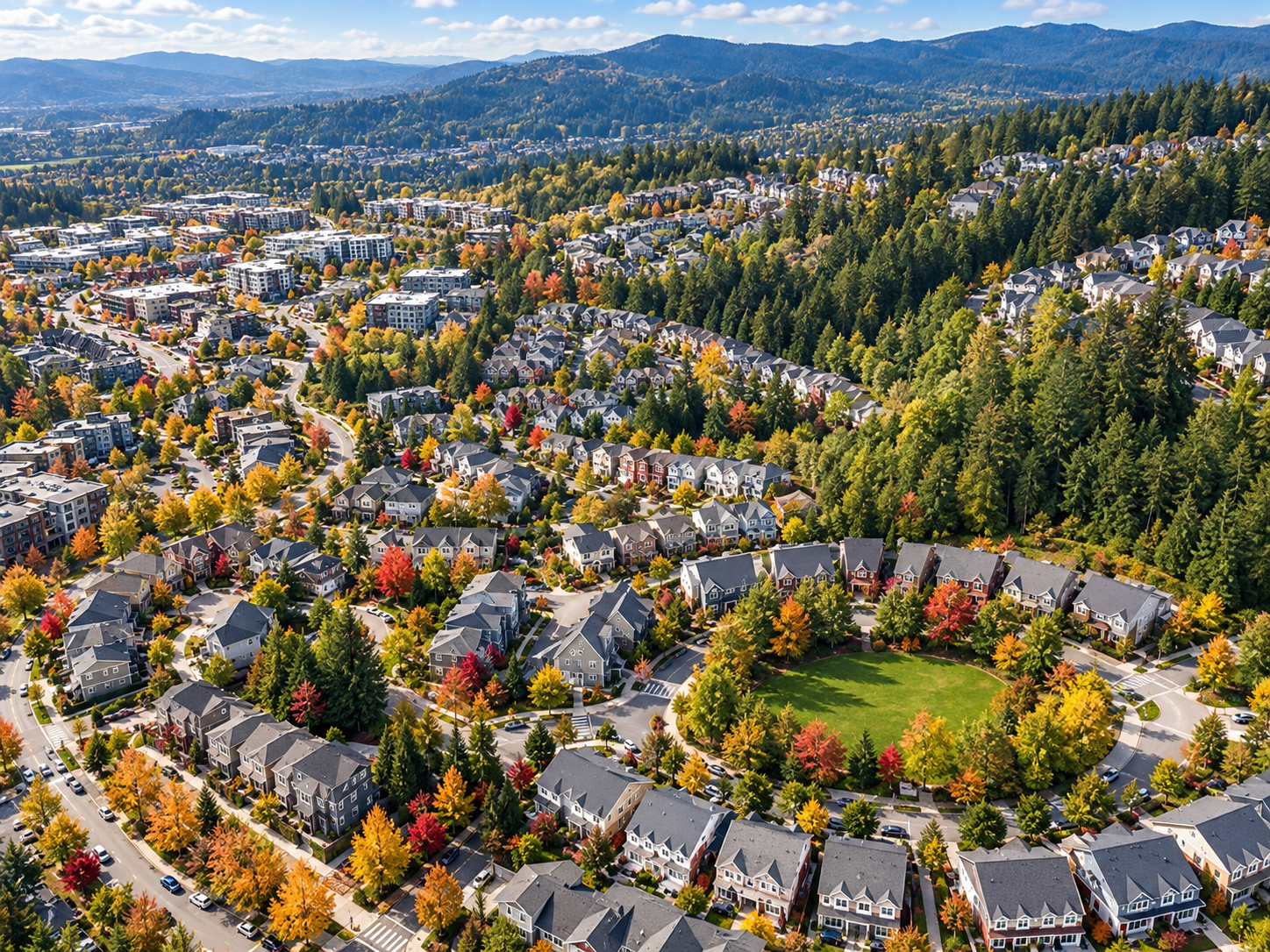
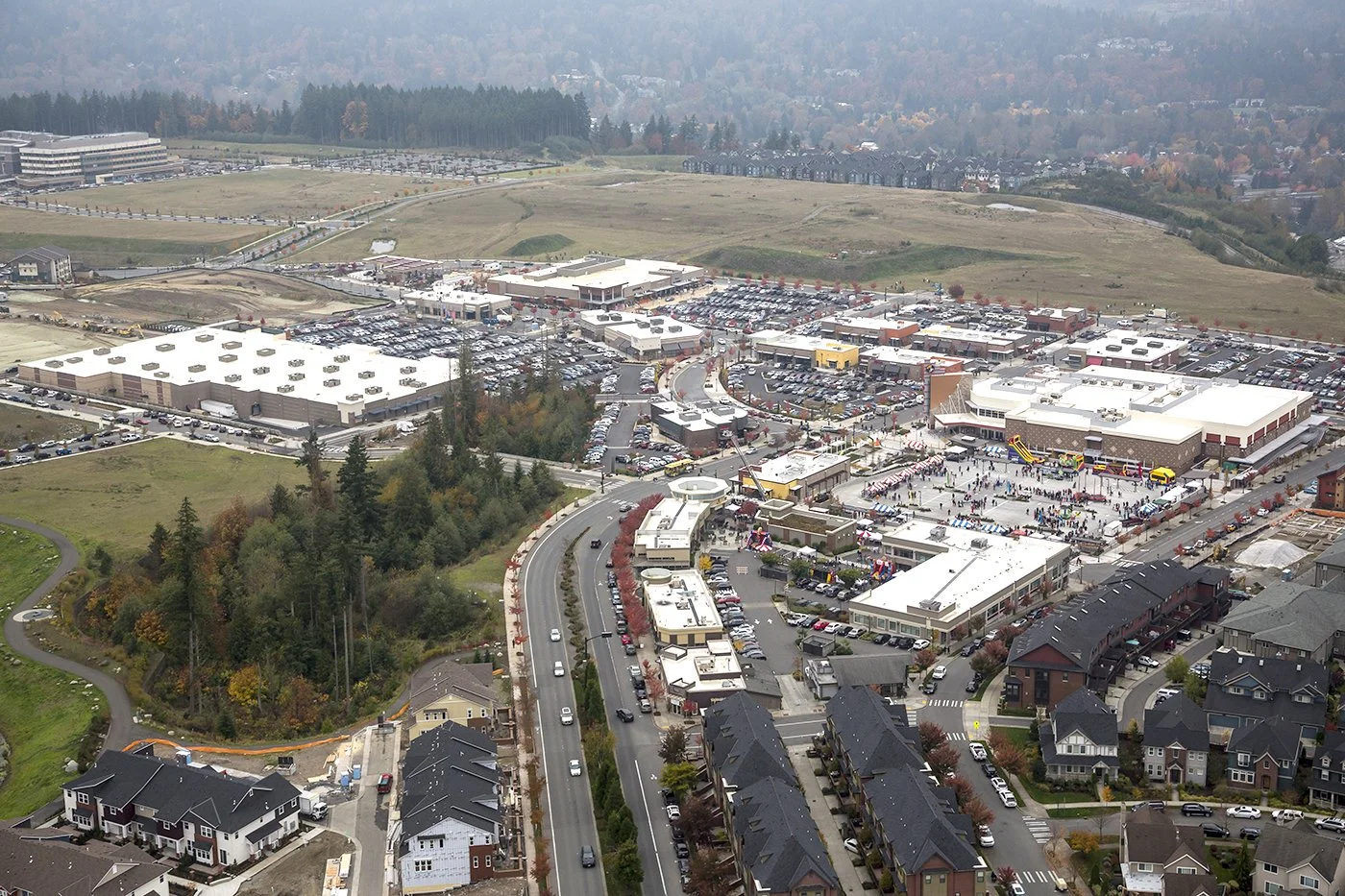
Overhead view of the Issaquah Highlands facing Southwest
Built From Scratch on an Old Coal Mine
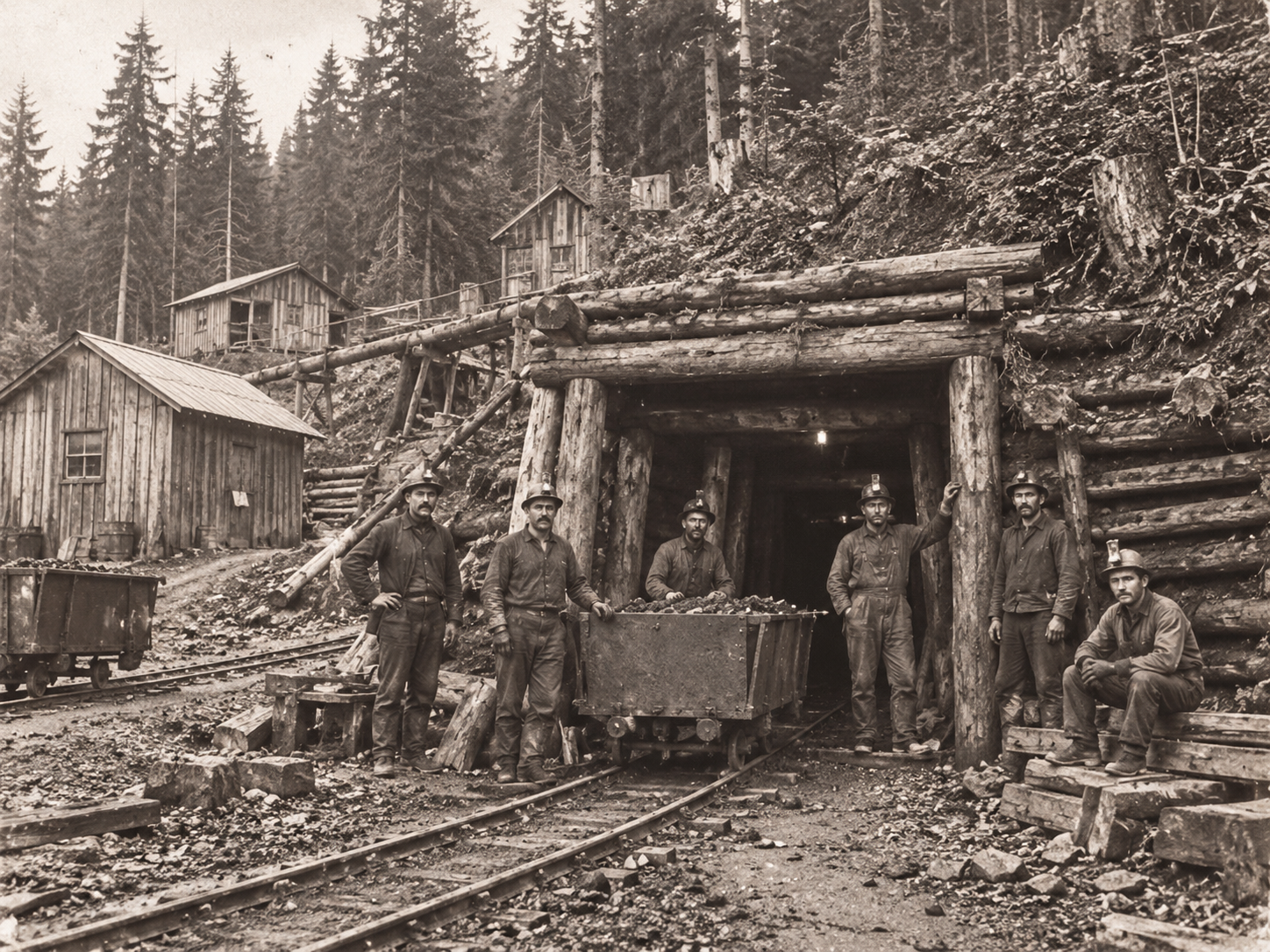
The land under the Highlands wasn't always residential. The Grand Ridge Mine operated here from 1909 into the 1950s, part of the same coal-mining economy that shaped so much of Issaquah's early history.
Development on the Highlands as a master-planned community began in the late 1990s. Unlike the valley floor's organic, decades-by-decades growth, the Highlands was designed as a single, coordinated community from day one: street grid, parks, retail, and housing planned together rather than built up piecemeal.
A Different Kind of Issaquah
That planning shows up in how the neighborhood actually feels:
Newer construction, generally built from the late 1990s onward rather than a mix of eras.
Its own retail hub at Grand Ridge Plaza, covered in more depth in our everyday-shopping post, so residents don't need to head down to the valley for groceries or errands.
Walkable streets built around parks and trails, rather than a historic Main Street grid.
A noticeably more contemporary architectural feel than downtown.
For a lot of buyers, the Highlands is less a part of Issaquah and more a whole different answer to the same question: where should I live on the Eastside?
Who Chooses the Highlands
The Highlands tends to draw a specific kind of buyer:
Families who want newer construction and modern floor plans over character and upkeep.
Commuters who want quick access to I-90 and SR-900 without living downtown.
Buyers who want walkability, just in a newer, park-centered form rather than a historic one.
It's worth comparing directly against the valley floor and the specific neighborhoods covered in our neighborhoods post, since “the Highlands” covers a range of price points and housing types on its own.
For Buyers & Sellers
Buyers comparing the Highlands to downtown are often really asking about trade-offs: newer construction versus character, a planned community versus an organic one. Naming that trade-off directly, rather than assuming buyers already know it, tends to move the conversation forward faster.
Want the honest comparison between the Highlands and the rest of Issaquah for your specific priorities? Reach out to Kelly Azzarello Real Estate.

Because the City on Your Mail Isn't Always the City You're In
Part of the Why Issaquah? series: Because the City on Your Mail Isn't Always the City You're In
By now, if you've read more than one post in this series, you've seen the pattern: a property with an "Issaquah" address that isn't actually inside the city of Issaquah. It's not a mistake, and it's not unique to Issaquah. It's how the postal system works everywhere in the country, and understanding the mechanism makes the whole thing much less confusing.
The USPS "Preferred City Name"
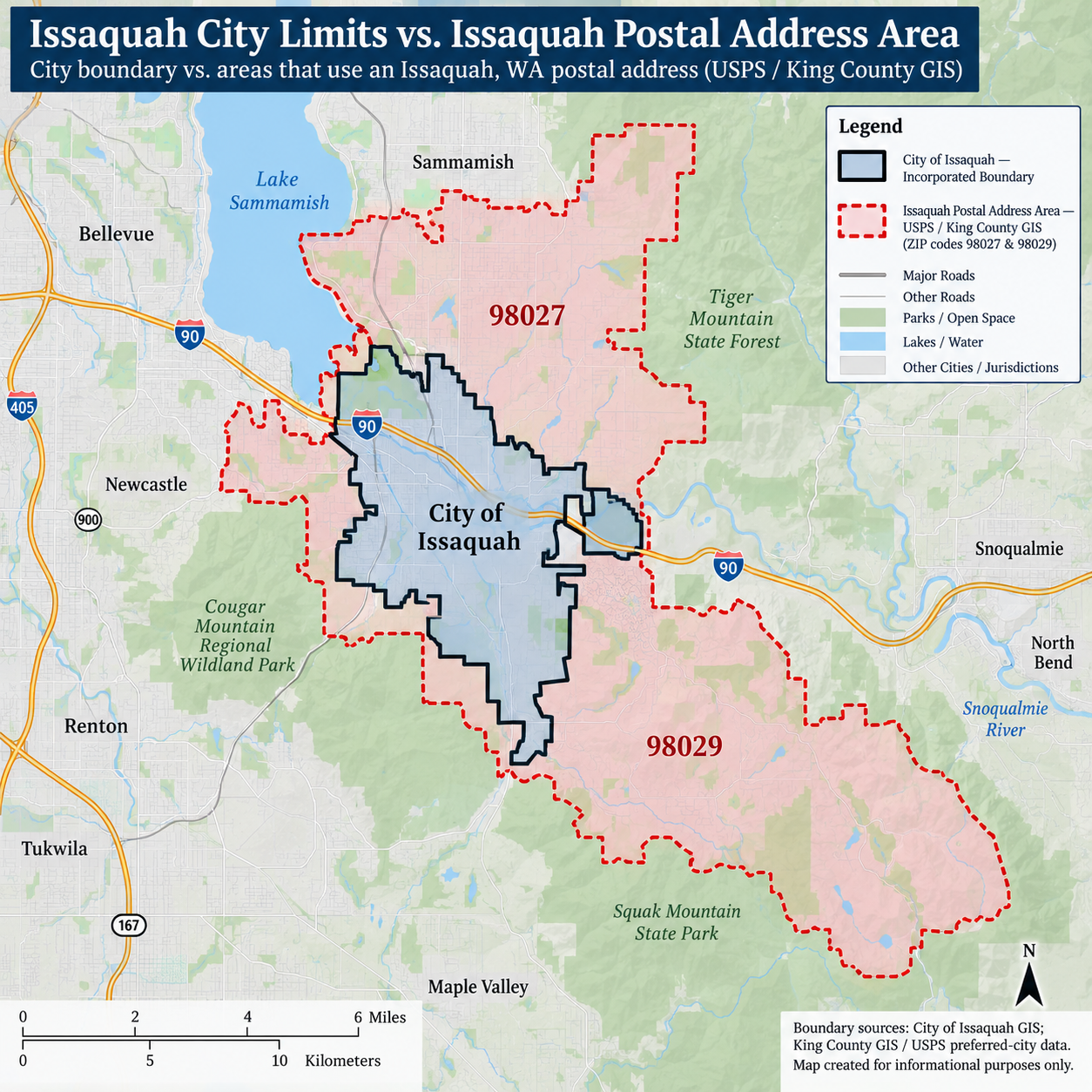
Every ZIP code is assigned a preferred city name by the U.S. Postal Service, chosen for mail-sorting efficiency, based on the post office that actually services that ZIP code. It has no legal relationship to municipal boundaries at all. A ZIP code's preferred name is frequently the nearest incorporated city, even when the address it's attached to sits well outside that city's actual limits, in unincorporated county land, or even inside a different city entirely.
This is a nationally documented phenomenon, not a local quirk. One well-known example: Sandy Springs, Georgia, spent years petitioning USPS for its own preferred city name instead of "Atlanta," and was refused. The Census Bureau even has a formal term for the distinction: a "postal city" versus a legal, incorporated city.
What This Looks Like Around Issaquah
We've run into several real versions of this exact mismatch while researching this series:
Preston has its own dedicated ZIP code and its own physical post office, entirely separate from Issaquah's. It is not an Issaquah postal address at all, despite sitting close to the city.
Hobart is split: parts of it fall under Issaquah's ZIP code, other parts under Maple Valley's, and a small historic Hobart ZIP covers a third slice. There's no single answer for "what city is Hobart" without checking the specific parcel.
Mirrormont and May Valley generally use Issaquah's ZIP code as their preferred postal city, despite being unincorporated King County, well outside Issaquah's actual municipal boundary.
It Happens Just as Often Inside City Limits, Too
This isn't only a rural, unincorporated-land issue. It shows up just as often with annexed neighborhoods.
Like the city of Issaquah and the postal Issaquah, the lines between many communities deserve deeper investigation before making an offer. Even longtime neighborhoods like Klahanie may be mistakenly thought of as part of Issaquah. It carries an Issaquah postal address, was part of unincorporated King County before that, and today is officially part of the city of Sammamish, having been annexed in 2016. We've even seen it mistakenly referred to as a separate city entirely, including on real estate and rental sites that ought to know better.
This is something we can help you clarify in your search.
Why This Actually Matters for a Buyer
A postal city name tells you almost nothing about which government you'd actually deal with: which city council sets your property taxes and zoning, which police and fire departments respond, which permitting office handles a remodel, and in unincorporated areas, whether you're on city utilities or a private well and septic. Two homes with identical "Issaquah, WA" addresses can sit in entirely different jurisdictions, with entirely different rules.
The only way to know for certain is to check the parcel directly against the actual city limits, not against what the mailing address says.
For Buyers & Sellers
Whenever a listing's city name is doing any work in a buyer's decision, whether that's school district assumptions, expected commute, or just a sense of identity, it's worth verifying the actual jurisdiction rather than taking the postal address at face value. This is a five-minute check that prevents a much more frustrating conversation after closing.
Not sure whether a specific address is actually inside the city its mail says it's in? Reach out to Kelly Azzarello Real Estate and we'll check it for you.

Because Three Mountains Come With the Address
Part of the Why Issaquah? series: Because Three Mountains Come With the Address
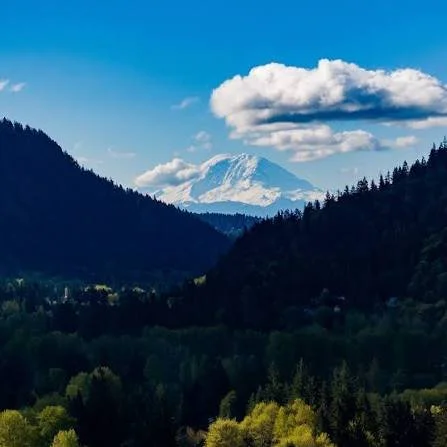
Photo of mountains facing south from Issaquah, WA
Cougar, Squak, and Tiger, the three peaks locals call the "Issaquah Alps," wrap around the city on three sides, and together they hold well over 100 miles of trail. That's not a stat you find attached to most suburban addresses. It means that depending on which neighborhood you're in, a genuine mountain trailhead might be a five-minute drive, or in some cases a walk, from your front door.
A Different Trail for a Different Mood
Cougar Mountain Regional Wildland Park, on the city's western edge, is the largest of the three and feels the most remote: old-growth remnants, abandoned coal mine sites, and enough mileage that you can genuinely get turned around if you're not paying attention. Squak Mountain State Park, tucked between Cougar and Tiger, is the quieter middle child, popular with trail runners who want climbs without crowds. And Tiger Mountain State Forest, home to Poo Poo Point and dozens of other named trails, is the workhorse of the three, with options ranging from a stroller-friendly loop to a genuine all-day mountain hike.
Down in the valley, Lake Sammamish State Park adds the water side of the equation: nearly two miles of shoreline, swimming beaches, picnic areas, and boat and paddleboard launches, all inside a ten-minute drive of most Issaquah neighborhoods.
Why Buyers Keep Bringing This Up
For a lot of relocating families, this is the single biggest lifestyle upgrade Issaquah offers over a more built-out Eastside city: the outdoors isn't something you plan a trip toward, it's something you're already inside of. Dog owners, trail runners, and parents of active kids tend to name this specifically when asked why they chose Issaquah over Bellevue or Redmond, not because those cities lack parks, but because Issaquah's access is bigger, wilder, and closer, all at once.
For Buyers & Sellers
Distance to a named trailhead, Cougar, Squak, or Tiger Mountain, is a detail worth pulling out explicitly in listing copy, the same way you'd note a school boundary or a commute time. Buyers relocating for lifestyle reasons are often searching by trail name, not just neighborhood name.
If getting a mountain trailhead within walking or short driving distance is a priority for your next home, let's build your search around it. Reach out to Kelly Azzarello Real Estate and we'll map out which Issaquah neighborhoods put the Alps closest to your door.