

Want to sell? Don’t miss out on a hidden gem: hardwoods under the carpet
If your home was built in the 1970's or earlier, which is not uncommon in established neighborhoods in Bellevue, Sammamish, Redmond, Issaquah, and Renton, there's a decent chance real hardwood is hiding under that living room carpet. Even if you're not sure what's under that carpet, it's a good idea to check it out before spending thousands replacing worn carpet when the better, and maybe even cheaper, move is right underneath your feet.
How to Check Before You Commit to Anything
Before you order new carpet or call a flooring crew, pull up a corner in a closet or under a heat register — anywhere the seam won't be seen if you decide to keep the carpet after all. You're looking for solid wood strip flooring, which shows up in all kinds of homes, sometimes in surprising places.
If you find it, a light sand and refinish typically runs a fraction of the cost of new carpet or engineered flooring, and buyers consistently respond to real hardwood in listing photos.
Why This Is Worth the Effort
Buyers touring homes for sale in Bellevue, Sammamish, Redmond, Issaquah, Renton, and Klahanie expect a certain level of finish, and original hardwood flooring signals quality and character that builder-grade flooring can't fake. It's one of the few updates where the “before” condition of the house actually works in your favor. This is especially true if the house has the charm of a craftsman or mid-century modern build — a style you'll find throughout many of these Eastside neighborhoods. Make certain you speak to your broker before doing anything though, as brokers like us have contacts and experience to help guide you through.
What It Costs vs. What It's Worth
A professional hardwood floor refinishing job is generally priced per square foot and is almost always less expensive than replacing flooring outright — and it photographs beautifully for real estate listing marketing.
One of the first questions sellers across Bellevue, Sammamish, Redmond, Issaquah, Renton, and Klahanie ask us about refinishing their hardwoods is whether they'll get their money back; the ever-present ROI debate. There's no easy answer to this, and there are many things that go into making this decision. In our experience helping local sellers get their homes ready to sell, ROI on a project like this shows up in a few different ways:
1. Real return. This is the straightforward version: you put in $10,000 and the sale price increases by $10,000 — or $8,000, or $6,000. It's rarely a dollar-for-dollar trade, but it's the easiest to measure.
2. Attraction. This is where a project makes the home more appealing to buyers without necessarily attaching to a specific dollar amount. A more attractive home draws more interest, which can mean more showings, more offers, and a stronger negotiating position — even if you can't point to the exact number it added.
3. Detraction. This is the flip side: something about the home is unattractive enough that buyers notice it, and if you don't address it before listing, you're doing the home — and yourself — a disservice. It's not about adding value so much as it is about not losing it.
Sometimes you have the history of why the carpet was installed. If it was installed to hide poorly installed floors, or floors that were damaged (water, pets, etc.), you'll need to consider whether or not it's worth it to refinish, recarpet, or replace entirely.
In our example below, that carpet was old, unattractive, musty, and worn — squarely in the “detraction” category. It had to go. Luckily, we discovered the hardwood beneath it was in great shape.
An Example From Our Own Experience
In a recent case for us, a client came to us with her parents' older home in the Eastside area. They had lived there for 50 years, and the carpet in the home today was there when they bought it. After 5 minutes of investigation we determined that the hardwoods were throughout the main floor of the house (with the exception of the kitchen) and they seemed to be in very good condition.
We recommended pulling up the carpet (which needed to be done anyway), and in this case decided that refinishing was not necessary. Why?
1. The hardwoods were in very good shape (no major stains, though some fading, no large scratches, etc.).
2. The color of the floors was fairly neutral, and refinishing, like painting, is very personal. Not only would the savings of not refinishing go to the sellers' bottom line, but buyers would refinish it the way they wanted and wouldn't be paying for someone else's “tastes” in color.
Here's the dining room before, still carpeted, and the same room after the carpet came up — no sanding, no refinishing, just the original floor underneath:

Before: the dining room, still carpeted

After: same dining room, original hardwood exposed

Living room, carpet pulled back mid-process
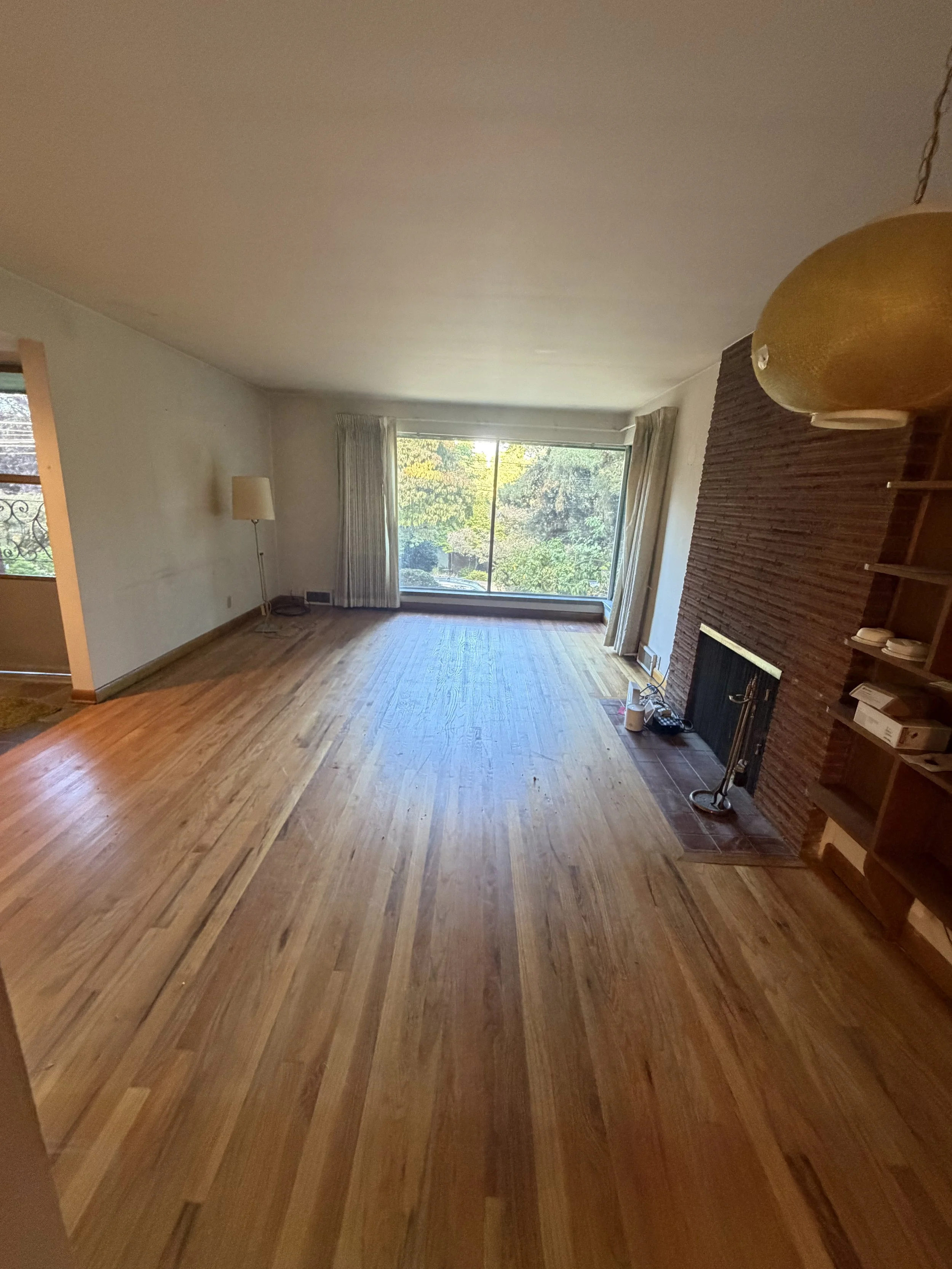
Living room after, hardwood fully exposed
It's worth saying plainly: at this point, there has been zero refinishing done to these floors. What you're seeing is simply the original hardwood, cleaned up, with the carpet and padding removed. It already looks great.
One detail worth knowing about: it's common with hardwood floors to have quarter round trim at the bottom of the baseboards. That quarter round is often removed when carpet is installed, since carpet gets tucked under the baseboard for a more finished look. In this case, we decided not to reinstall the quarter round — matching the existing trim exactly would have been difficult, and we expect the new owners will want to refinish the floors themselves, at which point they'll likely replace the quarter round to match whatever finish they choose.
We also didn't touch the flooring anywhere else in the house. The basement and kitchen both have rolled linoleum, and we left both as-is rather than expanding the scope of this project.
If a buyer's feedback mentions the floors needing refinishing, or the missing quarter round, our response is simple: “We discovered wonderful hardwoods below the old carpet and felt that buyers would appreciate them more than simply covering them up again. We didn't refinish them because we expected the buyers would want to pick the finishes themselves, and replace the quarter-round at that time as well as flooring in other areas of the house. We priced it with the fact that the buyer would want to refinish themselves, not pay the seller for that — especially if they wanted a different color or finish.”
While I wouldn't say it's easy to pull up carpet, tack strips, and staples in the flooring, it is definitely something that can be done by the seller or a handyman. You'll want to be careful not to mar the flooring during carpet removal, but it doesn't require a flooring professional, and YouTube will be your friend. You'll need a few tools and some way to get the old carpet and tack strips to the dump, but you'll likely find a use for the tools — maybe in your next home when you prepare to move in.
Even a partial refinish in the main living areas can be enough to shift buyer perception the moment they walk in.
Thinking About Selling Your Home in Bellevue, Sammamish, Redmond, Issaquah, Renton, or Klahanie?
Every home is different, and not every fix is worth the money. If you'd like a second set of eyes on what's actually worth doing before you list — and what to skip — we're happy to walk through it with you, room by room. We work with sellers throughout the Eastside and know what local buyers respond to.
Kelly Azzarello Real Estate | Compass Real Estate
📞 (425) 830-6457
🎥 Watch home-selling tips and Eastside market updates on our YouTube channel — [link coming soon]

How do I buy a house?
Learn how to buy a home in the Seattle area with this expert guide from local brokers. Understand budgeting, credit, down payments, and how to make an offer with confidence.

A Step-by-Step Guide from a Seattle Broker
Buying a home is one of life’s biggest milestones, and one of the most rewarding when you understand how the process works. As seasoned real estate brokers, we’ve helped hundreds of buyers navigate every stage, from the first financial questions to the moment they receive the keys. Here’s what you should know to get started with confidence.
Step 1: Know What You Can Afford
Before you fall in love with a home, it’s important to determine your price range. A good rule of thumb is that your total monthly housing payment (including taxes and insurance) should stay within 25–30% of your gross income. A lender can pre-qualify you for a loan, but we help you translate that number into a realistic budget that fits your lifestyle and long-term goals. It’s not just about what the bank says you can buy, it’s about what feels comfortable for you.
Step 2: Understand Your Financing
Your credit score, down payment, and debt-to-income ratio all play roles in securing your mortgage.
Most loan programs require a minimum credit score of around 620, though stronger credit opens doors to better rates. Many buyers are surprised to learn they don’t need 20% down. There are conventional and government-backed options that start at 3–10%.
We connect clients with trusted local lenders who can explain which programs fit their situation.
Step 3: Plan Your Timeline
How long does it take to buy a home? The honest answer: it depends.
Once you’re pre-approved, most buyers spend one to two months finding the right property, followed by 30–45 days for financing and closing. A skilled agent helps streamline the process by handling details, anticipating issues, and keeping everyone on schedule.
Step 4: Know the Key Terms
Earnest money is a small deposit (usually 1–3% of the purchase price) that shows sellers you’re serious. It’s held in escrow and applied toward your down payment or closing costs once the sale closes. Your down payment is your initial investment in the home. It can come from savings, equity, or even approved gift funds.

Step 5: Making an Offer
Once you’ve found the right home, your agent will help craft a competitive offer that balances price, timing, and terms. We analyze recent comparable sales, assess the seller’s motivation, and position your offer to stand out. It’s important to understand whether the market is calm or competitive. We build strong relationships with local agents and a deep understanding of negotiation strategies can make the difference between getting the home you want and missing out.
Step 6: Move Forward with Confidence
Buying a home doesn’t have to be overwhelming. With clear guidance, trusted partners, and local expertise, the process becomes not just manageable, but exciting. If you’re thinking about buying a home in the Seattle or Tacoma area, we’d love to walk you through your options, answer your questions, and help you make the smartest move possible.
· 📞 Let’s start a conversation today.

Estates and Real Estate Brokers
Understanding how real estate fits into an estate can be complex for the uninitiated. Kelly and her team will help you better understand where a real estate broker can help save time, save energy, save money.
Navigating Life Transitions with Compassion and Clarity

Real estate often becomes a central part of the estate process, whether you’re planning ahead or managing an estate after a transition. In many cases, real estate is the single biggest asset in the estate. At Kelly Azzarello Real Estate, we understand that these moments can be emotional and complex. Our dedicated team specializes in helping families navigate them with clarity, compassion, and expertise.
Don’t worry about sounding professional. Sound like you. There are over 1.5 billion websites out there, but your story is what’s going to separate this one from the rest. If you read the words back and don’t hear your own voice in your head, that’s a good sign you still have more work to do.
Be clear, be confident and don’t overthink it. The beauty of your story is that it’s going to continue to evolve and your site can evolve with it. Your goal should be to make it feel right for right now. Later will take care of itself. It always does.
Planning Ahead for Peace of Mind
For those planning ahead, we help clients make thoughtful choices about their home before it becomes part of an estate. That may include exploring downsizing options, evaluating the home’s future role in a long-term plan, or coordinating with your attorney, accountant, and financial advisor to align your real estate assets with your broader estate goals. Preplanning can ease family stress later and ensure your wishes are clearly documented and achievable.
“Proactive planning today creates peace of mind for tomorrow.”
Managing an Estate or Transition with Care
When handling an estate after someone has passed or transitioned to in-home, long-term, or memory care, our focus shifts to sensitive coordination and practical support. We work closely with executors, attorneys, and accountants to manage the property efficiently and respectfully—assessing market value, organizing cleanouts or repairs, and preparing the home for sale. Through our trusted network of professionals—move managers, stagers, contractors, and estate specialists—we make sure every step is handled with care.
Experience You Can Trust
As a Certified Senior Advisor (CSA®) and Senior Real Estate Specialist (SRES®), Kelly Azzarello brings both expertise and empathy to these transitions. Together with our team, we help families and individuals find the best path forward—whether that means selling, simplifying, or adapting for care at home. With the right guidance and resources, you can move through life’s changes with confidence and peace of mind.