
Want to sell? Don’t miss out on a hidden gem: hardwoods under the carpet
If your home was built in the 1970's or earlier, which is not uncommon in established neighborhoods in Bellevue, Sammamish, Redmond, Issaquah, and Renton, there's a decent chance real hardwood is hiding under that living room carpet. Even if you're not sure what's under that carpet, it's a good idea to check it out before spending thousands replacing worn carpet when the better, and maybe even cheaper, move is right underneath your feet.
How to Check Before You Commit to Anything
Before you order new carpet or call a flooring crew, pull up a corner in a closet or under a heat register — anywhere the seam won't be seen if you decide to keep the carpet after all. You're looking for solid wood strip flooring, which shows up in all kinds of homes, sometimes in surprising places.
If you find it, a light sand and refinish typically runs a fraction of the cost of new carpet or engineered flooring, and buyers consistently respond to real hardwood in listing photos.
Why This Is Worth the Effort
Buyers touring homes for sale in Bellevue, Sammamish, Redmond, Issaquah, Renton, and Klahanie expect a certain level of finish, and original hardwood flooring signals quality and character that builder-grade flooring can't fake. It's one of the few updates where the “before” condition of the house actually works in your favor. This is especially true if the house has the charm of a craftsman or mid-century modern build — a style you'll find throughout many of these Eastside neighborhoods. Make certain you speak to your broker before doing anything though, as brokers like us have contacts and experience to help guide you through.
What It Costs vs. What It's Worth
A professional hardwood floor refinishing job is generally priced per square foot and is almost always less expensive than replacing flooring outright — and it photographs beautifully for real estate listing marketing.
One of the first questions sellers across Bellevue, Sammamish, Redmond, Issaquah, Renton, and Klahanie ask us about refinishing their hardwoods is whether they'll get their money back; the ever-present ROI debate. There's no easy answer to this, and there are many things that go into making this decision. In our experience helping local sellers get their homes ready to sell, ROI on a project like this shows up in a few different ways:
1. Real return. This is the straightforward version: you put in $10,000 and the sale price increases by $10,000 — or $8,000, or $6,000. It's rarely a dollar-for-dollar trade, but it's the easiest to measure.
2. Attraction. This is where a project makes the home more appealing to buyers without necessarily attaching to a specific dollar amount. A more attractive home draws more interest, which can mean more showings, more offers, and a stronger negotiating position — even if you can't point to the exact number it added.
3. Detraction. This is the flip side: something about the home is unattractive enough that buyers notice it, and if you don't address it before listing, you're doing the home — and yourself — a disservice. It's not about adding value so much as it is about not losing it.
Sometimes you have the history of why the carpet was installed. If it was installed to hide poorly installed floors, or floors that were damaged (water, pets, etc.), you'll need to consider whether or not it's worth it to refinish, recarpet, or replace entirely.
In our example below, that carpet was old, unattractive, musty, and worn — squarely in the “detraction” category. It had to go. Luckily, we discovered the hardwood beneath it was in great shape.
An Example From Our Own Experience
In a recent case for us, a client came to us with her parents' older home in the Eastside area. They had lived there for 50 years, and the carpet in the home today was there when they bought it. After 5 minutes of investigation we determined that the hardwoods were throughout the main floor of the house (with the exception of the kitchen) and they seemed to be in very good condition.
We recommended pulling up the carpet (which needed to be done anyway), and in this case decided that refinishing was not necessary. Why?
1. The hardwoods were in very good shape (no major stains, though some fading, no large scratches, etc.).
2. The color of the floors was fairly neutral, and refinishing, like painting, is very personal. Not only would the savings of not refinishing go to the sellers' bottom line, but buyers would refinish it the way they wanted and wouldn't be paying for someone else's “tastes” in color.
Here's the dining room before, still carpeted, and the same room after the carpet came up — no sanding, no refinishing, just the original floor underneath:

Before: the dining room, still carpeted

After: same dining room, original hardwood exposed

Living room, carpet pulled back mid-process
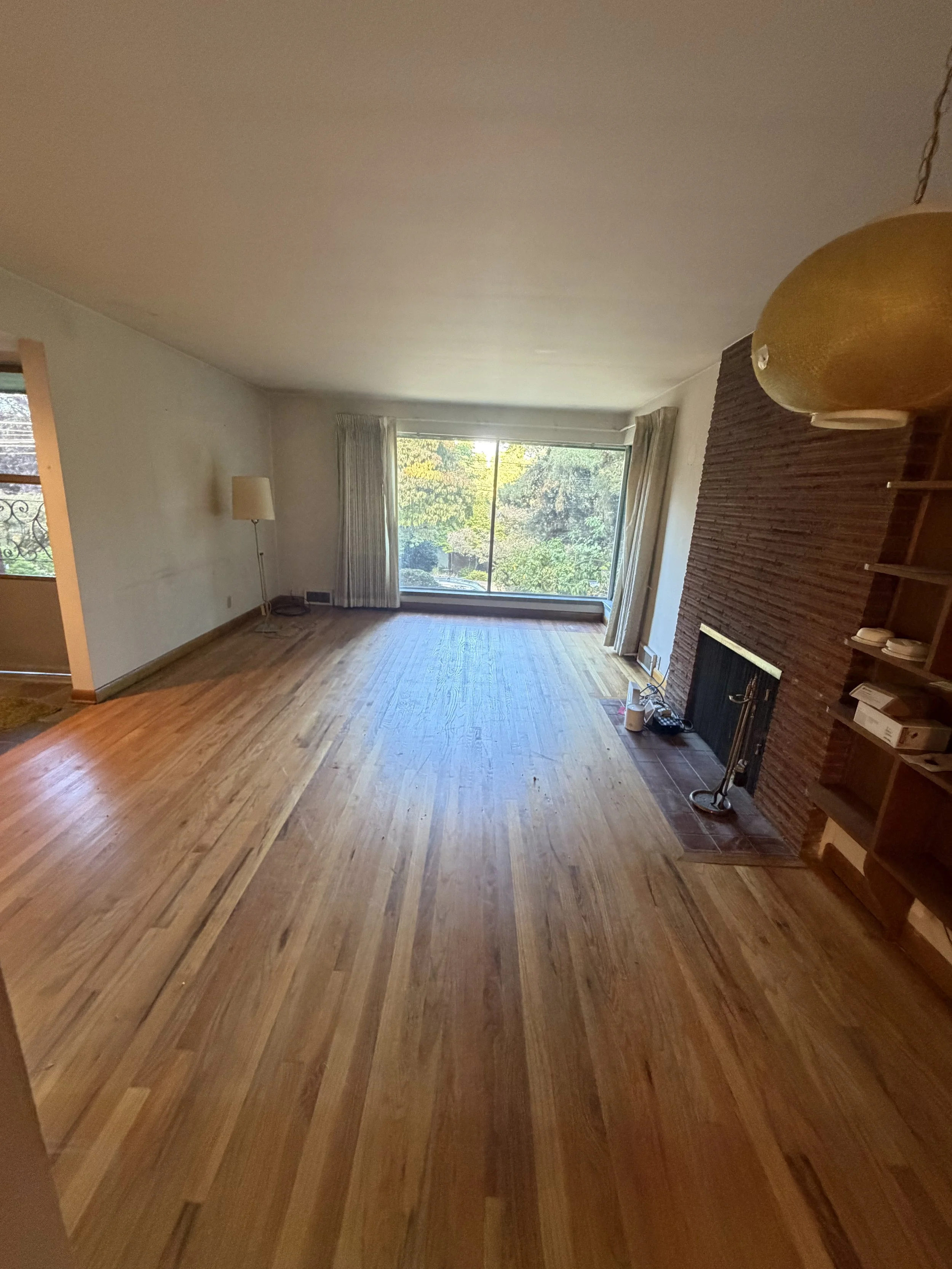
Living room after, hardwood fully exposed
It's worth saying plainly: at this point, there has been zero refinishing done to these floors. What you're seeing is simply the original hardwood, cleaned up, with the carpet and padding removed. It already looks great.
One detail worth knowing about: it's common with hardwood floors to have quarter round trim at the bottom of the baseboards. That quarter round is often removed when carpet is installed, since carpet gets tucked under the baseboard for a more finished look. In this case, we decided not to reinstall the quarter round — matching the existing trim exactly would have been difficult, and we expect the new owners will want to refinish the floors themselves, at which point they'll likely replace the quarter round to match whatever finish they choose.
We also didn't touch the flooring anywhere else in the house. The basement and kitchen both have rolled linoleum, and we left both as-is rather than expanding the scope of this project.
If a buyer's feedback mentions the floors needing refinishing, or the missing quarter round, our response is simple: “We discovered wonderful hardwoods below the old carpet and felt that buyers would appreciate them more than simply covering them up again. We didn't refinish them because we expected the buyers would want to pick the finishes themselves, and replace the quarter-round at that time as well as flooring in other areas of the house. We priced it with the fact that the buyer would want to refinish themselves, not pay the seller for that — especially if they wanted a different color or finish.”
While I wouldn't say it's easy to pull up carpet, tack strips, and staples in the flooring, it is definitely something that can be done by the seller or a handyman. You'll want to be careful not to mar the flooring during carpet removal, but it doesn't require a flooring professional, and YouTube will be your friend. You'll need a few tools and some way to get the old carpet and tack strips to the dump, but you'll likely find a use for the tools — maybe in your next home when you prepare to move in.
Even a partial refinish in the main living areas can be enough to shift buyer perception the moment they walk in.
Thinking About Selling Your Home in Bellevue, Sammamish, Redmond, Issaquah, Renton, or Klahanie?
Every home is different, and not every fix is worth the money. If you'd like a second set of eyes on what's actually worth doing before you list — and what to skip — we're happy to walk through it with you, room by room. We work with sellers throughout the Eastside and know what local buyers respond to.
Kelly Azzarello Real Estate | Compass Real Estate
📞 (425) 830-6457
🎥 Watch home-selling tips and Eastside market updates on our YouTube channel — [link coming soon]