


Logistics and Planning: What Sellers Overlook Before Listing
Timing and planning decide how smoothly the sale goes. These five items are easy to overlook until they cause a problem.
Timing and planning decide how smoothly the sale goes. These five items are easy to overlook until they cause a problem.
Show-readiness and access
Why it matters: Showings come with little notice. A home that takes hours to get ready, or that is hard to enter, gets fewer showings, which shrinks the pool of buyers.
What to do:
- Decide how quickly the home can be ready to show, and plan for pets, children and work-from-home schedules.
- Find the cause of any access problem, such as tenants, locked rooms, gates or alarm codes, and settle it with your agent: lockbox access, notice periods, and how access works if there are tenants or other occupants. Set showing windows with your agent.
What not to do:
- Do not limit showing times so much that buyers cannot see the home.
- Do not stay home during showings.
- Do not leave pets loose, or valuables and medications out.
- With tenants, follow the lease and the law.
- Ask your agent about anything else that applies.
Where you will live and store things
Why it matters: A sale takes weeks to months, and living in a home that is being shown is hard. Planning avoids a rush that leads to clutter, damage or extra costs.
What to do:
- Decide whether you will stay or move out first, and when.
- Sort belongings before packing and choose storage (a rented unit, a portable container or a family garage).
- Pack and label off-season and nonessential items first.
- Keep essentials within reach.
- Plan where you will go if the timing of your sale or your purchase shifts.
What not to do:
- Do not crowd the garage, attic or crawl space with storage while the home is listed, since buyers and inspectors need to see and access them.
- Do not leave the decision about where to live until after you have an offer.
- Do not leave a home vacant without checking your insurance coverage.
Contractor lead times
Tradespeople are not always available on short notice, and repairs found late can delay your sale. Lead times vary, so allow for them when you plan your timeline, and get written estimates, licenses and receipts for any work.
An outside opinion
Why it matters: You stop seeing problems you live with. An outside view shows what buyers will notice and in what order to address it.
What to do:
- Ask an agent for a walk-through before you start any work, and ask a friend with fresh eyes as well.
- Ask what is most likely to come up at the inspection and what to fix first, and take notes.
- Consider a pre-listing inspection to find the causes of problems before a buyer's inspector does.
What not to do:
- Do not take comments personally; the goal is to see what a buyer will see.
- Do not start projects before the walk-through.
- Do not rely only on people who are used to the home.
Avoiding over-improving
Some updates cost more than they return, and the money comes out of your proceeds. Start with condition, then appeal, ask your agent what comparable homes sold for before any large project, and do not start a kitchen or bath remodel just before listing without that input: [link: return on investment post].
See the full guide: What Do Sellers Overlook Before Listing? A Short Guide
If something turns up, we can help
As agents we work with contractors and other vendors regularly, and we can share names from our experience and help you compare bids. You always choose who to hire. A broker should not require you to use their vendor, and should not be paid by a vendor you hire.
From Our Own Experience
As agents for buyers and sellers, we see both sides of transactions. Here are a few issues we’ve encountered that could easily have been avoided.
- As we were about to go to market, we had a final walkthrough with the seller. They did a great job of cleaning out the home, but put all of the boxes in the garage. This wasn’t the problem though: About 20 of those boxes were stacked in front of the furnace, water heater, and electric panel making it nearly impossible for the inspector to access them without a lot of work. An inspector who goes to that much trouble to access those items will probably make sure to find something to note in the report.
- The vendor who installed new carpet covered the crawl space access. Five minutes with a carpet knife during installation would have saved a lot of time searching for the access panel.
- A secondary electric panel that was hidden behind loose boards. The inspector knew there was a secondary panel when inspecting the primary, but could not find it.
- An older home that had a newer electrical panel, but two sets of outlets close to each other. The expectation was that one set was the original and decommissioned (but not removed/capped), and the other was the newer service. However, the buyer’s inspector had to test all of the outlets and report that some did not work or were ungrounded, raising inspection items and additional questions during the inspection response period.
A list of changes or improvements with the dates and locations if necessary, and permits or information about the licensed vendor come in handy when questions arise.
Thinking about buying or selling in the Seattle Area?
Kelly Azzarello Real Estate | Compass
Email: kelly@kellyazzarello.com
Phone: (425) 830-6457
Web: www.kellyazzarello.com
Instagram: instagram.com/kellyazzarello
YouTube: youtube.com/kellyazzarellorealestate
This post is general information about real estate topics. It is not legal, tax or financial advice, and it does not replace a professional inspection. Rules and practices differ by situation and change over time. Check current requirements and talk with a licensed professional, such as an inspector, contractor, attorney or CPA, about your own property.

Paperwork and Records: What Sellers Overlook Before Listing
Many sellers leave paperwork until the last minute. Organized records support your price and keep the sale on schedule.
Many homeowners leave finding and organizing their paperwork and records until the last minute. Then they have to scramble for the information, or never get to it before the home goes on the market.
Organized records are valuable in three ways:
- They identify changes and maintenance. Maintenance records can make a buyer more comfortable with the purchase, and improvements and major upgrades can add value through warranties and design information.
- They help market the home by showing what was done and when. Most buyers do not need to know the cost of the work, but the list shows the home was cared for.
- When your home sells, there will be an accounting for tax purposes. Organized records make it easier to document for your accountant, and may save you money.
Service records and receipts
Why it matters: Buyers and inspectors want to know whether major systems have been maintained. Records show what was done, when and by whom. Having this information ready for potential buyers helps support your price.
What to do:
- Start with a list of major systems and work: furnace or HVAC, water heater, roof, sewer, windows and remodels.
- Find the records: emailed receipts, bank or card statements, contractor invoices, permits and warranties. Ask contractors for copies if you do not have them.
- Keep one folder, on paper or digital, with the date, what was done, who did it and the cost. Records of major improvements may matter for tax purposes when you sell, so ask your CPA which ones to keep.
What not to do:
- Do not guess or round dates.
- Do not share receipts that show account numbers or other personal information.
- Do not wait until the last minute.
Documents to gather
Why it matters: HOA documents, warranties, manuals, utility history and earlier inspection reports answer buyer questions before they are asked. Documents held by an association can take time to obtain, and missing ones can delay a sale.
What to do:
- List what applies: HOA or condo documents and fees, warranties, appliance manuals, twelve months of utility costs, earlier inspection reports and repair records.
- Find who holds each item (the HOA manager, a builder, a utility account) and request them early. Put everything in one place and tell your agent what you have.
What not to do:
- Do not hold back an earlier inspection report without asking your agent how it affects your disclosures.
- Do not promise that a warranty transfers until you have read its terms.
- Do not wait for the buyer to ask.
Permits
Unpermitted work can come up when a buyer's agent, inspector, appraiser, lender or insurer asks, and it can stall a closing. Check the permit records for your address and do not leave unpermitted work out of your disclosures: [link: unpermitted work post].
See the full guide: What Do Sellers Overlook Before Listing? A Short Guide
From Our Own Experience
In 2025 we helped a buyer purchase an old, charming home. That home had an addition at some point (adding two bedrooms), but no one knew when that was added.
After the purchase and closing, the buyer contacted the city to have recent changes and upgrades inspected so there would be no issue when they eventually sell the house.
They were getting ahead of something that they knew would make most buyers more comfortable.
During that process the city inspector noted that he could not find building plans on file, so he questioned whether the addition had been permitted correctly.
Our buyer (and now homeowner) had no information from the seller on when it might have been done. However, the seller had left behind a collection of photos, some dated decades earlier, that showed the addition being built. They helped the city narrow its search for the documents.
Thinking about buying or selling in the Seattle Area?
Kelly Azzarello Real Estate | Compass
Email: kelly@kellyazzarello.com
Phone: (425) 830-6457
Web: www.kellyazzarello.com
Instagram: instagram.com/kellyazzarello
YouTube: youtube.com/kellyazzarellorealestate
Tax: Tax treatment depends on your individual circumstances and changes over time. Consult a CPA or tax professional about your situation.

Small Problems That Read as Neglect: What Sellers Overlook Before Listing
Each small problem usually costs little to fix, but together they tell a buyer the house has not been looked after. Three places to look.
Each small problem usually costs little to fix, but together these problems tell a buyer the house has not been looked after. This invites a closer look at everything else.
Here are three places to look.
Deferred maintenance
Why it matters: These issues show up at showings and in the inspection report, where each one becomes a line item a buyer can use to negotiate.
What to do:
- Walk through room by room with a notepad. List every sticky door, dripping faucet, running toilet, loose handrail, cracked outlet cover and burned-out bulb.
- For recurring issues, find the root cause first. A dripping faucet may need a new cartridge. A door that sticks may point to humidity or settling. Fix the cause, then make the adjustment or repair to the damaged area.
- Handle the simple items yourself and use a licensed tradesperson for plumbing or electrical work that calls for one.
- Finish the list before photos.
What not to do:
- Do not use temporary fixes such as tape or a dab of caulk over a leak.
- Do not take on electrical or plumbing work beyond your skill. Poor work can become a safety issue, and it raises bigger questions than the original problem would.
- Do not wait for the inspector to make the list for you.
Safety items
Why it matters: Safety items are quick for an inspector to check and easy for a buyer to notice, and a missing or failed item can end up in the inspection report. One often overlooked issue is smoke or carbon monoxide alarms. In the State of Washington, the seller of an owner-occupied single-family home must install carbon monoxide alarms before the buyer moves in, so check the rules for your home and ask your agent about smoke alarms and additional local requirements.
What to do:
- Check that smoke and carbon monoxide alarms are present and working.
- Look at the date printed on each unit.
- Test GFCI outlets near water with the test and reset buttons.
- Check that handrails are solid, and look for trip hazards on steps and walkways.
- If something fails, find out why before replacing it. A GFCI that will not reset may point to a wiring or moisture problem. A chirping alarm may need only a new battery or may be past its life. Have a licensed electrician look at anything electrical you cannot explain, and keep the receipt.
What not to do:
- Do not remove an alarm to stop it from chirping.
- Do not replace a failed GFCI with a standard outlet.
- Do not paint over or cover alarms.
Roof, exterior, decks and porches
Inspectors check all of these, and moss, lifted shingles, rotted trim and wobbly railings often turn into repair requests. Find the cause (an overflowing gutter, a leak, failed flashing) before you repair, and get a written estimate for anything you cannot finish: [link: roof and exterior maintenance post].
If something turns up, we can help
As agents we work with contractors and other vendors regularly, and we can share names from our experience and help you compare bids. You always choose who to hire. A broker should not require you to use their vendor, and should not be paid by a vendor you hire.
From Our Own Experience
A buyer inspected a charming older home in a Seattle neighborhood. During the inspection it was determined that the grounded outlets were not in fact grounded. The home had been built before grounded outlets were required, and there were no ground wires within the walls to ground those outlets correctly.
Whether the seller understood the nature of the safety issue or not, it was up to us to help the buyer understand what the potential impacts could be. In the end, the buyers decided they would be upgrading the electrical systems in the home to provide for air conditioning and additional capacity, so they weren’t hung up on having the seller fix the issue for them and proceeded with the sale with an understanding of what they were getting into.
Thinking about buying or selling in the Seattle Area?
Kelly Azzarello Real Estate | Compass
Email: kelly@kellyazzarello.com
Phone: (425) 830-6457
Web: www.kellyazzarello.com
Instagram: instagram.com/kellyazzarello
YouTube: youtube.com/kellyazzarellorealestate
This post is general information about real estate topics. It is not legal, tax or financial advice, and it does not replace a professional inspection. Rules and practices differ by situation and change over time. Check current requirements and talk with a licensed professional, such as an inspector, contractor, attorney or CPA, about your own property.

Water and Moisture: What Sellers Overlook Before Listing
Water leads to rot, mold and structural damage, and buyers know it. Here are three areas to check, and what to do and not do.
Water is what inspectors and buyers worry about most, because it leads to rot, mold and structural damage. Three areas to check before you list.
Moisture, drainage and signs of past water
Why it matters: Water shows up at the pre-inspection, where moisture readings, stains and smells get noted, and at the first showing, where a stain or a musty smell makes buyers wonder what else is wrong. Even if you don’t notice it, the buyer’s inspector likely will, and then it will be harder to react without additional stress and cost.
What to do if you suspect or find an issue:
- Find the source first. Check that gutters are clear, that downspouts carry water away from the house, and that the ground slopes away from the foundation. Inside, trace ceiling stains, musty smells, bubbling paint and warped baseboards back to a roof leak, a plumbing leak, condensation or a drainage problem.
- Then fix the cause. Clear or repair gutters, extend downspouts, rebuild the slope at the foundation, or repair the leak. Use a licensed tradesperson where the work calls for one, and keep the receipt.
- Then repair the damage. Replace wet drywall or trim, let the area dry completely, and paint.
- If the cause cannot be fully fixed before listing, get a written estimate from a qualified contractor so the issue can be disclosed. If a buyer asks about it, you can quickly show that the issue is understood and a fix is planned.
What not to do:
- Do not paint over a water stain without fixing the cause. Fresh paint over a stain makes buyers and inspectors suspicious, and the stain usually comes back.
- Do not hide damage behind furniture or stored items.
- Do not leave a known water problem out of your disclosures.
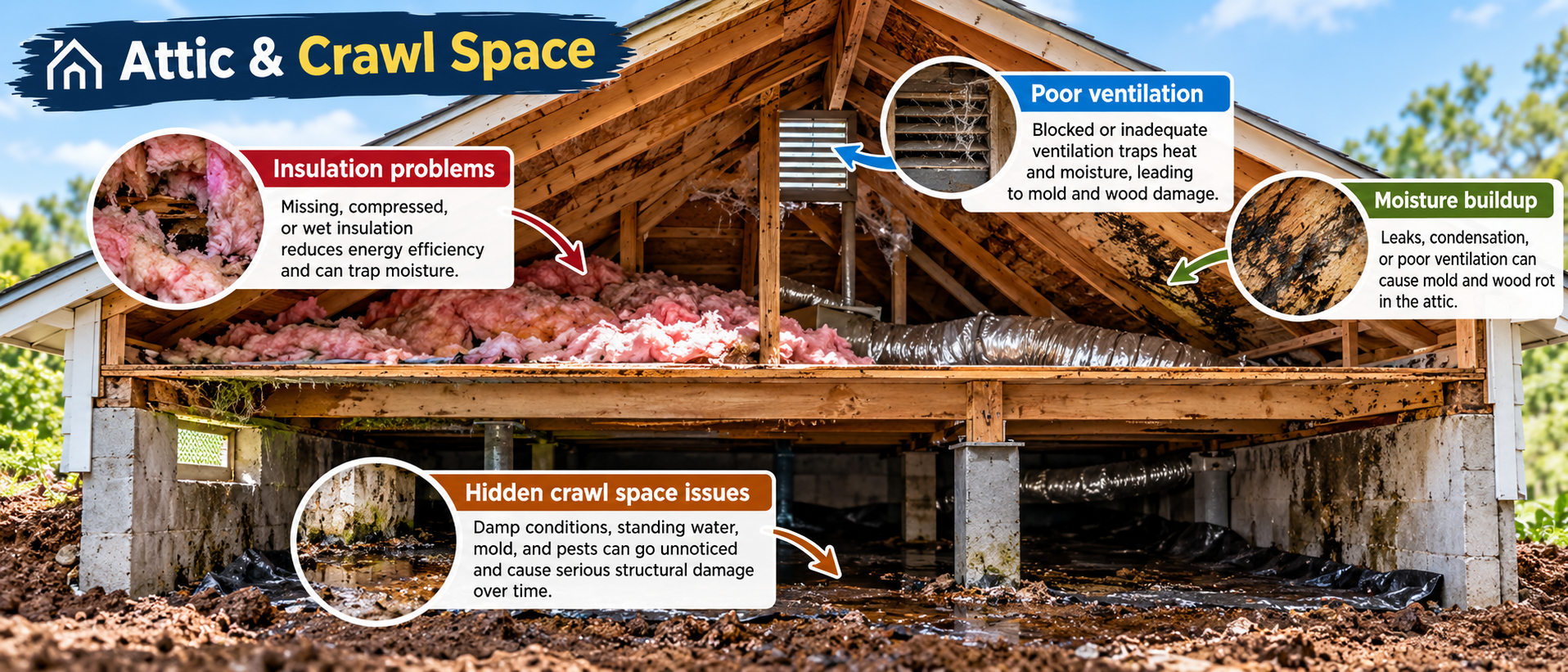
Attics and crawl spaces
Both collect moisture, pests and aging insulation that nobody sees day to day, and inspectors go into both. A crawl space inspection is our number one recommendation before listing: [link: crawl space post].
Trees and plants near the house
Branches and dense plants against the house give rodents a path to the roof and attic, hide what is behind them, and can damage siding. Cut them back from the siding, roofline and foundation, and have a sewer scope done if roots are a concern: [link: sewer scope post].
If something turns up, we can help
As agents we work with contractors and other vendors regularly, and we can share names from our experience and help you compare bids. You always choose who to hire. A broker should not require you to use their vendor, and should not be paid by a vendor you hire.
From Our Own Experience
One of our earliest transactions was for a small, starter home. During the showings and inspection period we noticed that the front yard was “mushy” and we suspected there might be water issues.
Then came a dry period and the lawn firmed up. A day before closing, we had a hard rainstorm and went to inspect the property just to be safe. It looked like there was a moat around the front of the house.
When a neighbor walked by we asked if this was a regular issue, and the neighbor said: “Every time it rains hard.”
Since it was an obvious issue that had not been part of the seller disclosure, we immediately contacted the seller’s agent with the information, photos, and related the conversation with the neighbor. They quickly contacted the seller, and we were able to discuss alternatives and have the issue resolved (at the seller’s cost).
Thinking about buying or selling in the Seattle Area?
Kelly Azzarello Real Estate | Compass
Email: kelly@kellyazzarello.com
Phone: (425) 830-6457
Web: www.kellyazzarello.com
Instagram: instagram.com/kellyazzarello
YouTube: youtube.com/kellyazzarellorealestate
This post is general information about real estate topics. It is not legal, tax or financial advice, and it does not replace a professional inspection. Rules and practices differ by situation and change over time. Check current requirements and talk with a licensed professional, such as an inspector, contractor, attorney or CPA, about your own property.

Presentation: What Sellers Overlook Before Listing
There are things we see every day and no longer notice: odors, dust, burned-out bulbs. Buyers notice them right away, and they are easy to fix.
There are things that are present every day, but we just don’t notice them anymore. Odors. Dust. Mismatched or missing light bulbs. These all make an impression on potential buyers, and are easy to fix.
Remember that buyers usually see the home online before they visit, so the first impression happens on a screen, and that screen is often on a phone, not a computer. If they don’t like what they see in the pictures, they won’t be interested in touring the home.
And even if the pictures are great, when they enter the home they will be looking to confirm that the photos were “real,” and they will notice things you have become “nose blind” to.
These items help improve how the home looks in photos and at showings.
Lighting
Why it matters: Lighting changes how every room looks in showings and photos. Mismatched or dim bulbs make rooms look dated, and a dark home at a showing is a poor experience, especially when a buyer cannot find a switch.
What to do:
- Check every fixture, lamp and switch. Replace burned-out or flickering bulbs, and if a fixture keeps failing, find out why (a loose connection, or a dimmer that does not work with the bulb).
- Use matching bulbs in each room, with the same brightness and color. Many big box home improvement stores now sell LED bulbs that can be switched between brightness and color settings, which makes matching easier.
- If you use home automation to manage your lighting, review the scenes and routines you have set. A buyer who enters a dark home and cannot turn on the lights has a poor experience. Set the lights to be on, or make sure the switches work normally. Open curtains and blinds for showings and photos. It also helps to mention the home automation in the listing, even if you do not describe every feature.
What not to do:
- Do not leave lighting on a routine that turns lights off or dims them during showings.
- Do not mix warm and cool bulbs in the same room.
- Do not exceed a fixture's wattage rating.
The professional-photo test
Why it matters: Photos show clutter, harsh light and dark corners that are easy to miss in person.
What to do:
- Take phone photos of each room from the doorway and from corners, the way a photographer would.
- Look for clutter, cords, reflections, dark corners and personal items.
- Find the cause of each problem you see (a dark corner may need a lamp or a brighter bulb, and clutter needs to go), fix it, and retake the photo.
- Repeat until the photos need no explanation, then have the photographer shoot.
What not to do:
- Do not rely on how the room looks in person.
- Do not wait until the photographer arrives to fix what you can fix now.
- Do not use editing that misrepresents the home.
Deep cleaning and odors
Buyers notice fingerprints, dusty vents and odors within seconds, and odors make them wonder about mold, pets or smoke. Find the source of any odor, deep clean, and do not cover it with air fresheners: [link: odors post].
Declutter and depersonalize
Clutter makes rooms look smaller and hides condition, and buyers open closets and garages. Clear counters, thin out closets, and keep access open to the attic hatch, electrical panel and water heater: [link: decluttering post].
Neutral paint and flooring
Bold colors and worn floors narrow the pool of buyers. Patch, prime and repaint in a light neutral, check what is under old carpet, and in an older home check for asbestos before sanding or tearing out old flooring: [link: paint post] and [link: hardwood floors post].
Curb appeal
The first impression happens online and again at the curb. Fix causes first (such as drainage that stains walkways), then freshen the entry, trim the beds and use a soft wash on siding: [link: curb appeal post].
See the full guide: What Do Sellers Overlook Before Listing? A Short Guide
From Our Own Experience
We were walking through a home with a seller just before listing their home. They had spent weeks cleaning things and packing away clutter.
While Kelly was talking with her, Kelly looked up at the cold air return vent in the ceiling. It was extremely dirty.
The seller was shocked. She had lived in the home for many years, and didn’t recall having ever noticed that cold air return, much less remembered ever cleaning it.
It was easy to correct, and a potential “poor impression” was avoided.
Thinking about buying or selling in the Seattle Area?
Kelly Azzarello Real Estate | Compass
Email: kelly@kellyazzarello.com
Phone: (425) 830-6457
Web: www.kellyazzarello.com
Instagram: instagram.com/kellyazzarello
YouTube: youtube.com/kellyazzarellorealestate
This post is general information about real estate topics. It is not legal, tax or financial advice, and it does not replace a professional inspection. Rules and practices differ by situation and change over time. Check current requirements and talk with a licensed professional, such as an inspector, contractor, attorney or CPA, about your own property.

What Do Sellers Overlook Before Listing? A Short Guide
Most sellers declutter and cut the grass. The items that cost money are the ones they stop noticing. Here are the five areas to check before you list.
Most sellers know to declutter and cut the grass. The items that cost them money are usually the ones they have stopped noticing: a downspout that empties against the foundation, a handful of small repairs, a room that photographs badly. Buyers and their inspectors see these things in the first fifteen minutes.
This guide groups the most common overlooked items into five areas. Each area has its own post with the details, what to do and what not to do.
The five areas
| Area | What is in it | Why it matters | Read more |
|---|---|---|---|
| 1. Water and moisture | Moisture and drainage, attic and crawl space, trees and plants near the house | Water is what inspectors and buyers worry about most. | Read the post |
| 2. Small problems | Deferred maintenance, safety items, roof, exterior, decks and porches | Small problems add up and read as neglect. | Read the post |
| 3. Presentation | Lighting, the photo test, deep cleaning and odors, decluttering, paint and flooring, curb appeal | Buyers see the photos before they see the house. | Read the post |
| 4. Paperwork and records | Service records, documents to gather, permits | Good records support your price and avoid delays. | Read the post |
| 5. Logistics and planning | Show-readiness, where you will live and store things, contractor lead times, an outside opinion, avoiding over-improving | Timing and planning decide how smoothly the sale goes. | Read the post |
If you only do five things
- Find and fix the source of any moisture or drainage problem.
- Walk through the house and finish the small repairs.
- Deep clean, clear out and fix the lighting.
- Gather your service records and documents.
- Make the home easy to show on short notice.
Start with water. Water problems are the ones most likely to turn into a negotiation after the inspection.
If something turns up, we can help
As agents we work with contractors and other vendors regularly, and we can share names from our experience and help you compare bids. You always choose who to hire. A broker should not require you to use their vendor, and should not be paid by a vendor you hire.
Thinking about buying or selling in the Seattle Area?
Kelly Azzarello Real Estate | Compass
Email: kelly@kellyazzarello.com
Phone: (425) 830-6457
Web: www.kellyazzarello.com
Instagram: instagram.com/kellyazzarello
YouTube: youtube.com/kellyazzarellorealestate
This post is general information about real estate topics. It is not legal, tax or financial advice, and it does not replace a professional inspection. Rules and practices differ by situation and change over time. Check current requirements and talk with a licensed professional, such as an inspector, contractor, attorney or CPA, about your own property.

The Number One Thing We Recommend Before You List: Inspect the Crawlspace
The crawlspace is where moisture, pests and failing insulation build up unseen, and a buyer's inspector will check. Here is what to look for and what to do first.
Why the crawlspace is first
The crawlspace is the part of the house nobody looks at, and it is where moisture, pests and failing insulation tend to build up quietly. Buyers' inspectors go in. What they find there can reshape a negotiation, and the fixes can be larger than a seller expects. Finding it first gives you time and options.
What to look for
Standing water, damp soil or a musty smell.
Missing, torn or displaced vapor barrier over the soil.
Wet, sagging or missing insulation.
Blocked or damaged vents.
Signs of pests, such as droppings or chewed material.
Plumbing leaks or stains on the subfloor and framing.
Rot or damage to wood framing.
What to do
Have the space looked at, by you if you are comfortable and it is safe, or by a qualified professional.
Find the cause of any moisture first, such as a leak or drainage problem, and fix it.
Then repair the damage: insulation, vapor barrier and vents, with licensed professionals for pest and plumbing work.
If it cannot be fully fixed before listing, get a written estimate so it can be disclosed and priced.
Keep receipts and reports.
What not to do
Do not add new insulation over a leak or damp area.
Do not seal vents or cover problems.
Do not skip it because nobody has looked in years.
For more detail, read [link: The crawl space and attic nobody has checked in years].
From Our Own Experience
In the Pacific Northwest, crawlspaces are often beneath the entire home. This gives you more to inspect, and more to repair. We also have more damp weather, which can translate into higher moisture levels in these locations. While these are easily managed, they are often ignored for years at a time: “What I can’t see can’t hurt me, right?”
In nearly every case that we list a home we highly recommend having the crawlspace (and attic) inspected. Having this done earlier rather than later will help you identify a vendor, get multiple quotes, and schedule the work at a time that is convenient for you.
In some cases, such as a sudden leak, insurance may help offset the cost of the work. Maintenance and long-term wear are usually not covered, so ask your insurer.
Very close to home, we listed a family member’s home a few years ago. Even though she had the entire crawlspace cleaned and reinsulated a few years earlier when her kitchen was remodeled, upon having a pre-inspection before her home went on the market we discovered pests had again invaded her crawlspace.
Fortunately:
- She was aware from previous experience what to expect.
- She relied on us to help her find a vendor that could do the work quickly and without inflated “emergency” pricing.
- We negotiated a transferable warranty with the vendor, so it could be passed on to the buyer.
If this had been a buyer’s inspection, she may have been unable to react quickly and get the work done, costing her both time and money.
Thinking about selling in The Seattle Area?
Kelly Azzarello Real Estate | Compass
kelly@kellyazzarello.com | (425) 830-6457
Instagram: instagram.com/kellyazzarello
YouTube: youtube.com/kellyazzarellorealestate
Disclaimer
This post is general information about real estate topics. It is not legal, tax or financial advice, and it does not replace a professional inspection. Rules and practices differ by situation and change over time. Check current requirements and talk with a licensed professional, such as an inspector, contractor, attorney or CPA, about your own property.

What Improvements Should I Make Before Selling? What Adds Price, Value and Sellability?
Price, value and sellability are three different goals. Here is what to fix first, what to freshen next, which larger projects to weigh carefully, and what to skip.Three different goals
Sellers often ask what improvements "add value," but there are three separate goals, and the best project for one may not help the others.
· Price: raising what buyers are willing to pay.
· Value: what an appraiser will support, which depends on condition, features and comparable sales.
· Sellability: how many buyers will want the home and how quickly. Removing objections often does more here than adding features.
Fix first: condition and risk
Problems buyers fear come first, because they cost you in negotiation and can cancel a deal. These include water problems, roof and drainage issues, safety items, pest damage, and unpermitted work. They rarely add to the price, but leaving them can reduce it. See our hidden-issues series [LINK] and our checklist of overlooked prep items [LINK].
A word of caution: Washington's contractor registration law (RCW 18.27) generally lets homeowners work on their own property without a contractor registration, but that exemption does not apply to someone who performs contractor work on their own property for the purpose of selling, demolishing or leasing it (see RCW 18.27.090(12) and RCW 18.27.010). In practice, if you are repairing or remodeling to get a home ready to sell or rent, assume the owner exemption may not protect you, and hire a registered contractor for that work. Permits, electrical work and plumbing work have their own separate rules, and unpermitted or poorly done DIY work may also have to be disclosed on the Form 17. To check your situation, contact the Washington Department of Labor & Industries (L&I) or an attorney.
Freshen next: appeal
These changes often have the best return on cost because they change how the home looks and feels in photos and at showings.
· Deep cleaning and odor removal
· Paint in light neutral colors
· Lighting and window coverings
· Decluttering and storage
· Curb appeal and a clean exterior
· Refinishing existing hardwood floors
Decide carefully: larger projects
Kitchen and bath remodels, new hardwood or other flooring throughout and additions that increase square footage are expensive and can take months.
Carpet, paint and hardwood refinishing may be worthwhile as they specifically speak to whether the home will be "move in ready" for a buyer. These can also be done relatively quickly and inexpensively compared to major remodels.
Whether any of these pay back depends on their current condition, the home's price range, your neighborhood and what comparable homes offer. Ask your agent what buyers in your price range expect before starting.
Skip or limit
· Projects chosen for your own taste, such as unusual finishes or colors.
· Upgrades that leave a known defect unfixed.
· Large DIY projects because they always take longer than expected; your time is better spent on other things to prepare for the sale.
· Anything that needs permits that require extensive lead time.
What order should I do these in?
1. Get an agent walk-through and a list of what buyers will notice.
2. Find the causes of any major problems and fix them, especially to mechanical systems like heating, air conditioning, or roofing, plumbing, etc.
3. Do the "appeal" work that costs little and offers bang for the buck.
4. Price larger projects against the likely return, or choose to alter the listing price and/or provide a buyer credit instead.
From Our Own Experience
One of our listings a few years ago was a home in bad shape, with unfinished projects and a lot of deferred maintenance. The sellers were motivated to sell, and needed to get the house on the market quickly. However they didn't have the funds (or credit) to do any major work before listing.
In preparing the home we had to identify:
- What could be fixed within the timeline and budget
- What needed to be disclosed on the Form 17 (Seller Disclosure), and whether it was addressed or not.
- How to keep the sellers focused on what they needed to do to move
- How to address the ability to keep the home "showing ready" while on the market.
Our Approach
After multiple meetings with the sellers, we decided to manage the project ourselves, freeing the sellers to focus on packing and moving.
What we did:
- Identified and managed handyman services to fix the issues that were relatively easy. This included making any non-licensed repairs (doors, painting, etc.) to touch up and create a more updated look.
- Worked with the sellers to identify a vendor to recarpet the home. As part of this process we initiated a three-stage plan with the vendor:
- Vendor removed the carpet and padding one day
- A handyman was employed for a single day to remove squeaks and prime the sub floors (to address pet stains, etc.)
- The carpet vendor returned to install the carpet and padding
- Managed disposal of old, unneeded items (aka junk). This included furniture, yard waste, old tools, unwanted clothing, and other items. For this the disposal company needed to make three separate trips to the transfer station.
- Replaced most lightbulbs to provide consistent, bright quality light throughout the home.
- Yard cleanup with a professional landscaper.
- Managed a set of cleaners to provide a deep clean for the home.
- Professional staging (funded by us) to make the home attractive.
What we didn't do:
- Take on major remodeling or time consuming repairs.
- We documented and disclosed any issues that required licensed repairs that were not critical or safety concerns.
- Priced the home with the understanding that the buyer would need to invest in it to "make it their own". This allowed us to limit the pre-listing investment while providing both the buyer and seller an advantage.
The Result
Even though this home was put on the market in a traditionally difficult time to sell, through pricing and all of the prep work we were able to market the home well. In the end, we had a near record number of showings and open house groups through, and within the weekend had multiple offers and were able to improve the listing price considerably without any contingencies, a quick close, and a plan for the sellers to move on with their lives.
While this was one of the most challenging homes for us to list, and we did a lot more work than we originally planned, we were able to provide the seller with a solution to their issue in a way that was beneficial to them.
Thinking about selling in the Seattle Area?
Kelly Azzarello Real Estate | Compass
kelly@kellyazzarello.com | (425) 830-6457
Instagram: instagram.com/kellyazzarello
YouTube: youtube.com/kellyazzarellorealestate
Disclaimer
This post is general information about real estate topics. It is not legal, tax or financial advice, and it does not replace a professional inspection. Rules and practices differ by situation and change over time. Check current requirements and talk with a licensed professional, such as an inspector, contractor, attorney or CPA, about your own property.

Who Can I Call to Find Out What to Do (and Not Do) Before Selling?
Before you spend money on a sale, start with an agent walk-through. Here is who else can help, what each one does, and what we can and cannot do.
Start with an agent walk-through
Before you spend money, ask an agent to walk through the home with you. An agent sees the home the way buyers will, knows what is likely to come up in an inspection, and can help you decide what to fix, what to leave and in what order.
For more on understanding maintenance or issues before listing, see [LINK to Topic 22: Should I Get a Pre-Listing Inspection?].
For more on which improvements are worth making, see [LINK to Topic 05: What Improvements Should I Make Before Selling?].
At the walk-through, we provide you with:
1. A comparative market analysis at the time of the walk through
2. Ideas for using your home, furnishings and resources to improve the sale
3. Rough cost estimates, plus a list of vendors you can contact to refine them
4. A timeline for getting to market
5. Guidance on what to disclose on the Form 17 seller disclosure, whether or not an issue is repaired
Who else can help, and with what
In Washington, a real estate broker cannot refer or recommend a specific vendor with the expectation that you must use that vendor. You always choose, not us. What we can do is give you a list of possibilities to consider and help you compare them, based on our experiences. Bring this up when we meet.
A home inspector. A pre-listing inspection finds problems before a buyer's inspector does. See our post on whether to get one. [LINK to Topic 22]
Specialty inspectors. A sewer scope, a pest inspection, a chimney inspection or a crawl space review each answer a specific question.
Licensed contractors and tradespeople. They give estimates and do the repairs. Check licenses and registration through the Washington Department of Labor and Industries (lni.wa.gov).
A stager or photographer. They help with the presentation of your home, and are critical as they provide seasoned opinions on how the home will look online AND in person.
A CPA or tax professional. Ask about taxes on the sale, records of improvements, and anything unusual about your situation.
An attorney. For estates, trusts, divorces, title questions or anything legally complicated.
Your mortgage lender. To get a payoff figure, and to plan financing for your next home.
Your HOA or property manager. For HOA documents, rules and fees, if they apply.
Your insurance agent. Especially if the home will be vacant while it is listed.
What we can and cannot do
As agents we work with contractors, suppliers and vendors regularly, and we have helped clients through large repairs. We can help you compare bids and ask the right questions, but who you hire is always your decision.
What not to do
Do not start large projects before getting advice. Some updates cost more than they return.
Do not rely on friends and relatives who are used to the home. They stop seeing problems too.
Do not hire the first contractor available without checking license and insurance.
From Our Own Experience
A big part of what we do is help sellers understand and prepare before they list. Here are some examples, with details changed to protect privacy:
- The Retirees Who Plan Ahead: A couple bought their retirement home last year and plan to sell their current home in our area next spring. We met with them, identified what should stay with the house when they list, asked them to collect information on their updates and upgrades, and began confirming that the title is clear so the home is ready to sell.
- The Estate: When a client's mother passed away, the client asked us to help list the property as an estate sale. The family wanted time to sort through the house and get it ready. Although the house was sold "as is," we still wanted to present a property with charm and value. We helped them identify painters, stagers, cleaners, and other trades to prepare the property and get it on the market. It sold within a week of listing.
- The Couple Heading Back Home: This couple's children are grown, and they have found a property in their native country. We have had ongoing discussions to help identify and prepare for listing their property early in the coming year. This work included assessing what maintenance items to invest in, what to do to improve curb appeal, how to "thin out" their current furnishings to make the home more appealing, and a short consulting meeting with our stager to plan.
Thinking about selling in the Seattle Area?
Kelly Azzarello Real Estate | Compass
kelly@kellyazzarello.com | (425) 830-6457
Instagram: instagram.com/kellyazzarello
YouTube: youtube.com/kellyazzarellorealestate
Disclaimer
This post is general information about real estate topics. It is not legal, tax or financial advice, and it does not replace a professional inspection. Rules and practices differ by situation and change over time. Check current requirements and talk with a licensed professional, such as an inspector, contractor, attorney or CPA, about your own property.

Out of Sight, Out of Mind, Out of Pocket
Have you ever been surprised by a hidden issue in your house? Maybe on that cost you thousands of dollars?
The hidden home problems worth knowing about now, so selling your home later doesn't come with a surprise bill
Here's something we hear a lot: "Everything works, so we're good."
But a toilet that flushes tells you very little about the sewer line underground, and a light that turns on tells you nothing about the panel behind the wall.
The most expensive surprises in a home are usually the ones nobody can see.
And they rarely pick a convenient time. A problem that surfaces in the middle of a sale usually costs more, takes more time, and leaves you with fewer choices than one you found and handled on your own schedule. A buyer's inspector will find it either way. The only question is whether you find it first.
This series walks through the hidden problems one at a time, short and plain, so you can find out what's there, what it might cost, and what to do about it. Whether you plan to sell soon, someday, or never, a little attention now keeps small things small.

How to use this guide
Pick the topic that matches what you're wondering about and jump in. Each post takes only a few minutes to read. Not sure where to start? Begin with the first section below. Those are the hardest problems to see, which is why they tend to surprise people most.
Hidden underground and behind the walls
• Sewer lines and older plumbing (including CPVC): Why a working toilet doesn't mean a healthy pipe, and what to know about CPVC.
• Electrical panel and wiring: Older panels and wiring can worry buyers, lenders, and insurers.
• Buried oil tanks: A tank left in the yard can complicate financing and cost real money to deal with.
• Asbestos (popcorn ceilings and more): What it is, where it hides, and why you shouldn't scrape to find out.
• The crawl space and attic nobody has checked in years: Moisture, pests, and insulation problems that build quietly.
• Pests and wood rot: Damage inside walls and beams that shows up on an inspection report.
Big-ticket items that age out
• Roof age and condition: What an aging roof tells a buyer's inspector, and what it tells you.
• Water heater age: A five-minute check that can save you a flooded utility room.
• Broken windows and failed seals: Fogging, condensation, and windows that won't open or close.
• Deferred exterior maintenance: Small things that invite bigger problems.
What buyers notice the moment they walk in
• Odors: Pet, smoke, and cooking smells that settle into carpet, ducts, and insulation.
• Highly stylized paint or decor: Bold choices that can narrow your buyer pool.
The paperwork side
• Unpermitted work: The paperwork problem that can stall a closing.
• Should you inspect before you sell? Pre-sale inspections and disclosure basics.
• Which add-on inspections are worth ordering? Sewer scope, pest, chimney, and more, and when each makes sense.
Why finding out early matters
When a hidden problem shows up at the last minute, everyone is learning about it at the same time, and that's when it gets stressful. Problems found early, with real estimates in hand, are much easier to work through. You choose the contractor, the timing, and the budget, instead of being backed into a corner.
If something turns up, we can help
Most homeowners deal with a problem like these once in a lifetime, if ever. Hopefully you'll never need to reline a sewer line, replace a panel, or dig up a buried tank. If you do, it helps to have someone who has been through it before.
As agents, we work with contractors, suppliers, and vendors all the time, and we've helped clients through situations like these. We can't recommend specific companies, but we can help you work out what kind of professional you need, what questions to ask, and how to compare bids, so you find the right fit for your situation.
Whether you're selling soon, someday, or not at all, we're glad to be a resource.
Kelly Azzarello Real Estate | Compass
kelly@kellyazzarello.com | (425) 830-6457 | www.kellyazzarello.com
This series is general information, not legal or financial advice. Disclosure rules and licensing requirements differ by state.

Out of Sight series banner.