


Who Can I Call to Find Out What to Do (and Not Do) Before Selling?
Before you spend money on a sale, start with an agent walk-through. Here is who else can help, what each one does, and what we can and cannot do.
Start with an agent walk-through
Before you spend money, ask an agent to walk through the home with you. An agent sees the home the way buyers will, knows what is likely to come up in an inspection, and can help you decide what to fix, what to leave and in what order.
For more on understanding maintenance or issues before listing, see [LINK to Topic 22: Should I Get a Pre-Listing Inspection?].
For more on which improvements are worth making, see [LINK to Topic 05: What Improvements Should I Make Before Selling?].
At the walk-through, we provide you with:
1. A comparative market analysis at the time of the walk through
2. Ideas for using your home, furnishings and resources to improve the sale
3. Rough cost estimates, plus a list of vendors you can contact to refine them
4. A timeline for getting to market
5. Guidance on what to disclose on the Form 17 seller disclosure, whether or not an issue is repaired
Who else can help, and with what
In Washington, a real estate broker cannot refer or recommend a specific vendor with the expectation that you must use that vendor. You always choose, not us. What we can do is give you a list of possibilities to consider and help you compare them, based on our experiences. Bring this up when we meet.
A home inspector. A pre-listing inspection finds problems before a buyer's inspector does. See our post on whether to get one. [LINK to Topic 22]
Specialty inspectors. A sewer scope, a pest inspection, a chimney inspection or a crawl space review each answer a specific question.
Licensed contractors and tradespeople. They give estimates and do the repairs. Check licenses and registration through the Washington Department of Labor and Industries (lni.wa.gov).
A stager or photographer. They help with the presentation of your home, and are critical as they provide seasoned opinions on how the home will look online AND in person.
A CPA or tax professional. Ask about taxes on the sale, records of improvements, and anything unusual about your situation.
An attorney. For estates, trusts, divorces, title questions or anything legally complicated.
Your mortgage lender. To get a payoff figure, and to plan financing for your next home.
Your HOA or property manager. For HOA documents, rules and fees, if they apply.
Your insurance agent. Especially if the home will be vacant while it is listed.
What we can and cannot do
As agents we work with contractors, suppliers and vendors regularly, and we have helped clients through large repairs. We can help you compare bids and ask the right questions, but who you hire is always your decision.
What not to do
Do not start large projects before getting advice. Some updates cost more than they return.
Do not rely on friends and relatives who are used to the home. They stop seeing problems too.
Do not hire the first contractor available without checking license and insurance.
From Our Own Experience
A big part of what we do is help sellers understand and prepare before they list. Here are some examples, with details changed to protect privacy:
- The Retirees Who Plan Ahead: A couple bought their retirement home last year and plan to sell their current home in our area next spring. We met with them, identified what should stay with the house when they list, asked them to collect information on their updates and upgrades, and began confirming that the title is clear so the home is ready to sell.
- The Estate: When a client's mother passed away, the client asked us to help list the property as an estate sale. The family wanted time to sort through the house and get it ready. Although the house was sold "as is," we still wanted to present a property with charm and value. We helped them identify painters, stagers, cleaners, and other trades to prepare the property and get it on the market. It sold within a week of listing.
- The Couple Heading Back Home: This couple's children are grown, and they have found a property in their native country. We have had ongoing discussions to help identify and prepare for listing their property early in the coming year. This work included assessing what maintenance items to invest in, what to do to improve curb appeal, how to "thin out" their current furnishings to make the home more appealing, and a short consulting meeting with our stager to plan.
Thinking about selling in the Seattle Area?
Kelly Azzarello Real Estate | Compass
kelly@kellyazzarello.com | (425) 830-6457
Instagram: instagram.com/kellyazzarello
YouTube: youtube.com/kellyazzarellorealestate
Disclaimer
This post is general information about real estate topics. It is not legal, tax or financial advice, and it does not replace a professional inspection. Rules and practices differ by situation and change over time. Check current requirements and talk with a licensed professional, such as an inspector, contractor, attorney or CPA, about your own property.

“As-Is”: What It Does and Does Not Mean
As-is" does not mean "no inspection" and it does not mean "no negotiating." Here is what the phrase really means in Washington.
The quick take
As-is generally means the seller does not plan to make repairs or give credits. It does not stop you from inspecting the home, and it does not erase the seller’s disclosure duties. It does mean you take the home in its current condition.
What "as-is" usually means
When a listing says "as-is," the seller is telling you they do not plan to make repairs or give credits for the condition of the home. You are buying it the way it stands today, and any work that comes up after that is yours to handle.
What it does not mean
• It does not mean you cannot inspect. You can still hire an inspector, and we generally recommend it.
• It does not necessarily mean you cannot negotiate. A seller may still agree to a price change after you learn what is wrong, especially if the home would otherwise go back on the market.
• It does not automatically cancel the seller’s legal duties. In Washington, most residential sellers must provide a Seller Disclosure Statement, known as Form 17.
The seller disclosure still matters
Form 17 asks the seller to answer questions about the property, such as roof, plumbing, and known defects. Some sellers are exempt, such as estate sales, bank-owned properties, trustees, and some new construction. Exempt sellers may still provide a disclosure voluntarily. When a disclosure is required and the buyer receives it, the buyer generally has three business days to rescind the agreement. Details depend on the contract, so review the timing with your agent.
Keep in mind that Form 17 only covers what the seller knows. It does not replace an inspection.
Washington is a "buyer beware" state
Buyers of resale homes generally do not get a warranty from the seller, and it can be hard to hold a seller responsible for a defect unless they misrepresented it. That is why inspection matters, and why waiving an inspection can leave you with limited recourse if something turns up later.
From our experience
We have seen as-is homes that were true opportunities, and others where the inspection found problems that changed the buyer’s plan. Buyers who budgeted for surprises, and who knew their walk-away number before they wrote an offer, were the most comfortable either way.
If you are buying an as-is home
• Inspect the home, and consider specialists such as a sewer scope or a roof or foundation expert if the inspector suggests it.
• Read the seller disclosure carefully, if there is one, and note the three-day window.
• Set aside a repair budget before you offer, and decide what you will do if the number is higher than expected.
• Ask us about the home’s history and about nearby sales.
If you are selling as-is
Selling as-is can simplify things when you do not want to manage repairs, and it can attract buyers who are comfortable with projects. It works best when the price reflects the condition. A pre-listing inspection can help you set expectations, and your agent can walk you through your disclosure duties.
Want the full list of terms?
See our plain-English glossary of real estate terms: www.kellyazzarello.com/jargon
Questions? We are glad to help.
If any of this raises a question about your own situation, reach out. If you need an answer faster, call and we will talk it through.
Sources and credits
We looked to NWMLS first and then Compass. Neither publishes a plain-language definition of this term, so the points above draw on the sources below, in our own words. General information only, not legal or financial advice. Confirm current details with your agent or lender, since forms and rules change.
Madrona Group, What Is Form 17 in Washington

The Appraisal Gap: What Happens When the Home Appraises Low
You agreed to a price, but the appraisal came in lower. Here is what that gap means, how the math works, and what your options are.
The quick take
An appraisal gap is the difference between the price you agreed to pay and a lower appraised value. The lender bases your loan on the appraisal, so you generally need to cover the difference, renegotiate, or walk away, depending on your contract.
What an appraisal gap is
When you buy with a loan, the lender orders an appraisal. A licensed appraiser estimates what the home is worth. The lender will only lend against the appraised value or the price, whichever is lower. If the appraisal comes in below the price you agreed to pay, the difference is the appraisal gap.
It is more common in competitive markets, in rising markets, with unusual homes, and where few similar homes have sold recently. Redfin reports that roughly 8% of appraisals come in below the contract price.
A simple example
This is a simplified example with round numbers. Your loan type and lender rules can change the math.
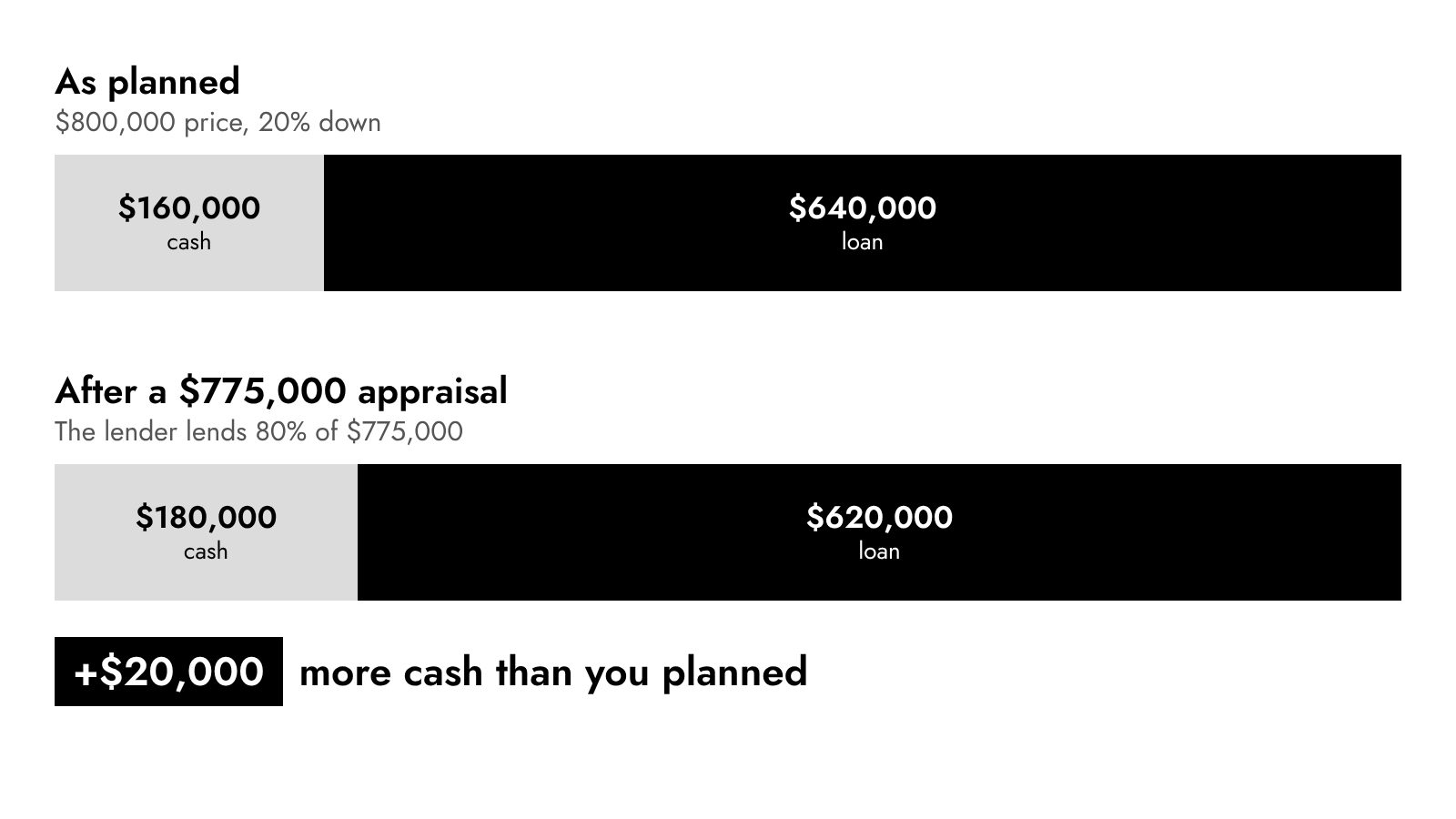
• You agree to buy a home for $800,000 and plan to put 20% down, which is $160,000, with a $640,000 loan.
• The home appraises at $775,000, which is $25,000 below the price.
• The lender will lend 80% of $775,000, or $620,000, instead of $640,000.
• To close at $800,000, you need $180,000 in cash instead of $160,000. That is $20,000 more than you planned.
Your options
Renegotiate: Ask the seller to lower the price to the appraised value, or to meet in the middle. Sellers sometimes agree, especially if the home would otherwise go back on the market.
Cover the gap: Pay the difference in cash from savings or other eligible funds. This keeps the deal alive, and it is a choice about how much you are willing to pay above appraised value.
Challenge the appraisal: Your lender may be able to request a reconsideration of value, if you have strong comparable sales or evidence of errors. There is no guarantee it will change.
Walk away: If your contract has an appraisal or financing contingency and you act on time, you may be able to cancel and recover your earnest money. Without that protection, you may risk the deposit.
Gap clauses in offers
In competitive situations, buyers sometimes include language promising to cover some or all of a low appraisal. It can make an offer more attractive, and it also means you take on the risk. If you consider it, decide the most you are comfortable paying and put that number in writing.
From our experience
We have seen buyers decide, in advance, that they would cover a specific amount over appraisal, and others decide they would not cover any. Both can be the right call. What matters is deciding before you are in the middle of a deal, with the clock ticking.
What this means if you are selling
A low appraisal can slow or break a sale. A well-supported price, with recent comparable sales that fit your home, makes a low appraisal less likely. Your agent can help you prepare, and can talk through what to do if the number comes in short.
Questions to ask your agent
• Does my offer have an appraisal or financing contingency, and when does it expire?
• How much cash could I bring if the appraisal comes in low?
• What comparable sales support this price?
Want the full list of terms?
See our plain-English glossary of real estate terms: www.kellyazzarello.com/jargon
Questions? We are glad to help.
If any of this raises a question about your own situation, reach out. If you need an answer faster, call and we will talk it through.
Kelly Azzarello Real Estate | Compass
Email: kelly@kellyazzarello.com
Phone: (425) 830-6457
Sources and credits
We looked to NWMLS first and then Compass. Neither publishes a plain-language definition of this term, so the points above draw on the sources below, in our own words. General information only, not legal or financial advice. Confirm current details with your agent or lender, since forms and rules change.
Redfin, What Is an Appraisal Gap?
Madrona Group, What Is a Financing Contingency in Washington

Earnest Money: Your Good-Faith Deposit, Explained
Earnest money is not an extra fee. It is a deposit toward your purchase, and it can be at risk if you miss a deadline. Here is how it works
The quick take
Earnest money is a good-faith deposit you make after the seller accepts your offer. It is credited toward your purchase at closing. You can lose it if you walk away for a reason the contract does not protect, so deadlines matter.
What earnest money is
Earnest money is a deposit that shows the seller you are serious. You give it after your offer is accepted, and if the sale closes, it is credited toward the money you owe at closing, usually your down payment and closing costs. It is not an extra fee. It is a part of your purchase money that moves in early.
How much is typical?
There is no legal minimum or maximum in Washington, so the amount is negotiated. The sources we looked at put typical deposits in a range from about 1% to 5% of the purchase price, and in competitive situations a larger deposit can make an offer look stronger. On an $800,000 home, 1% to 5% would be $8,000 to $40,000. Your agent can help you pick an amount that fits your situation.
| Home price | 1% | 2% | 3% | 5% |
|---|---|---|---|---|
| $500,000 | $5,000 | $10,000 | $15,000 | $25,000 |
| $800,000 | $8,000 | $16,000 | $24,000 | $40,000 |
| $1,000,000 | $10,000 | $20,000 | $30,000 | $50,000 |
Examples only. In Washington the amount is negotiated, with no legal minimum or maximum. Your agent can help you choose a number that fits your situation.
When is it due, and who holds it?
The timing is spelled out in your purchase and sale agreement, and it is usually within a couple of days after both sides have signed. Missing that deadline can put you in default, so plan ahead and know how you will pay.
You do not hand the money to the seller. A neutral party holds it, typically the escrow company, or in some cases the buyer’s brokerage in a trust account. Escrow generally cannot release the funds to either side without both parties’ written agreement or a court order.
When you get it back, and when you can lose it
Usually refundable: If you cancel under a contingency in your contract, such as inspection or financing, and you give notice on time and in the right form, your deposit is generally returned.
At risk: If you walk away for a reason the contract does not cover, if you miss a contingency deadline, or if you waived a protection to make your offer more competitive.
The standard Washington purchase and sale form also asks the parties to choose how a buyer default is handled. One option limits the seller’s remedy to keeping the deposit. The other lets the seller pursue additional remedies. Which one is checked in your contract matters, so read that section with your agent.
From our experience
We have seen disputes over a deposit that came down to a missed deadline or a notice that was not delivered correctly. The safest habit is to put every contingency date on a calendar the day your offer is accepted, and to deliver notices exactly as the contract says.
Tips for buyers
• Know the deadline and have the funds ready before you write the offer.
• Put every contingency deadline on your calendar on day one.
• Waiving protections to win an offer also puts your deposit at risk. Talk it through first.
• If there is a disagreement, do not assume you can simply ask for the money back. Both sides usually need to sign off, so get advice early.
This post is general information, not legal advice. For a specific default or dispute, a Washington real estate attorney is the right call.
Want the full list of terms?
See our plain-English glossary of real estate terms: www.kellyazzarello.com/jargon
Questions? We are glad to help.
If any of this raises a question about your own situation, reach out. If you need an answer faster, call and we will talk it through.
Kelly Azzarello Real Estate | Compass
Email: kelly@kellyazzarello.com
Phone: (425) 830-6457
Sources and credits
We looked to NWMLS first and then Compass. Neither publishes a plain-language definition of this term, so the points above draw on the sources below, in our own words. General information only, not legal or financial advice. Confirm current details with your agent or lender, since forms and rules change.