

Getting Outside in Sammamish
Between city parks, county preserves, three lakes, and an internationally recognized mountain bike park, Sammamish’s outdoor life is baked into the geography. Here’s the full rundown.
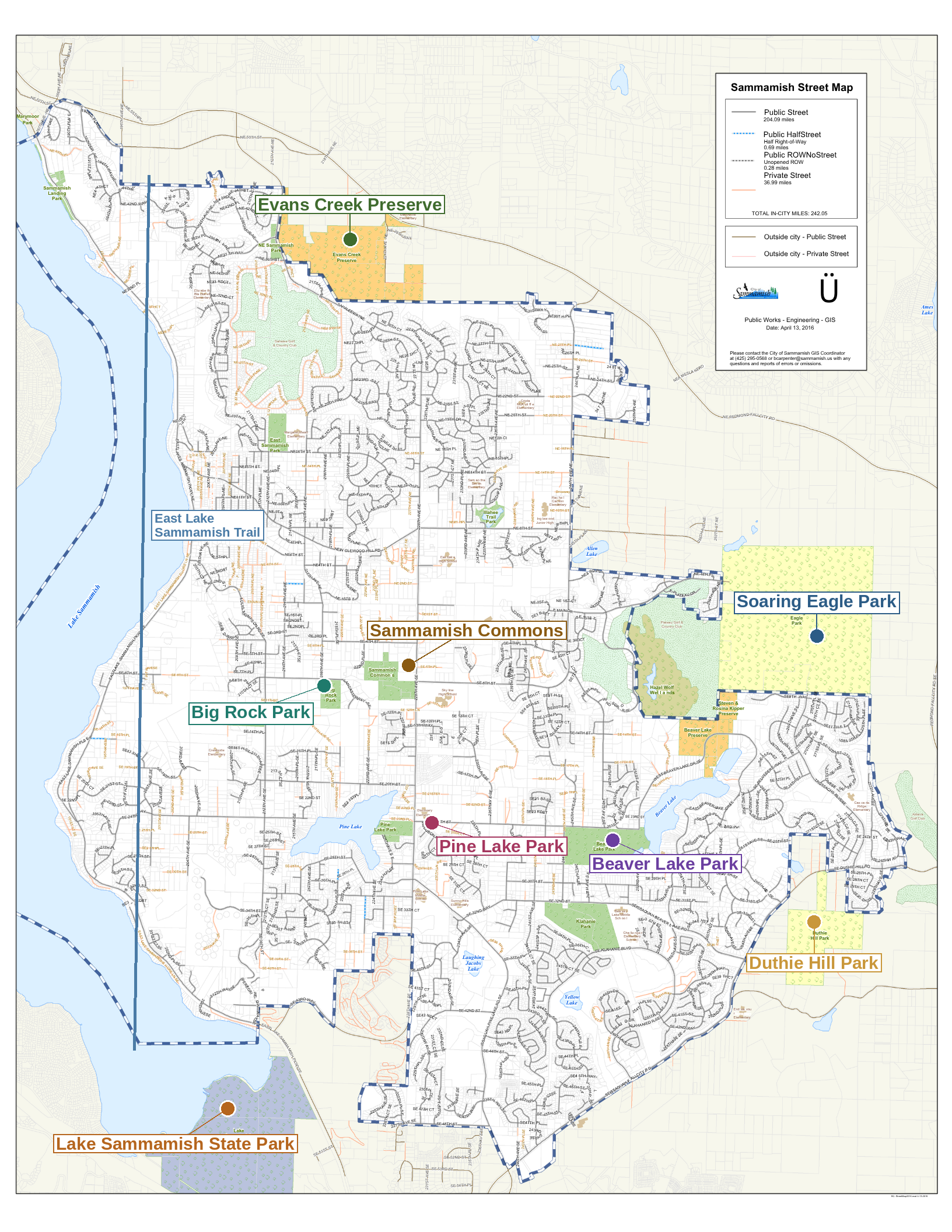
Sammamish’s outdoor life isn’t an afterthought, it’s baked into the geography. The city sits on a plateau bounded by a lake on one side and a valley on the other, and between city parks, county preserves, and a genuinely world-class mountain bike park, there’s a lot to do without ever getting in the car.
Sammamish Commons
Sammamish Commons is the closest thing this city has to a downtown, and it’s a natural place to start. City Hall, the library, sport courts, a splash pad open Memorial Day through Labor Day, a weekly farmers market, and the city’s Fourth on the Plateau celebration all happen on the same civic green space, with the Sammamish Community YMCA right there too.
Youth sports, well covered
Soccer and baseball are the best-served sports in Sammamish, with multiple organizations covering every level of commitment: Issaquah FC for soccer, Eastlake Little League for baseball, plus Eastlake Youth Football and Eastlake Youth Lacrosse. The Sammamish Community YMCA adds recreational leagues in basketball, volleyball, and more, alongside a full-size lap pool, gymnasium, and an outdoor water slide. The Boys & Girls Clubs of King County run additional year-round leagues in basketball, volleyball, flag football, track and field, and baseball, with summer sports camps. Sammamish itself doesn’t host many dedicated club teams, so families chasing a serious competitive club program, in swimming, soccer, basketball, and volleyball especially, typically end up in Issaquah’s or Redmond’s club systems instead, an easy enough drive, but worth knowing going in.
Cricket has a real, organized presence here too, at both the youth and adult level. Lake Sammamish State Park has two dedicated cricket fields used by adult leagues including the Northwest Cricket League and Washington Cricket League, and youth cricket runs through the Seattle Youth Cricket League, which uses grounds at Klahanie Park and Eastlake High School in addition to the state park fields. It’s a good example of how the city’s park system has grown to match the interests of its genuinely international community.
A trail network that actually connects
The backbone is the East Lake Sammamish Trail, an 11-mile paved, multi-use path running along the lake’s eastern shore from Marymoor Park in Redmond, through Sammamish, down to Issaquah. It’s flat, easy, and about as central to daily life here as a road, people use it to walk the dog, commute by bike, or just get outside for twenty minutes after work.
Beyond that paved spine, Sammamish backs up to a genuinely large amount of forested open space:
Soaring Eagle Regional Park, 600 acres with about 12 miles of trails through mature forest, land that’s been used as a travel corridor for thousands of years. It’s popular with both hikers and mountain bikers, and the trails range from a quarter-mile stroll to a 6-mile loop.
Evans Creek Preserve, a 179-acre former farm restored into meadow, wetland, and forested upland trails through more than 6,500 volunteer hours of restoration work. Boardwalks cross the wetter sections, and it’s an easy, family-friendly walk.
Big Rock Park, smaller and more tucked into a residential neighborhood, with a well-loved treehouse, garden, and a network of trails leading up to the namesake rock outcropping.
Three lakes built for summer
Lake Sammamish State Park, 500 acres at the south end of the lake, with two swimming beaches, picnic areas, a boat launch, and paddleboard and kayak rentals on site.
Pine Lake Park, smaller and more neighborhood-scaled, with a lifeguarded swimming area in summer, a fishing pier, and a soccer field and basketball court alongside the water.
Beaver Lake Park, covered in more depth in our neighborhoods post, rounds out the trio: 83 acres with year-round fishing, a free lifejacket loaner program in summer, a non-motorized boat launch, a large fenced off-leash dog area, and its own forested trail loop. The historic Beaver Lake Lodge, a holdover from the site’s resort era, still stands and is available for private event rentals.
A genuinely world-class mountain bike park
Duthie Hill Mountain Bike Park deserves its own mention. It’s 120 acres of purpose-built trails, roughly 9 miles worth, built and maintained by the Evergreen Mountain Bike Alliance through years of volunteer labor, and it has real international recognition as one of the best purpose-built trail networks in the Pacific Northwest. There’s a full progression here: smooth, flowy cross-country routes with bermed turns for beginners, all the way up to technical rock gardens, drops, and jump lines for advanced riders, plus regular skills clinics for kids. It sits just outside city limits on Issaquah-Fall City Road, close enough that it functions as a Sammamish amenity in every practical sense.
Golf, at three very different clubs
Sammamish has an unusual concentration of private golf for a city this size. Sahalee Country Club has hosted a PGA Championship and other major tournaments on its 27 holes of Ted Robinson-designed fairways. Aldarra Golf Club, on the site of the old Boeing family cattle farm, is a Tom Fazio design known for its condition and Cascade views. The Plateau Club rounds out the trio as a third private option on the plateau. None of these are public-access courses, but their presence shapes the character of the neighborhoods built around them, Sahalee and Aldarra both.
Where it all sits
This is the fifth post in our Why Sammamish? series. Up next: the top community events that bring the plateau together each year.
Kelly Azzarello Real Estate | Compass 📧 kelly@kellyazzarello.com 📞 (425) 830-6457 🌐 kellyazzarello.com
8 Sammamish Neighborhoods Worth Knowing
Sammamish isn’t one uniform suburb, it’s a collection of genuinely distinct neighborhoods. Here’s an introduction to 8 of them, from the largest (Klahanie) to the most exclusive (Aldarra).
Sammamish isn’t organized around one downtown, it’s organized around its neighborhoods. Each one has its own character, its own HOA and amenities, and often its own school assignment, so “moving to Sammamish” really means picking which of these you want to land in. Here are eight worth knowing, from the largest and most established to some of the newer, more exclusive pockets. Klahanie and Trossachs each get a fuller, standalone post later in this series, so consider these the introductions.
Klahanie
Klahanie is Sammamish’s largest neighborhood by a wide margin, with more than 3,000 homes in the city’s southwestern corner. It came into the city relatively late, annexed in 2016 after decades as its own unincorporated community, and it still has a distinct, self-contained feel: its own parks, pools, trail network, and retail center. Its location gives it one practical advantage over much of the rest of the plateau: proximity to I-90, which makes the commute toward Issaquah, Bellevue, and Seattle noticeably easier than from neighborhoods further north. It’s governed by a single master HOA: klahanie.com.
Trossachs
Trossachs sits on the plateau’s eastern side, known for upscale custom homes on larger lots, mature landscaping, and views toward the Cascades. It’s a newer, more deliberately planned community than some of Sammamish’s older neighborhoods, and it draws buyers looking for more space and privacy without leaving the city. It sits near Beaver Lake Park and Duthie Hill Mountain Bike Park, so outdoor access is part of the appeal. It has an HOA, though it appears to cover several smaller sub-communities (including at least one standalone condo association) rather than a single unified site.
Pine Lake
Ask longtime Sammamish residents which neighborhood they think of first, and Pine Lake comes up constantly. It’s centered on its namesake lake and the adjacent Pine Lake Park, giving it a genuine, walkable community anchor rather than just a name on a map. It’s centrally located, with established streets and nearby shopping, and it’s often the neighborhood people point to as classic, representative Sammamish living. I didn’t find a single HOA covering Pine Lake as a whole; it’s more likely a collection of smaller plat-level associations.
Sahalee
Sahalee is built around the private Sahalee Country Club and its championship golf course, which has hosted a PGA Championship and other major tournaments. It’s a gated community with mature evergreens, large lots, and a quiet, manicured character that’s distinct from the rest of the city. It falls in the Lake Washington School District, and it draws buyers specifically looking for privacy and a country-club lifestyle. The residential area is governed by the Sahalee Maintenance Association: sahaleehomes.com, separate from the private country club itself.
Beaver Lake
Beaver Lake has a more tucked-away feel than most of Sammamish, heavily wooded streets, larger lots, and a setting that reads more like a Pacific Northwest retreat than a typical suburban development. Homes range from modest cabins to larger estates, and the neighborhood centers on the lake and its adjacent city park. It’s a good fit for buyers who want quiet and nature without actually being far from anything. A Beaver Lake HOA turns up in local directory listings, but I couldn’t confirm an official site for it, worth verifying directly if it matters for a specific property.
Timberline
Timberline sits at the north end of the city, between Lake Sammamish and the Sahalee Golf Course, a smaller neighborhood (roughly 200 homes) known for its wooded setting and family-friendly streets. Its location gives it easy access to both the lake and the amenities clustered further south, while staying quieter than the more central parts of the plateau. It’s governed by the Timberline Ridge HOA: timberlineridge.org.
Inglewood
Inglewood sits on Sammamish’s western slope, and its main draw is right there in the geography: elevation and orientation that give a lot of homes real Lake Sammamish views. It’s an established neighborhood with a mix of home styles, prized for that view potential and its proximity to schools and parks along the western edge of the plateau. No HOA reference turned up in what I searched, so this may be a non-HOA neighborhood, worth confirming for any specific address.
Aldarra
Aldarra is Sammamish’s most exclusive address by most measures: a private, gated community built around the Tom Fazio-designed Club at Aldarra golf course, on what was once the 400-acre Aldarra Farm, a working cattle ranch owned by William Boeing Jr. Homes here are large custom estates on substantial lots, with protected land and Cascade Mountain views, and the neighborhood maintains its own private parks for residents. It’s a small, high-end pocket on the plateau’s eastern slopes rather than a large or typical neighborhood, but it’s a genuine part of the Sammamish story. It’s governed by the Aldarra Estates HOA: aldarraestates.org.
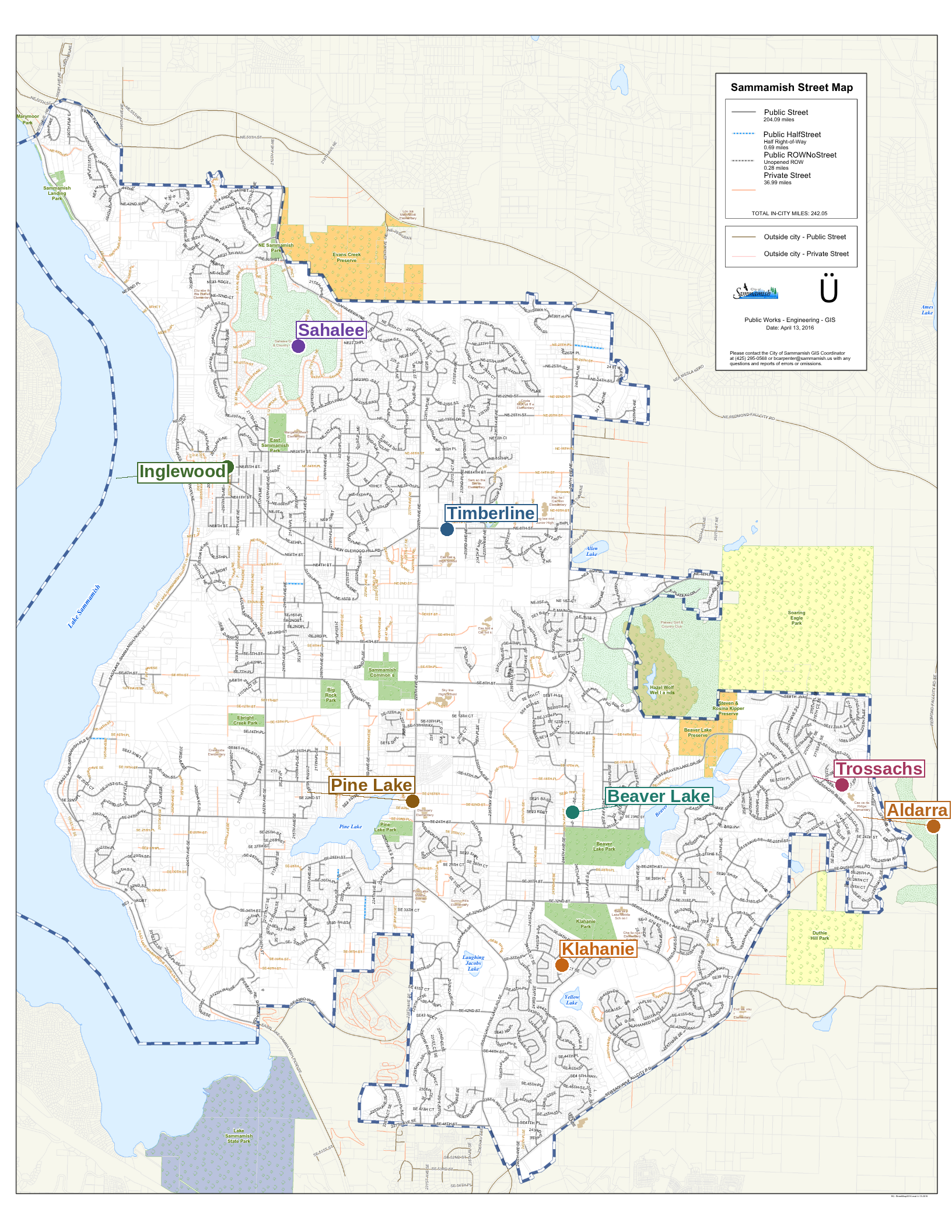
Roughly where they sit
Map showing the real, coordinate-based locations of eight Sammamish neighborhoods: Sahalee and Timberline in the north, Inglewood on the western slope near Lake Sammamish, Pine Lake and Beaver Lake in the center-south, Trossachs and Aldarra to the east, and Klahanie to the south
Marker positions are plotted from real coordinates for each neighborhood, so their relative locations are accurate. The city outline itself is illustrative, not an official boundary, and these points mark a reference location within each neighborhood, not its full extent.
A note on boundaries
The map above marks a reference point in each neighborhood, not its actual footprint, and HOA coverage noted above comes from each association’s own site where one exists. For an exact, address-level boundary on any of these eight, the authoritative source is the King County Assessor’s parcel and plat records, not a neighborhood website or blog post; that’s a good next step to formalize if this series eventually gets an appendix with real boundary maps.
This is the fourth post in our Why Sammamish? series. Up next: getting outside on the plateau, sports, trails, and everyday outdoor life. We’ll also be publishing standalone deep-dive posts on Klahanie and Trossachs later in the series.
Kelly Azzarello Real Estate | Compass 📧 kelly@kellyazzarello.com 📞 (425) 830-6457 🌐 kellyazzarello.com
Great Schools, Two Districts: How Education Works in Sammamish
Sammamish isn’t served by one school district, it’s split almost down the middle between two highly-rated ones. Here’s what that actually means for families house-hunting on the plateau.
Ask any Sammamish parent what drew them here and schools are almost always near the top of the list. What surprises a lot of newcomers is that “Sammamish schools” isn’t one system. Drive down 228th Avenue, the plateau’s main north-south corridor, and in about a mile you’ll pass two public high schools from two entirely different school districts, with a private school sitting right between them.
Two full-size districts, split down the middle
The Lake Washington School District (LWSD) serves the northern half of Sammamish, while the Issaquah School District (ISD) serves the south. Both are large, well-regarded districts in their own right, not small satellite systems built around Sammamish. LWSD is the second-largest school district in Washington State, serving roughly 31,000 students across Redmond, Kirkland, and Sammamish. ISD serves around 18,700 students across Sammamish, Issaquah, and parts of Bellevue and Renton, and ranks in the top 5% of Washington districts for overall performance. Both carry an A+ rating from Niche.
That’s the part worth sitting with: this isn’t one strong district and one weak one that the city happens to straddle. It’s two large, highly-rated districts that each treat a slice of Sammamish as a core part of their territory.
What that looks like on the ground
North Sammamish (LWSD): - Eastlake High School, located right on 228th Avenue NE in Sammamish - Renaissance School of Art and Reasoning, a small choice middle school housed on the Eastlake campus, plus Inglewood Middle School - Elementary schools serving the area include Elizabeth Blackwell, Rachel Carson, Christa McAuliffe, Margaret Mead, and Samantha Smith - Tesla STEM High School, LWSD’s selective, lottery-based STEM magnet, is technically located just across the city line in Redmond, but it’s a real option for Sammamish LWSD families since admission is district-wide by lottery, not by neighborhood zoning
South Sammamish (ISD): - Skyline High School, on 228th Avenue SE, about a mile south of Eastlake - Middle schools serving the area include Beaver Lake, Pacific Cascade, and Pine Lake - Elementary schools serving the area include Cascade Ridge, Cedar Trails, Challenger, Creekside, Discovery, Endeavour, and Sunny Hills
And in between the two comprehensive high schools sits Eastside Catholic, a private secondary school that relocated to Sammamish in 2008. It’s a genuinely unusual stretch of road: two full-size public high schools from different districts and a well-known private school, all within about a mile of each other.
Both flagship high schools perform well above state averages. Skyline consistently ranks in the top 3% of Washington high schools, with an IB program and strong graduation rates. Issaquah School District as a whole ranks in the top 5% of Washington districts across math, reading, science, and graduation rate.
The small pocket that’s neither
There’s one more wrinkle. A small area in the northeast corner of Sammamish, roughly 65 homes off 244th Avenue NE, actually falls into a third district: the Snoqualmie Valley School District, assigning those students to Fall City Elementary, Chief Kanim Middle School, and Mount Si High School. It’s a legacy of how boundaries were drawn long before the city incorporated, and it’s been a genuine point of friction locally: residents there have petitioned four separate times since 2003 to be moved into LWSD, since the neighborhood is surrounded on three sides by LWSD territory. The most recent petition was denied in late 2025, and as of early 2026 a group of parents is appealing that denial in King County Superior Court. It’s an active legal process, not a scheduled boundary change, so there’s no set timeline for how it resolves, but it’s worth knowing about if a specific address in that corner of the city matters to your decision.
Is this actually unusual for the Seattle area?
Sort of, and sort of not. Plenty of Eastside cities technically touch more than one district at their edges. Newcastle, for instance, has slivers in the Bellevue, Renton, and Issaquah districts. But most Eastside cities are still clearly anchored by one dominant district: Bellevue is essentially all Bellevue School District, Redmond and Kirkland are essentially all LWSD, and Issaquah proper is essentially all Issaquah School District.
What makes Sammamish different is the scale of the split. This isn’t a small edge case, it’s a genuine, roughly even division of a single city between two major, well-regarded districts, plus that small Snoqualmie Valley pocket on top. Among Eastside cities of a similar size, that kind of near 50/50 divide is more the exception than the rule.
Where the districts sit relative to each other
Schematic map showing the City of Sammamish split between the Lake Washington School District to the north and Issaquah School District to the south, divided roughly along SE 8th Street, with a small Snoqualmie Valley School District pocket in the northeast corner, and Eastlake High School, Eastside Catholic, and Skyline High School marked along the 228th Avenue corridor
A schematic look at how the two main districts divide the city, not an official boundary map. The real dividing line zigzags street by street rather than running perfectly straight, but this gives a sense of the geography: LWSD to the north, ISD to the south, roughly along SE 8th Street, with the small Snoqualmie Valley pocket tucked into the northeast corner.
For the real, address-level boundary, both districts publish official boundary lookup tools, and that’s always worth checking directly for any specific property:
Lake Washington School District: lwsd.org/students-families/families/attendance-areas
Issaquah School District: isd411.org/enrollment/whats-my-school
This is the third post in our Why Sammamish? series. Up next: getting outside, sports, trails, and everyday outdoor life on the plateau.
Kelly Azzarello Real Estate | Compass 📧 kelly@kellyazzarello.com 📞 (425) 830-6457 🌐 kellyazzarello.com
The History of Sammamish: From Plateau Farms to City
Sammamish didn’t exist as a city until 1999, but the plateau’s story goes back to 1877. Here’s the real history: the mill town, the Redmond/Issaquah identity split, incorporation day, and the Klahanie annexation saga.
Sammamish is one of the youngest cities in Washington State, but the plateau it sits on has a much longer story, one that only became “Sammamish” in the last few decades. Understanding how a rural, unincorporated stretch of King County turned into a nationally ranked city helps explain a lot about how the place feels today: why it’s organized around neighborhoods rather than a historic Main Street, why parts of it still feel connected to Redmond or Issaquah, and why a community this young already has such a strong sense of identity.
Before it was Sammamish
The plateau between Lake Sammamish and the Snoqualmie Valley was Snoqualmie territory long before any non-Native settlers arrived. The name “Sammamish” itself comes from the Snoqualmie language: according to members of the Snoqualmie Tribe, it’s a corruption of “Sqawx,” the Snoqualmie name for Lake Sammamish, combined with “abs,” a suffix referring to the people of a particular area. In other words, the city’s name predates the city by generations, it originally described the people of the lake, not a municipality.
The first permanent non-Native settler on the plateau was Martin Monohon, who arrived in 1877. For the next decade or so, settlement was sparse. It wasn’t until the 1890s that people began arriving in meaningful numbers, and even then, growth stayed concentrated in the southern part of the plateau near Pine Lake, which developed faster than the north.
A mill town, then a farm town, then a resort town
The plateau’s first real economic engine arrived in 1889, when the Seattle, Lake Shore & Eastern Railroad completed a line along the eastern shore of Lake Sammamish. A lumber mill relocated to the shoreline settlement that became known as Monohon, and the Allen and Nelson Mill Company ran it starting in November 1889. For the next 36 years, that mill was the plateau’s anchor industry.
Outside the mill town, the plateau’s economy through the early 20th century was mostly logging, dairy farming, and chicken farming, the kind of land use that leaves almost no visible trace today but shaped where roads and property lines ended up. By the 1930s, a handful of resorts had sprung up along Lake Sammamish’s shores, drawing Seattle-area visitors out to the plateau for swimming and vacationing well before anyone lived there year-round in large numbers.
Redmond to the north, Issaquah to the south
For most of the 20th century, this was all unincorporated King County, and it stayed that way even as postwar development slowly crept onto the plateau starting in the 1960s. What’s interesting is how residents identified during that period: the plateau essentially split in two along SE 8th Street. Households north of that line had Redmond phone numbers and zip codes and thought of themselves as connected to Redmond. Households south of it had Issaquah phone numbers and zip codes and felt tied to Issaquah. There was no single “Sammamish” identity yet, just two halves of a plateau, each oriented toward a different neighboring city.
That split shaped the next 15 years of political wrangling. By the mid-1980s the plateau’s population had passed 10,000 and was tripling every decade and a half, and growth was arriving faster than infrastructure could keep up. Long-time residents debated three options: annex to Issaquah, annex to Redmond, or incorporate as an entirely new city.
In 1991, voters rejected a proposal to annex the southern half of the plateau to Issaquah. That same year, Redmond quietly included the northern half of the plateau in a long-range annexation plan of its own, but the idea was contested for more than a year and eventually abandoned. In 1992, plateau residents put incorporation to a vote for the first time, and it failed decisively, 58 percent to 42 percent. Opponents argued a new city with no real commercial tax base would end up costing residents more, not less.
The incorporation push cooled for a few years, but the underlying frustration with King County didn’t go away; residents felt neglected on roads, parks, and basic services, while development kept getting approved around them. By 1998, a renewed incorporation campaign put the question back on the ballot, and this time it passed.
Incorporation day
The City of Sammamish officially came into existence at midnight on August 31, 1999. The celebration, called “Sammamish Day,” was actually held three days earlier, on a Saturday at Bill Reams East Sammamish Park, where roughly 1,000 people turned out for a concert featuring members of three Seattle-area symphony companies, an antique car show, and the formal incorporation ceremony. Mayor Phil Dyer unveiled the new city’s flag, and Amy Sanders and Tom Burgess were announced as co-winners of the city’s logo design contest.
Even the name wasn’t a given. During the incorporation process, options on the table included Monohon (after the old mill town), Inglewood, Sahalee, and, memorably, Heaven. Sammamish ultimately won out, in part because it had already been used as a placeholder name during an earlier, failed 1992 incorporation attempt (state law required a name on the petition), and it stuck.
The new city started with about 28,000 residents and a fairly bare-bones setup: city hall operated out of a shopping center, there was no post office, and the plateau’s main road still looked much like the country lane it had been decades earlier.
The Klahanie question
Not every plateau neighborhood joined the city in 1999. Klahanie, now one of Sammamish’s largest and best-known neighborhoods, was deliberately left out of the original incorporation boundary because the area was seen as leaning toward eventual annexation by Issaquah instead. For a while, that looked like exactly where things were headed: in November 2005, Klahanie voted to annex into Issaquah, but also voted against taking on a share of Issaquah’s existing municipal debt as part of the deal. Issaquah shelved the annexation plan the following year rather than absorb roughly $17 million in road improvement costs on Issaquah-Fall City Road without the debt-sharing arrangement.
Klahanie stayed unincorporated for another decade before the City of Sammamish annexed it on January 1, 2016, folding in a large, already-built-out community and pushing the city’s population past 60,000 in a single step, up from roughly 45,780 at the 2010 Census. It’s a good reminder that “how Sammamish got its current shape” wasn’t settled all at once in 1999. It kept evolving for another 17 years.
Special things about Sammamish
For a city that’s barely a quarter-century old, Sammamish has picked up a disproportionate number of national accolades:
Money magazine ranked Sammamish among America’s best small towns twice in its “Best Places to Live” survey: 12th in 2009 and 15th in 2011.
In 2012, Forbes and Nextdoor named Sammamish the friendliest town in America.
NerdWallet ranked Sammamish 13th on its 2016 list of Best Small Cities for Families.
In 2018, Money magazine ranked Sammamish 9th nationally in its “50 Best Places to Live” survey, and it was the only city in Washington, and one of only three in the entire Pacific Northwest, to make that list.
In 2021, WalletHub named Sammamish the #1 Best Small City in America, out of more than 1,300 cities evaluated, with especially high marks for economic health and safety.
The city’s official motto, adopted along the way, is fittingly understated: “Building Community Together.”
The plateau, at a glancE
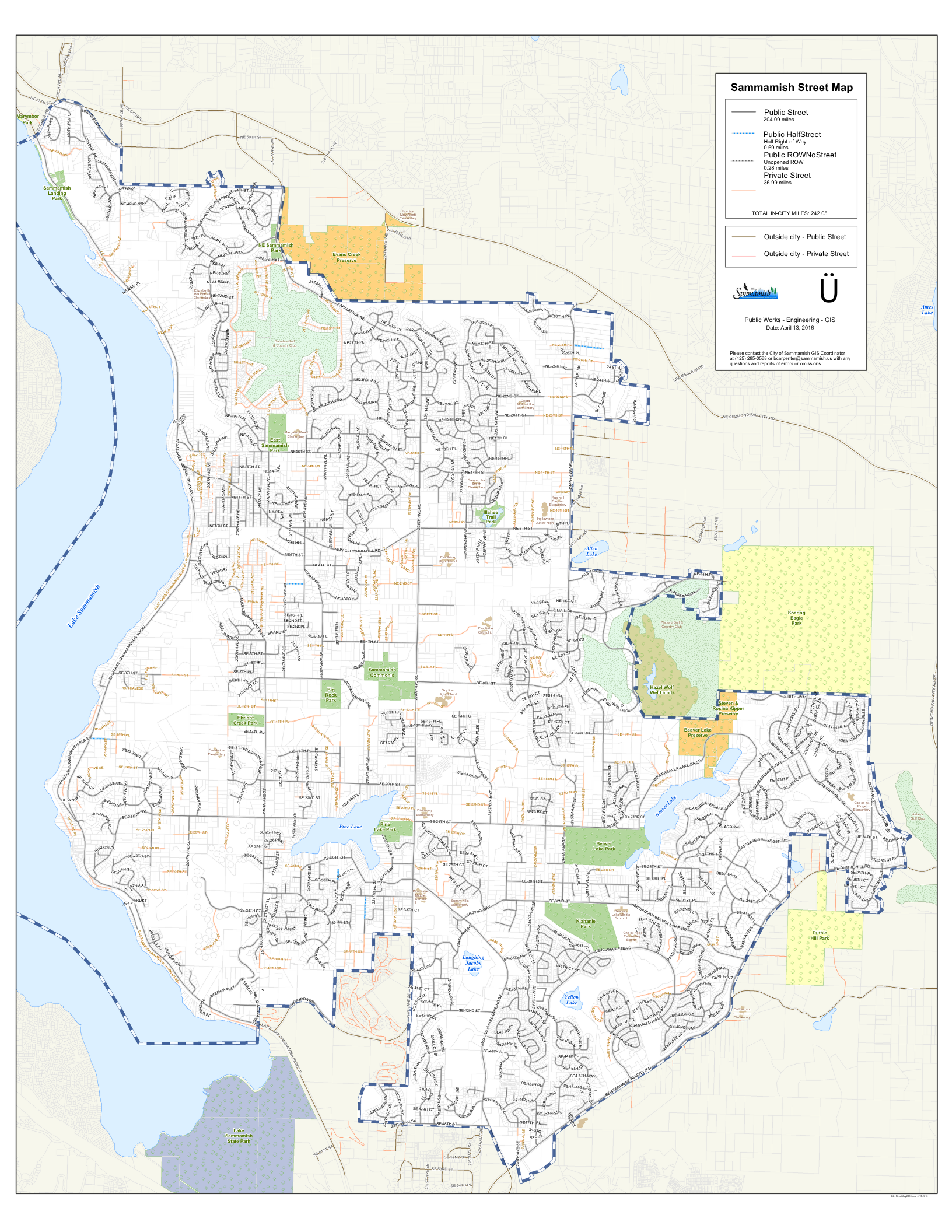
If this map doesn’t render wherever this post ends up, here’s a direct link:
This is the second post in our Why Sammamish? series. Up next: why Sammamish’s schools are such a draw, and the two-district quirk that surprises so many newcomers.
Kelly Azzarello Real Estate | Compass 📧 kelly@kellyazzarello.com 📞 (425) 830-6457 🌐 kellyazzarello.com