


Because the School District Is Bigger Than the City Itself
Part of the Why Issaquah? series: Because the School District Is Bigger Than the City Itself
This is where Issaquah's footprint really starts to sprawl past the City of Issaquah’s official boundaries.
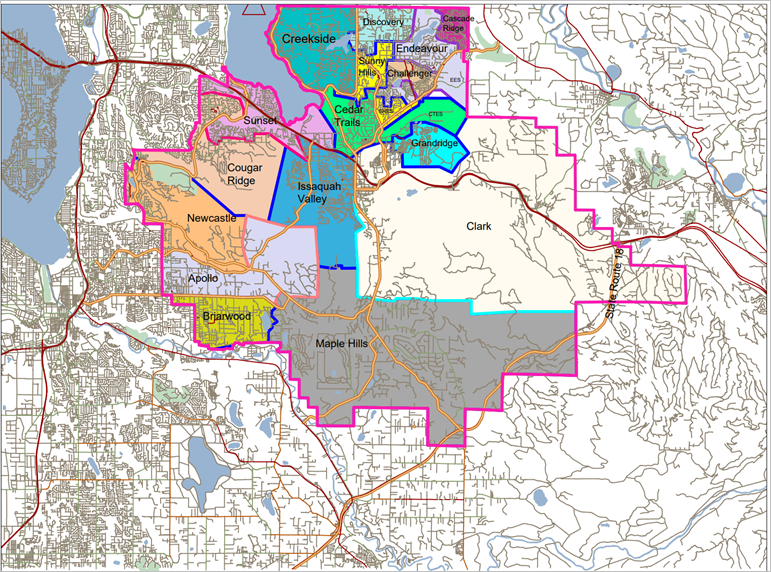
Map of the Issaquah School District elementary school boundaries.
Who It Covers
The Issaquah School District covers about 110 square miles across seven municipalities:
Issaquah
Sammamish
Bellevue
Newcastle
Renton
Preston
Unincorporated King County communities like Hobart and Mirrormont
It serves more than 18,000 students across 27 schools. It's consistently one of the top-ranked districts in the state, with graduation rates well above the statewide average.
High Schools
Three comprehensive high schools split the district today, each serving a geographic attendance zone:
Issaquah High School, the district's oldest, anchors the south side of the valley. It sits right behind the Issaquah Community Center on 2nd Ave SE.
Skyline High School, up on the Sammamish Plateau, serves the Highlands and Sammamish side.
Liberty High School covers the southwest.
A genuine fourth comprehensive high school is now under construction on the former Providence Heights College site, purchased by the district back in 2016. It broke ground in spring 2026, is targeting a fall 2027 opening, and is being built for roughly 650 to 700 students, specifically to relieve overcrowding at Skyline (running around 2,250 students) and Issaquah High (around 2,500). Confirm this is still on track before citing it as settled if you're reading this well after 2026.
Gibson Ek High School
There's also a fifth option today that doesn't work like the other three: Gibson Ek High School. It's not tied to a geographic attendance zone at all. Gibson Ek is the district's choice high school, an alternative, project-based program open to any 8th (and sometimes 9th) grader living within Issaquah School District boundaries, regardless of address. Getting in isn't a matter of which neighborhood you live in; students apply during a January-to-March window, and admission is decided by lottery, with a waitlist running into the fall. For families specifically interested in it, that's a very different process to plan around than simply buying in the right attendance zone.
For families choosing among the three geography-based schools, this means the specific school your kids attend can depend heavily on which side of Issaquah you land on. It's another reason the map matters more than the mailing address.
Elementary schools
The district has 16 elementary schools, each of which leads into a specific middle school, which in turn feed into one of the high schools (above)
Apollo
Briarwood
Cascade Ridge
Cedar Trails
Challenger
Clark
Cougar Ridge
Creekside
Discovery
Endeavour
Grand Ridge
Issaquah Valley
Maple Hills
Newcastle
Sunny Hills
Sunset
Middle schools
Beaver Lake
Cougar Mountain (the newest, opened in 2022)
Issaquah Middle
Maywood
Pacific Cascade
Pine Lake
Finding which school a student will attend
The district doesn't have an online address lookup tool. Its Find Your School page says to email the Transportation Department at transportation-enews@issaquah.wednet.edu with the full address, including city and ZIP, and they'll look up the assigned schools. The page says realtors can use this too, which fits the post's "check the actual attendance zone" advice. Linking to that page is safer than printing the email address, since the page will stay current if the address changes.
The district also has an Attendance Maps page with four PDF maps:
High school boundaries. This one also shows the outer edge of the whole district, so it's the best choice if you only want one map.
School feeder patterns, which show which elementary schools feed into which middle and high schools.
For Buyers & Sellers
School assignment is one of the first things relocating families ask about, and it's worth checking the actual attendance zone for a specific address rather than assuming based on neighborhood name; zone boundaries don't always follow the lines a buyer expects. For families interested in Gibson Ek specifically, timeline matters: the January-to-March application window means it's worth planning around well before move-in.
Sources:
Curious which attendance zone a specific home falls into, or want the honest rundown on Gibson Ek's process? Reach out to Kelly Azzarello Real Estate.
Kelly Azzarello Real Estate | Compass
📧 kelly@kellyazzarello.com | 📞 (425) 830-6457 | 🌐 kellyazzarello.com

08: Neighborhood Spotlight: Klahanie
Klahanie is Sammamish’s largest neighborhood, older than the city itself, and one of the most self-contained. Here’s a full spotlight, from a resident, on its history, amenities, and schools.
Klahanie is Sammamish’s largest neighborhood, and in a lot of ways its most self-contained. It has its own name origin, its own decades of history predating the city itself, its own shopping center, and enough parks and trails that plenty of residents could spend a weekend without ever leaving. It’s also home, we should say upfront: Kelly and I live right here, in Klahanie’s Winslow Place neighborhood.
What the name means
“Klahanie” comes from Chinook Jargon, the historic Pacific Northwest trade language, and it means “outside” or “the outdoors.” It’s a fitting name for a community built almost entirely around its trail network and green space.
Older than the city itself
Klahanie was established in 1984, which makes it older than the City of Sammamish, which didn’t incorporate until 1999. It grew in stages through the following decade as several established home builders developed different sections, which is why Klahanie has more variety in home styles and ages than a typical single-phase development. For most of its history, it was its own unincorporated King County community. It wasn’t annexed into the City of Sammamish until January 1, 2016, something we covered in more depth in the history post in this series.
Today, Klahanie covers 900 acres and contains roughly 1,967 single-family homes, 718 multifamily residences (condos and townhomes), and 405 apartment units, according to the Klahanie Association’s own figures.
A neighborhood of neighborhoods
Klahanie isn’t one uniform development, it’s made up of more than a dozen named sub-neighborhoods, each with its own character. A few examples:
• Audubon Ridge, 328 single-family homes, near Klahanie Park, Yellow Lake, and the Lakeside pool
• Heatherwood, 109 single-family homes, bordering a greenbelt and the Powerline trail
• Fairfield Green, 59 townhomes and condos, adjacent to the QFC shopping center
• Kenlock and Lake Park, smaller condo/townhome developments near Lakeside Park
• Highland Gardens, a 51-unit apartment community near the shopping center
• Winslow Place, Summit, Lancaster, Madison Place, and Mountainview round out the rest
A community built for sports
Klahanie’s HOA maintains a genuinely substantial set of shared amenities: two swimming pools (Lakeside and Mountainview, one of them covered for year-round use), three tennis courts, four basketball courts, and four pickleball and badminton courts.
Klahanie Park, a 64-acre city park next to Challenger Elementary, is the athletic hub. It carries multiple soccer and baseball/softball fields used constantly for practices, games, and camps, and it’s also the only park in Sammamish with a dedicated cricket field, home ground for youth and adult matches run by the Seattle Youth Cricket League and the Northwest Cricket League. The park also protects Queen’s Bog, one of only about fifty bogs left in Washington State.
Swimming has its own layer of organization worth untangling. The Klahanie Sharks are a separate, independent nonprofit swim club, not simply an HOA program, though the team uses the HOA’s pools and the two organizations partner closely. The Sharks compete in the 26-team Midlakes Summer Swim League each May through July, run by a volunteer board, and open only to Klahanie residents, roughly 200 swimmers, ages 5 to 18, each season.
The trail network
Klahanie’s roughly 30 miles of groomed trails have their own set of named routes that locals navigate by. The paved Perimeter Trail loops almost the entire community. The roughly 1.25-mile Yellow Lake Trail circles the neighborhood’s namesake lake, with a viewing dock and a resident-favorite counter-clockwise route that ends right at the dock. The Pipeline Trail runs north-south past Lakeside Park and Audubon. The Powerline Trail runs beneath the power lines and includes the neighborhood’s best-known local landmark, a steep stretch known simply as “snake hill.” And the Pea Patch Trail connects to a community garden plot off 256th, linking both the Yellow Lake and Powerline trails.
Yellow Lake itself sits at the literal center of the community. Gander Pond, Sutter Pond, and Queens Lake Bog round out the smaller water features scattered through the neighborhood. And Klahanie’s trails don’t dead-end at the neighborhood line, they connect into the wider plateau trail system covered in our outdoor life post, including Soaring Eagle Regional Park and Beaver Lake Park just beyond Klahanie’s borders, so the reach is bigger than the neighborhood itself suggests.
Schools
Klahanie falls within the Issaquah School District, with Challenger Elementary School and Beaver Lake Middle School both located inside the neighborhood. High schoolers feed into Skyline High School, the ISD comprehensive high school covered in our schools post.
Shopping and location
Klahanie Village, anchored by a QFC grocery store, sits at the neighborhood’s south end and functions as its de facto town center, restaurants, everyday shopping, and a Starbucks that regulars know by name. Klahanie’s location also gives it a real practical edge: it’s close enough to I-90 to make the commute toward Issaquah, Bellevue, and Seattle noticeably easier than from neighborhoods further north on the plateau, and Costco’s world headquarters sits about four miles away.
Where things sit
Schematic map of the Klahanie neighborhood showing Yellow Lake at the center, Klahanie Park to the west, Beaver Lake Middle School and Challenger Elementary School to the north and east, and Klahanie Village shopping center to the south
Marker positions are plotted from real coordinates; Klahanie’s boundary shown is illustrative, not an official line.
This is part of our Why Sammamish? series, digging into individual neighborhoods in more depth. Up next: a closer look at Trossachs.

Kelly Azzarello Real Estate | Compass 📧 kelly@kellyazzarello.com 📞 (425) 830-6457 🌐 kellyazzarello.com

03: Great Schools, Two Districts: How Education Works in Sammamish
Sammamish isn’t served by one school district, it’s split almost down the middle between two highly-rated ones. Here’s what that actually means for families house-hunting on the plateau.
Ask any Sammamish parent what drew them here and schools are almost always near the top of the list. What surprises a lot of newcomers is that “Sammamish schools” isn’t one system. Drive down 228th Avenue, the plateau’s main north-south corridor, and in about a mile you’ll pass two public high schools from two entirely different school districts, with a private school sitting right between them.
Two full-size districts, split down the middle
The Lake Washington School District (LWSD) serves the northern half of Sammamish, while the Issaquah School District (ISD) serves the south. Both are large, well-regarded districts in their own right, not small satellite systems built around Sammamish. LWSD is the second-largest school district in Washington State, serving roughly 31,000 students across Redmond, Kirkland, and Sammamish. ISD serves around 18,700 students across Sammamish, Issaquah, and parts of Bellevue and Renton, and ranks in the top 5% of Washington districts for overall performance. Both carry an A+ rating from Niche.
That’s the part worth sitting with: this isn’t one strong district and one weak one that the city happens to straddle. It’s two large, highly-rated districts that each treat a slice of Sammamish as a core part of their territory.
What that looks like on the ground
North Sammamish (LWSD): - Eastlake High School, located right on 228th Avenue NE in Sammamish - Renaissance School of Art and Reasoning, a small choice middle school housed on the Eastlake campus, plus Inglewood Middle School - Elementary schools serving the area include Elizabeth Blackwell, Rachel Carson, Christa McAuliffe, Margaret Mead, and Samantha Smith - Tesla STEM High School, LWSD’s selective, lottery-based STEM magnet, is technically located just across the city line in Redmond, but it’s a real option for Sammamish LWSD families since admission is district-wide by lottery, not by neighborhood zoning
South Sammamish (ISD): - Skyline High School, on 228th Avenue SE, about a mile south of Eastlake - Middle schools serving the area include Beaver Lake, Pacific Cascade, and Pine Lake - Elementary schools serving the area include Cascade Ridge, Cedar Trails, Challenger, Creekside, Discovery, Endeavour, and Sunny Hills
And in between the two comprehensive high schools sits Eastside Catholic, a private secondary school that relocated to Sammamish in 2008. It’s a genuinely unusual stretch of road: two full-size public high schools from different districts and a well-known private school, all within about a mile of each other.
Both flagship high schools perform well above state averages. Skyline consistently ranks in the top 3% of Washington high schools, with an IB program and strong graduation rates. Issaquah School District as a whole ranks in the top 5% of Washington districts across math, reading, science, and graduation rate.
The small pocket that’s neither
There’s one more wrinkle. A small area in the northeast corner of Sammamish, roughly 65 homes off 244th Avenue NE, actually falls into a third district: the Snoqualmie Valley School District, assigning those students to Fall City Elementary, Chief Kanim Middle School, and Mount Si High School. It’s a legacy of how boundaries were drawn long before the city incorporated, and it’s been a genuine point of friction locally: residents there have petitioned four separate times since 2003 to be moved into LWSD, since the neighborhood is surrounded on three sides by LWSD territory. The most recent petition was denied in late 2025, and as of early 2026 a group of parents is appealing that denial in King County Superior Court. It’s an active legal process, not a scheduled boundary change, so there’s no set timeline for how it resolves, but it’s worth knowing about if a specific address in that corner of the city matters to your decision.
Is this actually unusual for the Seattle area?
Sort of, and sort of not. Plenty of Eastside cities technically touch more than one district at their edges. Newcastle, for instance, has slivers in the Bellevue, Renton, and Issaquah districts. But most Eastside cities are still clearly anchored by one dominant district: Bellevue is essentially all Bellevue School District, Redmond and Kirkland are essentially all LWSD, and Issaquah proper is essentially all Issaquah School District.
What makes Sammamish different is the scale of the split. This isn’t a small edge case, it’s a genuine, roughly even division of a single city between two major, well-regarded districts, plus that small Snoqualmie Valley pocket on top. Among Eastside cities of a similar size, that kind of near 50/50 divide is more the exception than the rule.
Where the districts sit relative to each other
Schematic map showing the City of Sammamish split between the Lake Washington School District to the north and Issaquah School District to the south, divided roughly along SE 8th Street, with a small Snoqualmie Valley School District pocket in the northeast corner, and Eastlake High School, Eastside Catholic, and Skyline High School marked along the 228th Avenue corridor
A schematic look at how the two main districts divide the city, not an official boundary map. The real dividing line zigzags street by street rather than running perfectly straight, but this gives a sense of the geography: LWSD to the north, ISD to the south, roughly along SE 8th Street, with the small Snoqualmie Valley pocket tucked into the northeast corner.
For the real, address-level boundary, both districts publish official boundary lookup tools, and that’s always worth checking directly for any specific property:
Lake Washington School District: lwsd.org/students-families/families/attendance-areas
Issaquah School District: isd411.org/enrollment/whats-my-school
This is the third post in our Why Sammamish? series. Up next: getting outside, sports, trails, and everyday outdoor life on the plateau.
Kelly Azzarello Real Estate | Compass 📧 kelly@kellyazzarello.com 📞 (425) 830-6457 🌐 kellyazzarello.com