


14: Lakes of Sammamish: Where to Swim, Fish, Paddle, and Live on the Water
Lake Sammamish, Pine Lake, Beaver Lake, Yellow Lake and a few you can't see from the road: who can use each one, the rules in one line, and what it means if you want to live on the water.
Lakesof Sammamish: Where to Swim, Fish, Paddle, and Live on the Water
The city is named for a lake, but Lake Sammamish is only part of thewater story. Up on the plateau itself there are three smaller lakes,Pine Lake, Beaver Lake, and Yellow Lake, and each has a very differentrelationship with the people around it. Pine Lake has a city park andseasonal lifeguards. Beaver Lake has a lodge and a rack of free loanerlife jackets. Yellow Lake sits inside Klahanie, where access is ahomeowners’ association question.
That’s the real question with Sammamish’s lakes: not which one isprettiest, but who is allowed to use it. Some are public, some areresident-only, and a few are hard to spot from the road. Below is eachlake, its rules in one line, and, at the end, what it means if you wantto live on the water instead of just visiting.
Lake Sammamish
The big one. Lake Sammamish covers roughly 4,850 acres, withSammamish along its eastern shore, Issaquah at the south end, andRedmond and Bellevue to the north and west. Most of the shoreline isprivate, so the handful of public access points matter:
Sammamish Landing (Sammamish). An 8-acre park onthe eastern shore with three small beaches, two docks, a picnic shelter,and a display on the railroad that once ran along today’s East LakeSammamish Trail. It’s the only public property on the lake’s shorelineinside Sammamish city limits.
Lake Sammamish State Park (Issaquah). The lake’ssouth end, and the main public boat launch. It also has swimming beaches(Tibbetts and Sunset), picnic shelters, and athletic fields.
Idylwood Park (Redmond). Public access on thelake’s west shore.
At the north end, Marymoor Park in Redmond is where the 11-mile EastLake Sammamish Trail begins, a flat paved ride or walk along the waterthat comes up again and again in what people love about living here.
For anglers, wild coastal cutthroat, smallmouth bass, and yellowperch are the main draws. Kokanee, the lake’s landlocked sockeye, spawnin creeks like Laughing Jacobs, Tibbetts, and Issaquah Creek, and areclosed to fishing.
The rules, in one line: swim only at designatedbeaches (Sammamish Landing or the state park), launch boats at the statepark (fees apply), and check WDFW’s current rules before fishing, sincekokanee, steelhead, and some salmon are closed.
Pine Lake
Pine Lake is Sammamish’s most neighborhood-scale lake: a small lakewith a city park on its shore and homes around it. Pine Lake Park hassandy beaches, a designated swimming area, and calm water for kayaks andpaddleboards, and it’s a good example of what the plateau’s lake parksdo well. We introduced the Pine Lake neighborhood in 8Sammamish Neighborhoods Worth Knowing.
The rules, in one line: swim only in the designatedarea (lifeguards are on duty only during specific summer weeks), andfishing season runs from the fourth Saturday in April through October31, with a license.
Beaver Lake
Beaver Lake is actually a chain of three lakes, and the main lake iswhere the recreation happens. Beaver Lake Park covers 83 acres, with aswimming area, forested trails, a big meadow, and the historic BeaverLake Lodge, which began as a private resort in the 1930s. In summer thepark lends out life jackets for free, and the lake hosts the swim leg ofthe annual Beaver Lake Triathlon. One quirk: the public boat ramp isn’tin the park, it’s a state Fish & Wildlife access site on the lake’ssoutheast side. We covered the park in more detail in GettingOutside in Sammamish.
The rules, in one line: swim in designated areas,borrow the free life jackets in summer, fish year-round with a license,and use electric motors only, since gas motors aren’t allowed on thelake.
Yellow Lake
Yellow Lake is tucked into Klahanie beside Klahanie Park. It’s small,about 10 acres, and named for its yellow water lilies. A forested buffersurrounds it and a walking trail circles it, so it functions more asurban wildlife habitat than a swimming hole. It’s shallow and edged withlily pads, so don’t picture a beach.
Ownership and access are worth confirming rather than assuming.Reports describe the lake as owned by the Klahanie HOA, and the trail’sstatus isn’t as clear-cut. The Klahanie HOA can tell you what’s open tonon-residents: klahanie.com.
The rules, in one line: treat it as resident-onlyunless the HOA says otherwise, and don’t assume any swimming, fishing,or boating access.
The lakes you’ll hearabout but rarely see
Laughing Jacobs Lake. It’s the source of LaughingJacobs Creek, which runs through Sammamish and Issaquah to LakeSammamish. Below the creek’s falls is a primary spawning ground for thebig lake’s kokanee. The lake itself is reportedly private, so this oneis a story rather than a destination.
Ames Lake. It sits north of the city inunincorporated King County, near Union Hill-Novelty Hill. It shows up onregional maps, but we couldn’t confirm public access details, so ifyou’re house hunting up north, ask about it by address.
Ebright Creek Park. It’s not a lake, but thisneighborhood park has trails and a creek, and it’s a good stop for waterwithout a beach.
If you want to live on thewater
“Lake living” in Sammamish can mean three different things, and theprice, permits, and day-to-day experience differ a lot between them.
True waterfront. The property touches theshoreline, usually with a dock. You’ll find these on Lake Sammamish’seast shore, Pine Lake, and Beaver Lake. Frontage and views command apremium, and docks, lifts, and shoreline improvements add both lifestyleand regulatory complexity. It isn’t unusual to see a Beaver Lake listingwhere the frontage is tied to a shoreline variance.
Deeded or HOA lake access. The home isn’t on thewater, but the owners get access through an easement or acommunity-owned park or beach. Several developments around LakeSammamish own small private parks for residents. This can be the mostaffordable way to have a dock or beach, but the details live in thelegal documents, so read them.
Lake-adjacent. You live near the water and use thepublic parks: Pine Lake Park, Beaver Lake Park, Sammamish Landing, orthe state park. Because most of the shoreline is private, these publicaccess points are the whole story for many households.
Before you buy on or near a lake, ask about:
The dock’s permit history, and whether it’s allowed to stay asis.
The exact wording of any water-access easement or HOA beachrights.
Whether the lot sits in a mapped flood area, and whether floodinsurance will be required.
Shoreline rules that could limit a remodel, addition, or newdock.
The lake’s own rules: Beaver Lake, for example, allows electricmotors only.
Not sure which of the three fits? Tell us how you’d use the water,and we’ll search accordingly.
Helpful links
Cityof Sammamish Parks & Trails, for current hours, lifeguard weeks,and swimming rules
BeaverLake Park & Lodge, including the life jacket program
SammamishLanding Park
WDFW:Lake Sammamish and BeaverLake, for fishing rules and access
Where they sit
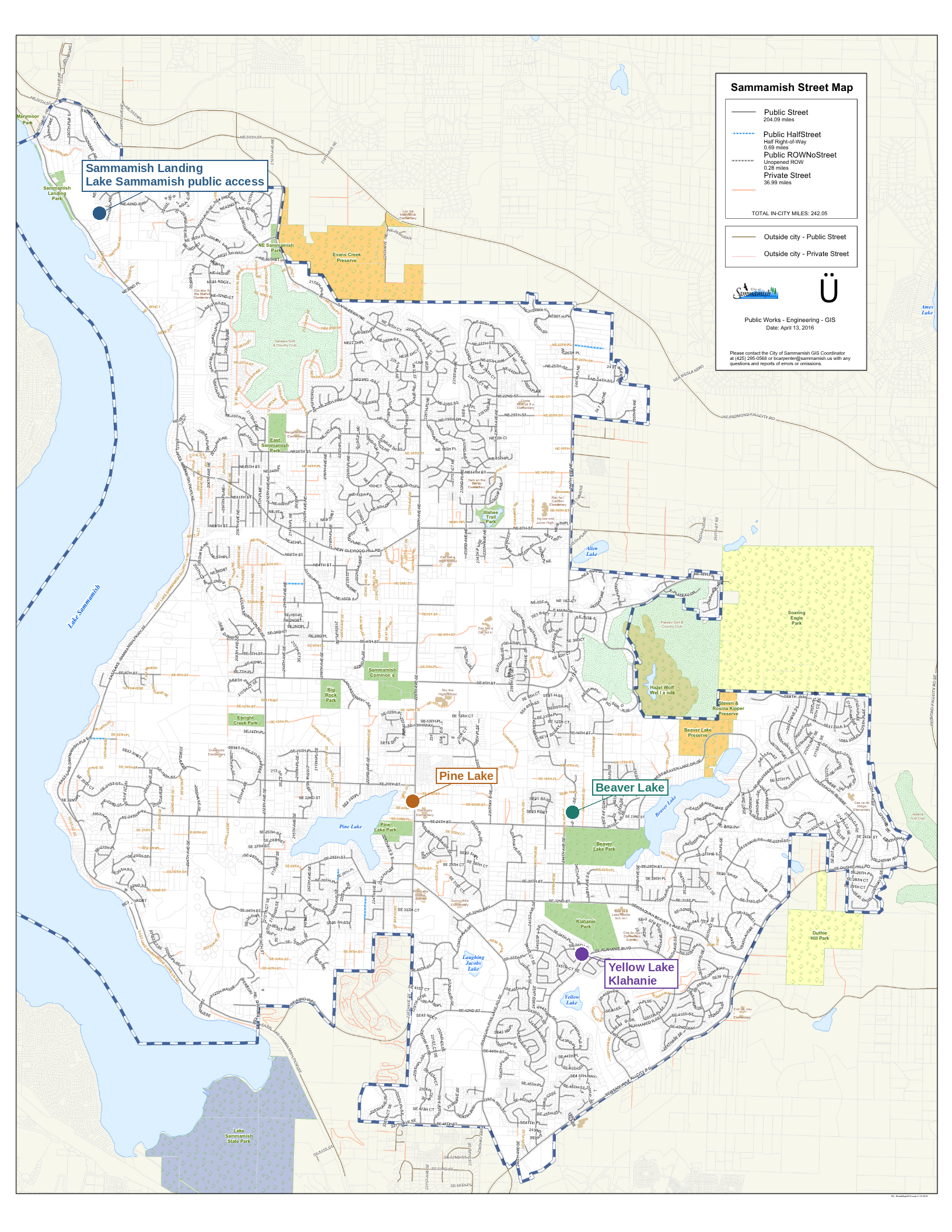
Official City of Sammamish street mapannotated with callouts for Sammamish Landing on Lake Sammamish, PineLake, Beaver Lake, and Yellow Lake in Klahanie
Base map: City of Sammamish Public Works – Engineering – GIS,Sammamish Street Map (April 13, 2016). Callouts and markers added by us,plotted from real coordinates; not an official city product.
This is a supplementary post in our Why Sammamish?series.
Kelly Azzarello Real Estate | Compass 📧 kelly@kellyazzarello.com 📞(425) 830-6457 🌐 kellyazzarello.com

11: Two More Neighborhoods and Two with Beach Access
Sammamish isn’t one uniform suburb, it’s a collection of genuinely distinct neighborhoods. Here’s an introduction to 8 of them, from the largest (Klahanie) to the most exclusive (Aldarra).
Our original neighborhoods roundup, plus the standalone posts on Klahanie and Trossachs, covered a good cross-section of the plateau, but they leaned toward the south and east. This post fills in three more, spread deliberately across different parts of the city: one right in the middle of the plateau near the high schools, one up north, and a special look at what might be Sammamish’s best-kept-secret amenity: private, residents-only beach and boat dock access to Lake Sammamish itself, which turns out to exist in more than one neighborhood.
Sammamish Highlands: the actual center of the plateau
If Sammamish has a geographic and civic center, it’s here. Sammamish Highlands sits on 228th Avenue right between the city’s two comprehensive high schools, Eastlake to the north and Skyline to the south, and it’s built around the Sammamish Highlands shopping center: Trader Joe’s, Safeway, Metropolitan Market, and a long list of everyday restaurants and services, several of which showed up in our restaurants post. It’s also right next door to Sammamish Commons, so residents get City Hall, the library, the farmers market, and the YMCA within easy reach too.
Homes here are mostly single-family and townhome product built from the 1990s onward, with sidewalks and community spaces that were genuinely planned in, not retrofitted. For buyers who want to walk to groceries, coffee, and a full-service pharmacy, and who want their kids within a short drive of either high school, this is about as central as Sammamish gets.
Heritage Hills: north of Inglewood Hill Road
Head north past Inglewood Hill Road, into the part of the plateau that didn’t really develop until the 1970s and 80s after Sahalee’s golf course opened and 228th Avenue was extended, and you’ll find Heritage Hills. It sits in the same northern cluster as Sahalee and Timberline, feeding into Lake Washington School District schools including Elizabeth Blackwell Elementary.
Heritage Hills has a quieter, more established feel than the newer developments further south, single-level and traditional homes on generously sized, often wooded lots, without the country-club gate of its Sahalee neighbor next door. It’s a good example of the kind of solid, unflashy neighborhood that doesn’t always make “top neighborhoods” lists but consistently draws buyers who’ve done their homework.
Lake Sammamish Beach Access: the private beaches most people don’t know about
Here’s a feature worth its own section. Sammamish’s public shoreline inside city limits is limited to the small Sammamish Landing park, but tucked into two different residential communities are private, deeded beach and dock amenities that most buyers never think to ask about.
Inglewood Beach Club, on the west side of the plateau at the corner of East Lake Sammamish Parkway and Inglewood Hill Road, offers 125 feet of private lake frontage with a sandy beach, a swimming area, a boat launch, and a dock. It’s an optional, paid membership available specifically to property owners within the Inglewood plat, and it functions as the genuine social heart of that part of the neighborhood: summer picnics, a Fourth of July celebration, and a beach that, on a hot July afternoon, feels like a private lake house shared among a few hundred families instead of one.
Waverly Hills, on the southeast side of the lake near East Lake Sammamish Parkway SE, is a separate neighborhood built around its own private beach club: 106 homes share 400 feet of waterfront, with a sandy beach, swim area, dock, boat launch, and BBQ area. It’s a smaller, tighter-knit community than Inglewood, but the amenity itself is just as real, lake access that comes with the deed rather than a trip to a state park.
Both are genuinely rare things to offer buyers: private, residents-only lake access with an actual dock and boat launch, not just a view. It’s the kind of amenity that’s easy to undersell if you don’t know to ask about it, and easy for out-of-area buyers to miss entirely since neither shows up on a standard “best parks” list.
Where they sit
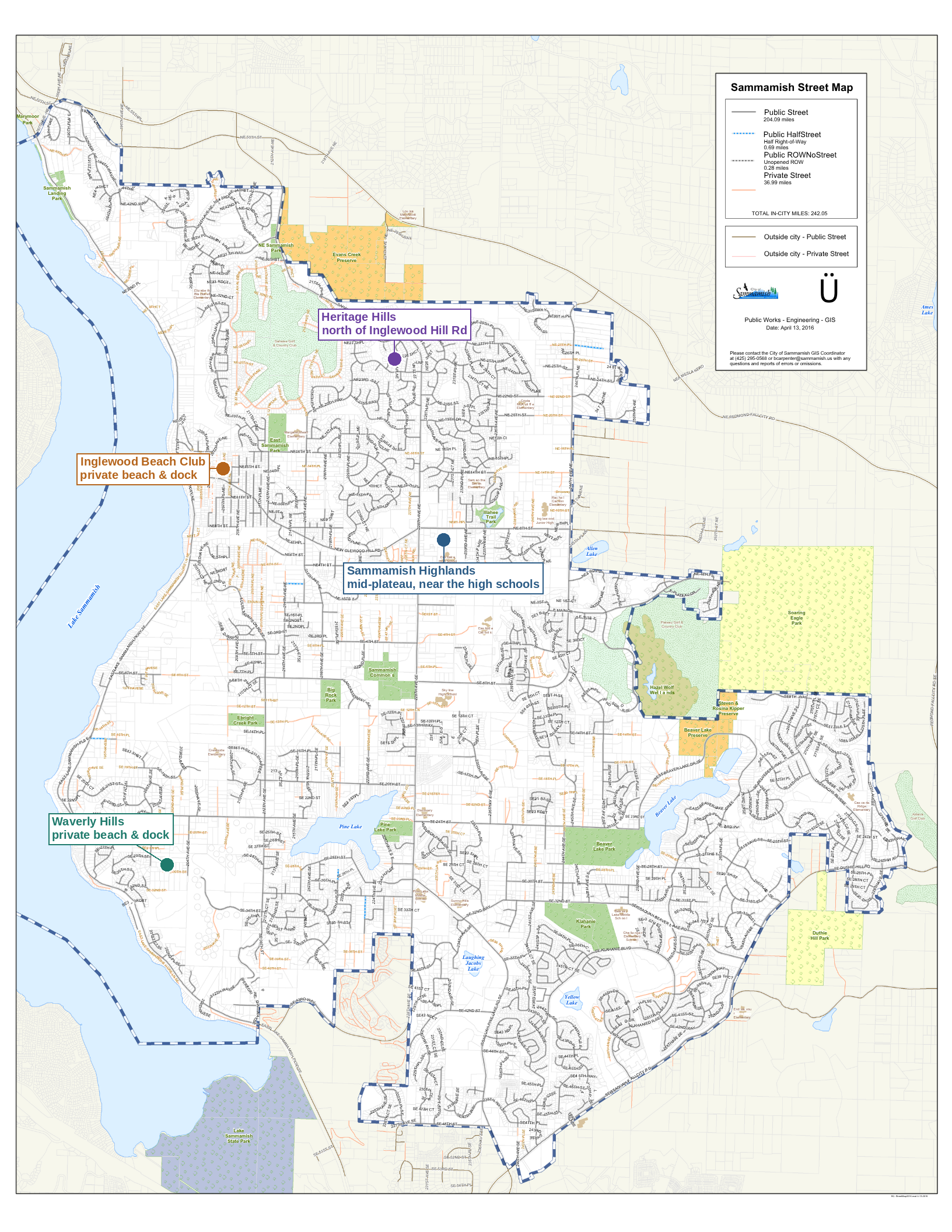
This is a supplementary post in our Why Sammamish? series, expanding on the original neighborhoods roundup. A dedicated post on Sahalee, covering both the residential community and the private golf club, is queued up next.
Kelly Azzarello Real Estate | Compass 📧 kelly@kellyazzarello.com 📞 (425) 830-6457 🌐 kellyazzarello.com

08: Neighborhood Spotlight: Klahanie
Klahanie is Sammamish’s largest neighborhood, older than the city itself, and one of the most self-contained. Here’s a full spotlight, from a resident, on its history, amenities, and schools.
Klahanie is Sammamish’s largest neighborhood, and in a lot of ways its most self-contained. It has its own name origin, its own decades of history predating the city itself, its own shopping center, and enough parks and trails that plenty of residents could spend a weekend without ever leaving. It’s also home, we should say upfront: Kelly and I live right here, in Klahanie’s Winslow Place neighborhood.
What the name means
“Klahanie” comes from Chinook Jargon, the historic Pacific Northwest trade language, and it means “outside” or “the outdoors.” It’s a fitting name for a community built almost entirely around its trail network and green space.
Older than the city itself
Klahanie was established in 1984, which makes it older than the City of Sammamish, which didn’t incorporate until 1999. It grew in stages through the following decade as several established home builders developed different sections, which is why Klahanie has more variety in home styles and ages than a typical single-phase development. For most of its history, it was its own unincorporated King County community. It wasn’t annexed into the City of Sammamish until January 1, 2016, something we covered in more depth in the history post in this series.
Today, Klahanie covers 900 acres and contains roughly 1,967 single-family homes, 718 multifamily residences (condos and townhomes), and 405 apartment units, according to the Klahanie Association’s own figures.
A neighborhood of neighborhoods
Klahanie isn’t one uniform development, it’s made up of more than a dozen named sub-neighborhoods, each with its own character. A few examples:
• Audubon Ridge, 328 single-family homes, near Klahanie Park, Yellow Lake, and the Lakeside pool
• Heatherwood, 109 single-family homes, bordering a greenbelt and the Powerline trail
• Fairfield Green, 59 townhomes and condos, adjacent to the QFC shopping center
• Kenlock and Lake Park, smaller condo/townhome developments near Lakeside Park
• Highland Gardens, a 51-unit apartment community near the shopping center
• Winslow Place, Summit, Lancaster, Madison Place, and Mountainview round out the rest
A community built for sports
Klahanie’s HOA maintains a genuinely substantial set of shared amenities: two swimming pools (Lakeside and Mountainview, one of them covered for year-round use), three tennis courts, four basketball courts, and four pickleball and badminton courts.
Klahanie Park, a 64-acre city park next to Challenger Elementary, is the athletic hub. It carries multiple soccer and baseball/softball fields used constantly for practices, games, and camps, and it’s also the only park in Sammamish with a dedicated cricket field, home ground for youth and adult matches run by the Seattle Youth Cricket League and the Northwest Cricket League. The park also protects Queen’s Bog, one of only about fifty bogs left in Washington State.
Swimming has its own layer of organization worth untangling. The Klahanie Sharks are a separate, independent nonprofit swim club, not simply an HOA program, though the team uses the HOA’s pools and the two organizations partner closely. The Sharks compete in the 26-team Midlakes Summer Swim League each May through July, run by a volunteer board, and open only to Klahanie residents, roughly 200 swimmers, ages 5 to 18, each season.
The trail network
Klahanie’s roughly 30 miles of groomed trails have their own set of named routes that locals navigate by. The paved Perimeter Trail loops almost the entire community. The roughly 1.25-mile Yellow Lake Trail circles the neighborhood’s namesake lake, with a viewing dock and a resident-favorite counter-clockwise route that ends right at the dock. The Pipeline Trail runs north-south past Lakeside Park and Audubon. The Powerline Trail runs beneath the power lines and includes the neighborhood’s best-known local landmark, a steep stretch known simply as “snake hill.” And the Pea Patch Trail connects to a community garden plot off 256th, linking both the Yellow Lake and Powerline trails.
Yellow Lake itself sits at the literal center of the community. Gander Pond, Sutter Pond, and Queens Lake Bog round out the smaller water features scattered through the neighborhood. And Klahanie’s trails don’t dead-end at the neighborhood line, they connect into the wider plateau trail system covered in our outdoor life post, including Soaring Eagle Regional Park and Beaver Lake Park just beyond Klahanie’s borders, so the reach is bigger than the neighborhood itself suggests.
Schools
Klahanie falls within the Issaquah School District, with Challenger Elementary School and Beaver Lake Middle School both located inside the neighborhood. High schoolers feed into Skyline High School, the ISD comprehensive high school covered in our schools post.
Shopping and location
Klahanie Village, anchored by a QFC grocery store, sits at the neighborhood’s south end and functions as its de facto town center, restaurants, everyday shopping, and a Starbucks that regulars know by name. Klahanie’s location also gives it a real practical edge: it’s close enough to I-90 to make the commute toward Issaquah, Bellevue, and Seattle noticeably easier than from neighborhoods further north on the plateau, and Costco’s world headquarters sits about four miles away.
Where things sit
Schematic map of the Klahanie neighborhood showing Yellow Lake at the center, Klahanie Park to the west, Beaver Lake Middle School and Challenger Elementary School to the north and east, and Klahanie Village shopping center to the south
Marker positions are plotted from real coordinates; Klahanie’s boundary shown is illustrative, not an official line.
This is part of our Why Sammamish? series, digging into individual neighborhoods in more depth. Up next: a closer look at Trossachs.

Kelly Azzarello Real Estate | Compass 📧 kelly@kellyazzarello.com 📞 (425) 830-6457 🌐 kellyazzarello.com

07: Top 5 Restaurants in Sammamish
Sammamish isn’t one uniform suburb, it’s a collection of genuinely distinct neighborhoods. Here’s an introduction to 8 of them, from the largest (Klahanie) to the most exclusive (Aldarra).

Sammamish’s restaurant scene doesn’t chase trends so much as it reflects who actually lives here: a genuinely international community that’s built a quietly excellent, unpretentious set of places to eat, mostly clustered in a few strip-mall plazas rather than a walkable downtown strip. These five come up again and again across independent review sources, not just once, but consistently over several years.
1. Pine Lake Ale House
A family-owned American gastropub near the same 228th Avenue corridor that locals genuinely describe as the neighborhood’s “Cheers”, the kind of place where the servers know your name. Wings, burgers, a deep beer list, and enough TVs to make it the default spot to watch a game, alongside a French dip regulars call the best they’ve had anywhere.
2. Sammamish Cafe & Spirits
An all-day American breakfast-and-brunch spot on NE 8th Street that regularly gets called the best breakfast in town, and sometimes the best breakfast reviewers have had anywhere. Generous portions, a full cocktail and Bloody Mary program, and a comfortable, unfussy diner-meets-bar atmosphere that works equally well for a Saturday morning omelet or a casual dinner.
3. Thai Trio
A small, cozy Thai spot near 228th Avenue NE built around a rotating menu of Thai street food rather than a standard, static menu. The owners are known for engaging directly with customers about the dishes and their roots, and regulars single out the pad kra pow and salt-and-pepper pork belly as reasons to keep coming back. Seating is limited, so it leans toward takeout on busy nights.
4. Diyar
A Persian-Mediterranean restaurant on Klahanie Drive, fully halal and alcohol-free by design. Owner Ramin Rafiei built it around the hospitality he grew up with in Iran, down to rotating artwork that changes with the holiday calendar, and it shows: it’s earned a startlingly high rating in a short amount of time. The Kashk o Bademjan (an eggplant appetizer) and the Vaziri platter, combining chicken and beef kabobs, are the dishes regulars point newcomers toward. One small note on geography: the mailing address reads Issaquah, a ZIP code quirk common to the Klahanie area, but it’s very much a Sammamish neighborhood restaurant.
5. La Casita Cocina Mexicana & Cantina
A family-run Mexican restaurant in the Pine Lake Shopping Center, the same plaza as the neighborhood Rite Aid, that’s been serving the Sammamish and Issaquah area for more than 40 years. It’s the kind of place regulars have been going to since childhood, with a large bar area, a private party room that fits up to 40 people, and a menu built around the reliable classics: carne asada, fajitas, enchiladas, and a well-regarded margarita program. Consistency is the draw here more than novelty, exactly what you want in a long-running neighborhood spot.
Where they are
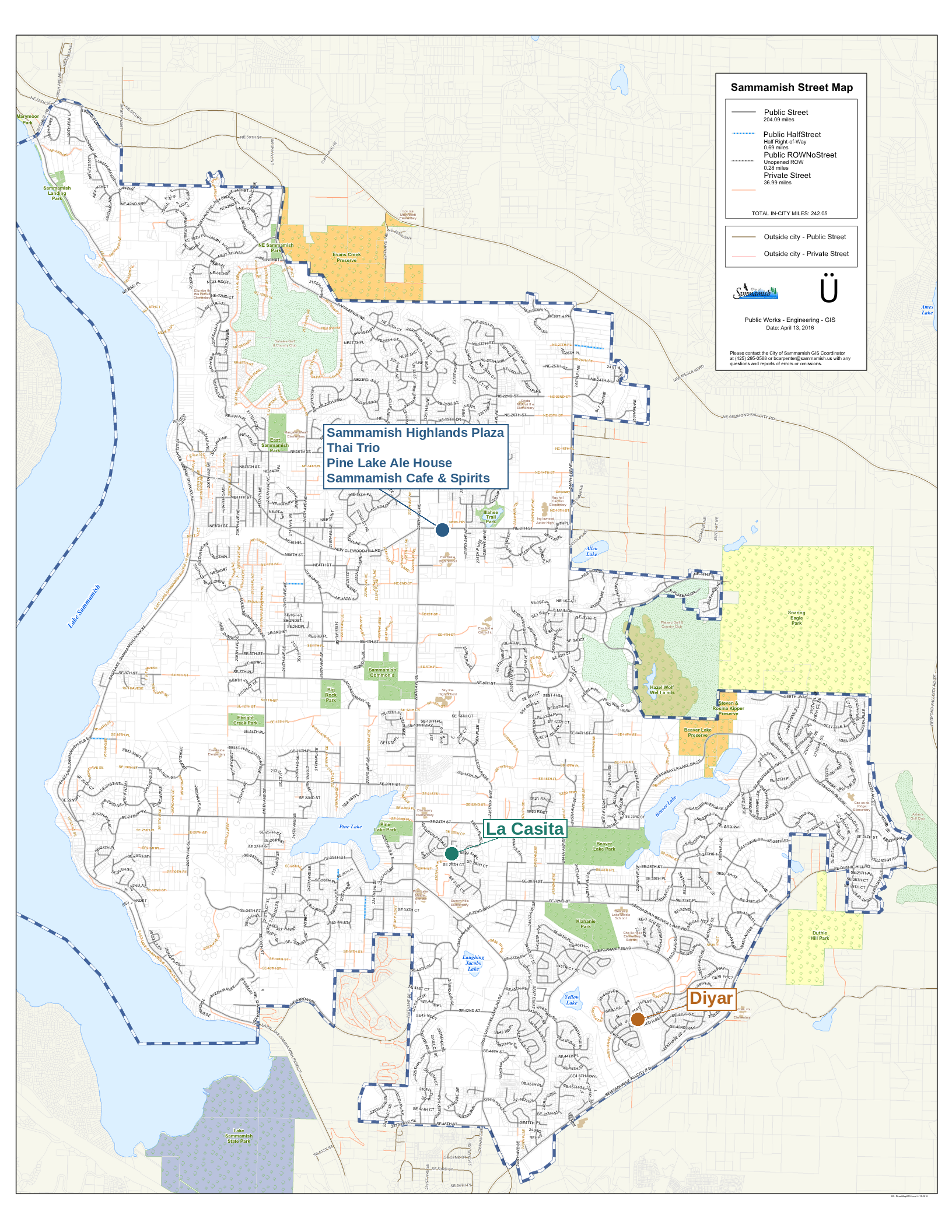
This is the seventh post in our Why Sammamish? series. Up next: a closer look at the neighborhoods that didn’t get their own full post yet, starting with Klahanie and Trossachs.
Kelly Azzarello Real Estate | Compass 📧 kelly@kellyazzarello.com 📞 (425) 830-6457 🌐 kellyazzarello.com