

What Is a Sewer Scope?
Part 1: What Is a Sewer Scope Inspection?
And why a flushing toilet isn't proof your sewer line is fine
We once encountered an issue in a transaction that perfectly illustrates this. An offer came in contingent on an inspection and a sewer scope, and the scope uncovered a break in the main sewer line running out to the street. Because the pipe was buried, nobody involved had any idea it was there.
That's the thing about sewer lines. They're out of sight, and they can be failing long before you notice anything.
A working toilet doesn't mean a healthy sewer line
A toilet that flushes only tells you that waste leaves the bathroom. A sewer line can be cracked, offset, invaded by roots, or partly collapsed and still drain most of the time. Symptoms tend to show up slowly, or not at all until the day it fails.
What a sewer scope is
A sewer scope (also called a sewer camera inspection or sewer line video inspection) is a video check of the pipe that carries wastewater from your house to the city sewer main or septic system. A technician feeds a waterproof camera on a flexible cable through a cleanout and records what it sees.
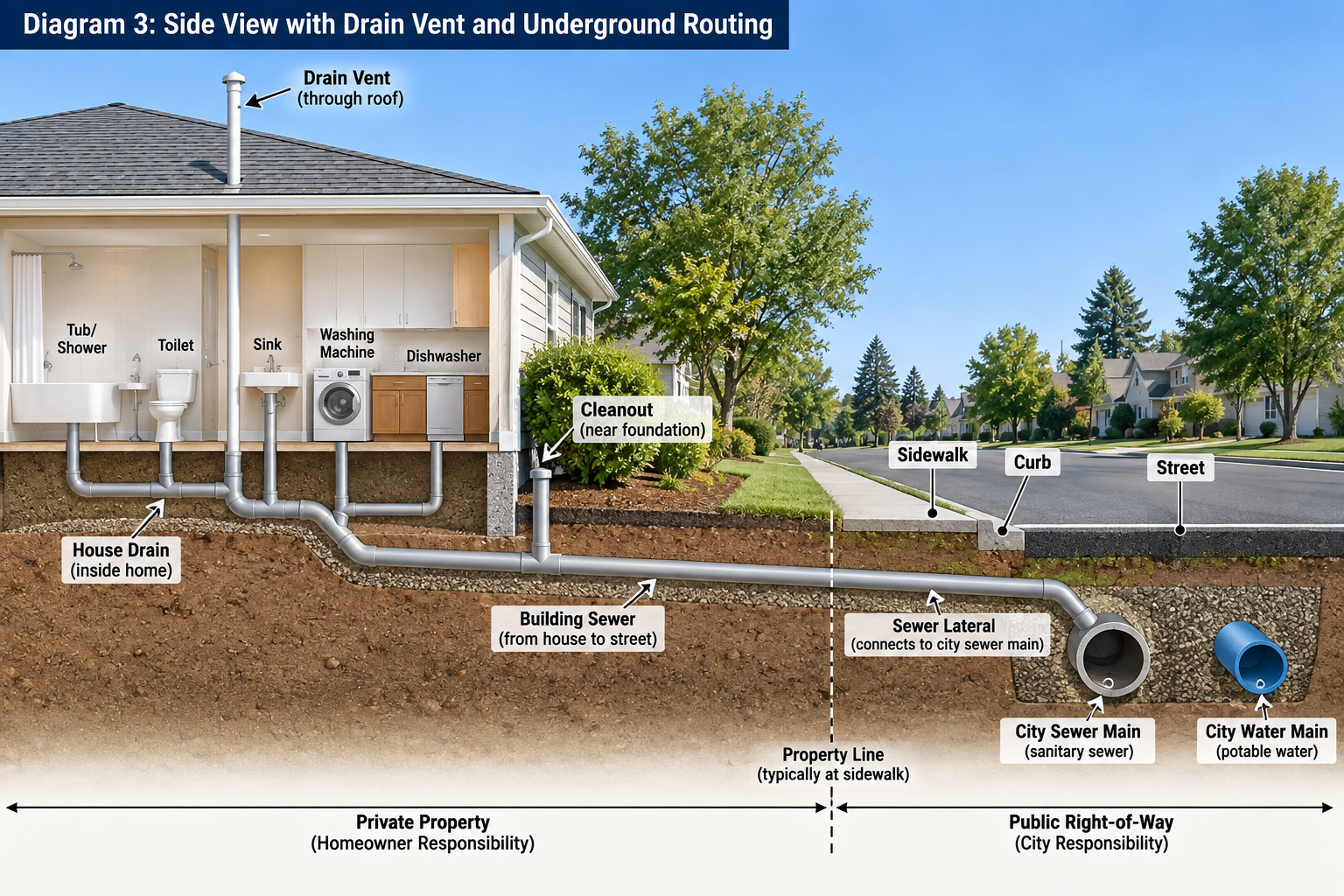
Side view of a home illustrating the sewer line connections.
It can reveal:
• Cracked, broken, or separated pipe
• Tree roots growing into joints
• Bellies, which are sags where waste and water collect
• Crushed or collapsed sections
• Deteriorating clay, cast iron, or Orangeburg (tar paper) pipe
• Heavy buildup or blockages
Is it part of a home inspection?
Usually not. Industry standards treat the buried sewer line as outside the scope of a typical home inspection, so it's a separate service you have to request. Not every inspector offers it, which we'll cover in the next post.
What does it cost?
Most published 2026 guides put a sewer scope at roughly $125 to $500 when there's an accessible cleanout, and often $100 to $250 when it's added to a home inspection. That's a small line item compared to what it can uncover.
Who should consider one?
• Homes more than about 20 to 30 years old
• Properties with mature trees near the sewer line
• Homes with older clay, cast iron, or Orangeburg pipe
• Homes with slow drains, gurgling, odors, or unusually wet or green patches in the yard
• Any home without a record of a recent scope, especially when nobody can vouch for its history
• Anyone who may sell someday. Knowing early gives you choices, instead of a surprise in the middle of a sale
Quick facts
What it is
A camera inspection of the main sewer line from your house to the street or septic system
How long it takes
Usually under an hour
Typical cost
About $125 to $500, or $100 to $250 as an add-on to a home inspection
In a standard home inspection?
Usually not. It is a separate service you request
Ask for
The video and a written report
Next in this series
• Post 2: Who Can Scope Your Sewer Line, an Inspector or a Plumber?
• Post 3: The Sewer Scope Found a Problem. Costs and Your Options
If something turns up, we can help
Hopefully you'll never need to reline or replace a sewer line. For most homeowners, it's a once-in-a-lifetime event. For us, as agents, it isn't. We see situations like this and have experience helping people through them.
We work with contractors, suppliers, and vendors regularly. We can't recommend specific companies, but we can help you work out what kind of professional you need, what questions to ask, and how to compare bids, so you find the right fit for your situation.
Whether you're selling soon or someday, we're glad to be a resource.
Kelly Azzarello Real Estate | Compass
kelly@kellyazzarello.com | (425) 830-6457 | www.kellyazzarello.com
[YouTube placeholder: link to video]
Cost ranges are general estimates drawn from published 2026 cost guides and vary by property, region, and contractor. This post is general information, not legal advice.


Because South of Town, the City Limits Start to Disappear
Part of the Why Issaquah? series: Because South of Town, the City Limits Start to Disappear
Why Issaquah? Because South of Town, the City Limits Start to Disappear
Category: Neighborhood Deep Dive | Suggested length: 450-550 words | Target reader: buyers curious about the rural edge of the Issaquah identity | Companion piece to "Because Room to Roam Comes in Two Very Different Flavors," which covers the zoning and real estate specifics this post intentionally leaves out.
Head south past the last roundabout in the city and the character of the place changes fast.
Sidewalks give up and become shoulders. Lots stretch out. Streetlights get sparse, then stop. “Issaquah” starts meaning a school district and a mailing address more than a municipal government.
For buyers who want room without leaving the Issaquah identity behind entirely, this is the part of the map worth understanding, and where it actually starts.
Where the Sidewalks End
The transition isn't gradual. Within a few minutes' drive, you can go from a standard suburban block to genuinely rural roads, no streetlights, no sidewalks, lots measured in acres rather than square feet.
It's a different rhythm entirely: quieter roads, more distance between neighbors, the kind of quiet that doesn't exist anywhere inside the city line.
A Slower Pace, By Design
This isn't an accident of geography. It's zoning, built specifically to keep density low and lots large the farther out you go.
For the actual mechanics, real lot sizes, zoning categories, and the specific communities that anchor this side of the map, that's a companion post in this series: “Because Room to Roam Comes in Two Very Different Flavors.” This post is about the feel of it, not the parcel data.
Who Chooses This Side
Buyers drawn to this part of the map tend to want:
- Real acreage, room for animals, a shop, or just genuine distance from neighbors.
- An Issaquah School District address, without needing to be inside Issaquah's city limits.
- A trade-off they've already decided is worth it: well and septic instead of city utilities, a longer drive instead of a short one.
It's not the right fit for a buyer who wants sidewalks and a five-minute walk to a coffee shop. For a buyer who's already decided they want land, though, it's often the only part of the map that actually delivers it.
For Buyers & Sellers
Because this area still carries an Issaquah address, buyers researching “Issaquah” online often don't realize a specific listing sits outside city limits until well into their search. Flagging that distinction early, rather than letting a buyer discover it later, tends to build trust rather than cost it.
Curious how far south you'd need to go to get the space you're after? Reach out to Kelly Azzarello Real Estate and we'll map it out.

Out of Sight, Out of Mind, Out of Pocket
The hidden home problems worth knowing about now, so selling your home later doesn't come with a surprise bill
Here's something we hear a lot: "Everything works, so we're good."
But a toilet that flushes tells you very little about the sewer line underground, and a light that turns on tells you nothing about the panel behind the wall.
The most expensive surprises in a home are usually the ones nobody can see.
And they rarely pick a convenient time. A problem that surfaces in the middle of a sale usually costs more, takes more time, and leaves you with fewer choices than one you found and handled on your own schedule. A buyer's inspector will find it either way. The only question is whether you find it first.
This series walks through the hidden problems one at a time, short and plain, so you can find out what's there, what it might cost, and what to do about it. Whether you plan to sell soon, someday, or never, a little attention now keeps small things small.

How to use this guide
Pick the topic that matches what you're wondering about and jump in. Each post takes only a few minutes to read. Not sure where to start? Begin with the first section below. Those are the hardest problems to see, which is why they tend to surprise people most.
Hidden underground and behind the walls
• Sewer lines and older plumbing (including CPVC): Why a working toilet doesn't mean a healthy pipe, and what to know about CPVC.
• Electrical panel and wiring: Older panels and wiring can worry buyers, lenders, and insurers.
• Buried oil tanks: A tank left in the yard can complicate financing and cost real money to deal with.
• Asbestos (popcorn ceilings and more): What it is, where it hides, and why you shouldn't scrape to find out.
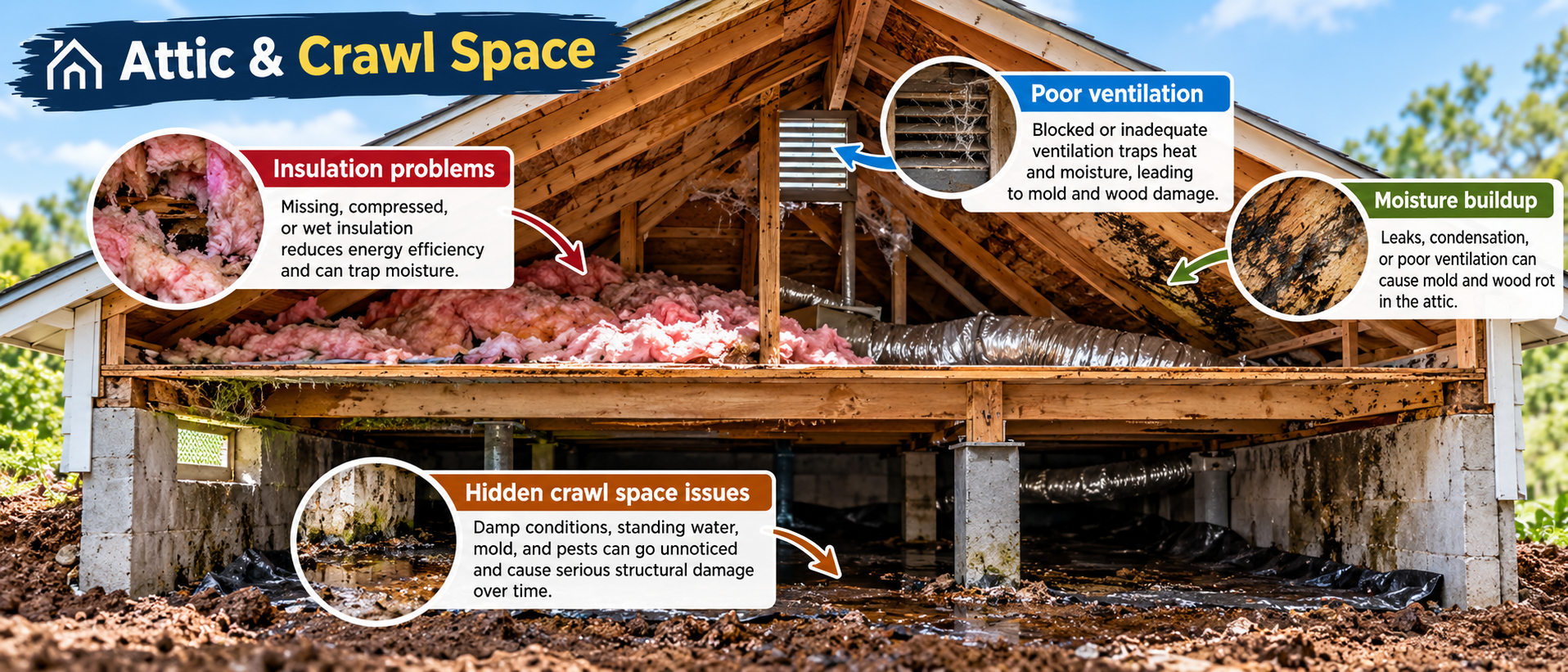
• The crawl space and attic nobody has checked in years: Moisture, pests, and insulation problems that build quietly.
• Pests and wood rot: Damage inside walls and beams that shows up on an inspection report.
Big-ticket items that age out
• Roof age and condition: What an aging roof tells a buyer's inspector, and what it tells you.
• Water heater age: A five-minute check that can save you a flooded utility room.
• Broken windows and failed seals: Fogging, condensation, and windows that won't open or close.
• Deferred exterior maintenance: Small things that invite bigger problems.
What buyers notice the moment they walk in
• Odors: Pet, smoke, and cooking smells that settle into carpet, ducts, and insulation.
• Highly stylized paint or decor: Bold choices that can narrow your buyer pool.
The paperwork side
• Unpermitted work: The paperwork problem that can stall a closing.
• Should you inspect before you sell? Pre-sale inspections and disclosure basics.
• Which add-on inspections are worth ordering? Sewer scope, pest, chimney, and more, and when each makes sense.
Why finding out early matters
When a hidden problem shows up at the last minute, everyone is learning about it at the same time, and that's when it gets stressful. Problems found early, with real estimates in hand, are much easier to work through. You choose the contractor, the timing, and the budget, instead of being backed into a corner.
If something turns up, we can help
Most homeowners deal with a problem like these once in a lifetime, if ever. Hopefully you'll never need to reline a sewer line, replace a panel, or dig up a buried tank. If you do, it helps to have someone who has been through it before.
As agents, we work with contractors, suppliers, and vendors all the time, and we've helped clients through situations like these. We can't recommend specific companies, but we can help you work out what kind of professional you need, what questions to ask, and how to compare bids, so you find the right fit for your situation.
Whether you're selling soon, someday, or not at all, we're glad to be a resource.
Kelly Azzarello Real Estate | Compass
kelly@kellyazzarello.com | (425) 830-6457 | www.kellyazzarello.com
This series is general information, not legal or financial advice. Disclosure rules and licensing requirements differ by state.
Because There's Always Something Happening Downtown
Part of the Why Issaquah? series: Because There's Always Something Happening Downtown
Why Issaquah? Because There's Always Something Happening Downtown
Category: Community & Events | Suggested length: 800-900 words | Target reader: buyers weighing community feel, families
Salmon Days gets the headline. It's really just the loudest night on a calendar that barely quiets down between May and September.
Here's the full rundown of what a summer actually looks like downtown, week by week.
Saturdays: The Farmers Market
The Issaquah Farmers Market runs Saturdays at the historic Pickering Barn, 9 a.m. to 2 p.m., May through September. It's a genuine destination market: more than 100 vendors on a typical weekend, live music, cooking demonstrations, and seasonal traditions like the Strawberry Festival and Kids' Day built right into the schedule.
Tuesdays and Thursdays: Free Music All Summer
Two separate weekly series keep the summer calendar busy:
- Concerts on the Green, Tuesday evenings on the Issaquah Community Center lawn, an eight-week season from early July through late August.
- Gas Station Blues, Thursday nights at the Historic Shell Station on Front Street, the same July-through-August stretch.
- ArtWalk & Music Stroll, first Fridays through the summer, through historic downtown.
- Fenders on Front Street, a classic-car gathering that draws a crowd of its own.
- Ongoing Village Theatre productions, giving the city a genuine year-round arts anchor.
Both are free, family-friendly, and about as close to a standing weekly neighborhood tradition as a city this size gets.
August: The Whole Downtown Goes Car-Free
Al Fresco on Front closes Front Street to vehicle traffic every weekend in August, Saturday morning through Sunday night. Olde Town turns into a walkable, mall-like stretch of outdoor dining, sidewalk shopping, live music, and pop-up activities for four weekends straight.
A Few More Worth Knowing
Then October: Salmon Days
Everything above builds toward the city's biggest weekend. Issaquah Salmon Days, held the first full weekend of October, is Washington's largest two-day festival: nearly 600 vendor booths, a Grande Parade, two live entertainment stages, and thousands of people watching salmon fight their way upstream past downtown. We cover it in its own post, since it deserves the space.
For Buyers & Sellers
For families weighing Issaquah against other Eastside cities, this calendar is often the tiebreaker. It's one thing to say a city has “community events.” It's another to show a buyer a weekly rhythm that runs from May through October without a real gap. Listings near downtown can lean into that specifically: walk to the market, walk to the concert, walk to the parade.
Want to know which Issaquah neighborhoods put you close enough to downtown to make this calendar part of your own routine? Reach out to Kelly Azzarello Real Estate.