


12: The Plateau Was Built on Horseback
Before it was a tech suburb, the Sammamish Plateau was horse country. A personal history, plus today's boarding barns, riding club, and horse-friendly trails.
The Plateau Was Built on Horseback
Before Sammamish was a city with a Costco headquarters four milesaway and a spot on Money magazine’s best-places list, it was chickenfarms, dairy farms, and open land, and for a lot of families who livedhere through the 1970s and 80s, it was horse country. That historyhasn’t disappeared. It’s just gotten quieter, tucked into a handful ofboarding barns, a genuinely dedicated riders’ club, and trails thatstill carry the word “horse” in their rules even as the plateau aroundthem filled in with rooflines.
My stepfather lived here through the 1970s and into the 80s, on aplot of land on the Pine Lake side of what’s now Klahanie. They kepthorses, and rode them under the power lines and across the open landthat’s now the neighborhood’s own Powerline Trail, the same stretchresidents walk, run, and bike today without necessarily knowing what itused to be. A ride usually meant a trip down to Sadlier’s Country Store,near where the Pine Lake QFC sits now, where a hitching post out frontsaw as much use as the parking lot. It’s a detail that’s easy to losetrack of on a plateau that’s grown as fast as this one has: twenty yearsbefore Klahanie was a neighborhood, it was still a place you’d ride ahorse to the store.
A hitching post at the general store
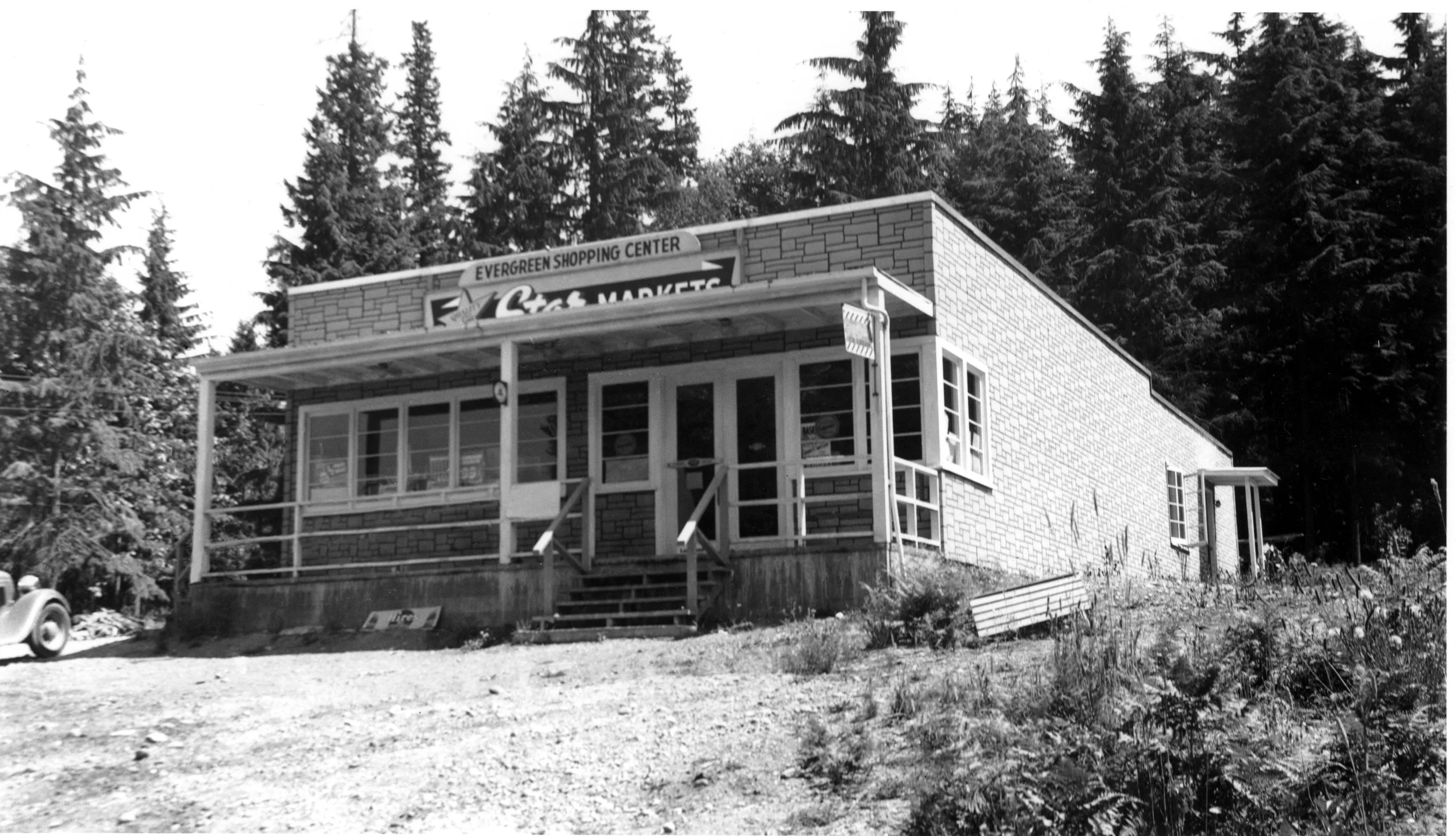
Sadlier’s Market, Pine Lake (Sammamish, WA)
Sadlier’s Country Store, known as Braden’s before that, sat at what’snow 2902 228th Avenue SE, the current address of the Pine Lake QFC (the building itself stood roughly where August Moon Chinese Restaurant istoday). Roy and Arminta Braden built it in 1946 and opened it in 1948;Joe Sadlier bought it around 1968 and the Sadlier name stuck until thestore closed in 1984. It was the only store on the plateau that soldmeat in its later years, which helped it outlast its smaller counterpartacross the lake. And it had a hitching post out front that localsgenuinely used, a detail confirmed independently by a 2011 Seattle Timespiece, in which a resident who arrived on the plateau in 1981specifically remembered horses tied up next to the cars right up untilthe store closed a few years later.
The Sammamish Saddle Club
The plateau’s horse community never fully went away, it organized.The Sammamish Saddle Club has spent years working to keep equestriantrail access intact as development filled in around it, includingreconstructing a trail link that was severed by a new housingdevelopment. The club’s advocacy work runs deeper than trailmaintenance, too: former club vice president Michelle Petitti’s horseadvocacy on the plateau led directly to her serving on the SammamishCity Council, a nice reminder that the horse community here has realcivic weight, not just a hobbyist’s footprint.
Today the club maintains an “adopt-a-trail” relationship with agenuine loop: Soaring Eagle Regional Park connects through the HazelWolf Wetlands (managed by the land trust Forterra) to Beaver Lake Parkand back, a roughly two-hour ride if you’re doing the whole thing onhorseback.
Where to ride and board today
RockMeadow Equestrian Center, on SE 34th Street, isthe plateau’s best-known boarding and training facility: a 10-acreproperty surrounded by more than 100 acres of pasture, wetlands, andtrails, with both an indoor and outdoor arena and ahunter/jumper-focused instruction program for riders from beginnerthrough competitive levels. A handful of other boarding and trainingoperations, including Gold Creek Equestrian Center, Red Gate FarmTraining, and Tashunka (which started in 2002 as a youth horsemanshipand leadership program before growing into full boarding and training),round out the options for anyone looking to keep a horse on the plateautoday.
The trails that still say“horse”
Equestrian use is folded into the plateau’s existing trail systemrather than set apart in its own network. Soaring Eagle RegionalPark carries real equestrian trail access as part of the SaddleClub’s adopted loop. Duthie Hill’s shared multi-usetrails are open to hikers, trail runners, and horses alongside mountainbikers, with horses holding the right of way. It’s a small detail, butit’s a real one: even a mountain bike park built in 2010 was designedwith the plateau’s older horse culture in mind, not around it.
Where things sit
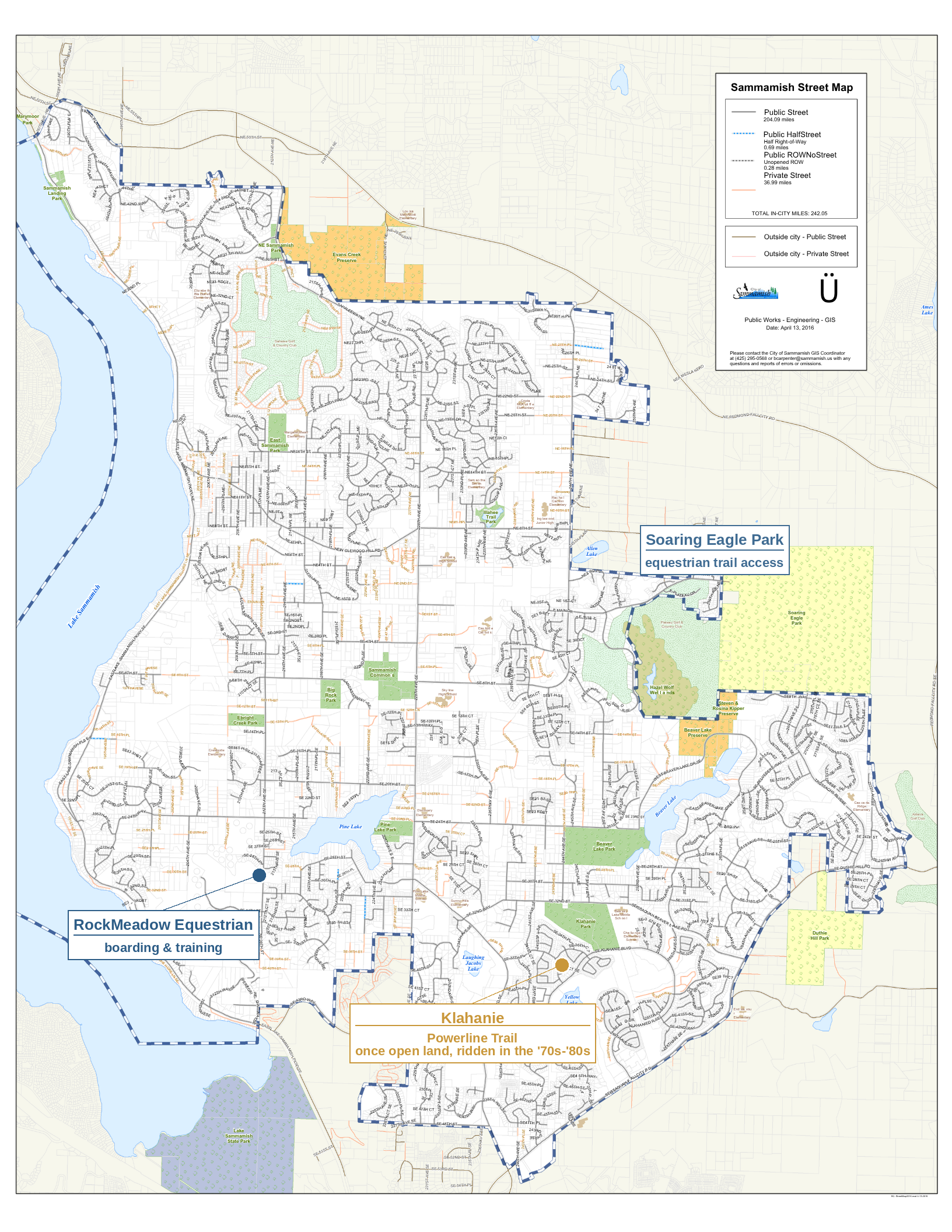
Official City of Sammamish street mapannotated with callouts for Klahanie and the Powerline Trail, RockMeadowEquestrian Center, and Soaring Eagle Park
Base map: City of Sammamish Public Works – Engineering – GIS,Sammamish Street Map (April 13, 2016). Callouts and markers added by us,plotted from real coordinates; not an official city product.
This is a supplementary post in our Why Sammamish? series. We’realso looking into the plateau’s other historic general stores, includingBarker’s Store (Pine View Grocery) on the other side of Pine Lake, for afuture post and companion video in our Then & Now series.
Kelly Azzarello Real Estate | Compass 📧 kelly@kellyazzarello.com 📞(425) 830-6457 🌐 kellyazzarello.com

02: The History of Sammamish: From Plateau Farms to City
Sammamish didn’t exist as a city until 1999, but the plateau’s story goes back to 1877. Here’s the real history: the mill town, the Redmond/Issaquah identity split, incorporation day, and the Klahanie annexation saga.
Sammamish is one of the youngest cities in Washington State, but the plateau it sits on has a much longer story, one that only became “Sammamish” in the last few decades. Understanding how a rural, unincorporated stretch of King County turned into a nationally ranked city helps explain a lot about how the place feels today: why it’s organized around neighborhoods rather than a historic Main Street, why parts of it still feel connected to Redmond or Issaquah, and why a community this young already has such a strong sense of identity.
Before it was Sammamish
The plateau between Lake Sammamish and the Snoqualmie Valley was Snoqualmie territory long before any non-Native settlers arrived. The name “Sammamish” itself comes from the Snoqualmie language: according to members of the Snoqualmie Tribe, it’s a corruption of “Sqawx,” the Snoqualmie name for Lake Sammamish, combined with “abs,” a suffix referring to the people of a particular area. In other words, the city’s name predates the city by generations, it originally described the people of the lake, not a municipality.
The first permanent non-Native settler on the plateau was Martin Monohon, who arrived in 1877. For the next decade or so, settlement was sparse. It wasn’t until the 1890s that people began arriving in meaningful numbers, and even then, growth stayed concentrated in the southern part of the plateau near Pine Lake, which developed faster than the north.
A mill town, then a farm town, then a resort town
Lake Sammamish Shingle Mills, Weber Point, 1910
The plateau’s first real economic engine arrived in 1889, when the Seattle, Lake Shore & Eastern Railroad completed a line along the eastern shore of Lake Sammamish. A lumber mill relocated to the shoreline settlement that became known as Monohon, and the Allen and Nelson Mill Company ran it starting in November 1889. For the next 36 years, that mill was the plateau’s anchor industry.
Outside the mill town, the plateau’s economy through the early 20th century was mostly logging, dairy farming, and chicken farming, the kind of land use that leaves almost no visible trace today but shaped where roads and property lines ended up. By the 1930s, a handful of resorts had sprung up along Lake Sammamish’s shores, drawing Seattle-area visitors out to the plateau for swimming and vacationing well before anyone lived there year-round in large numbers.
Redmond to the north, Issaquah to the south
For most of the 20th century, this was all unincorporated King County, and it stayed that way even as postwar development slowly crept onto the plateau starting in the 1960s. What’s interesting is how residents identified during that period: the plateau essentially split in two along SE 8th Street. Households north of that line had Redmond phone numbers and zip codes and thought of themselves as connected to Redmond. Households south of it had Issaquah phone numbers and zip codes and felt tied to Issaquah. There was no single “Sammamish” identity yet, just two halves of a plateau, each oriented toward a different neighboring city.
That split shaped the next 15 years of political wrangling. By the mid-1980s the plateau’s population had passed 10,000 and was tripling every decade and a half, and growth was arriving faster than infrastructure could keep up. Long-time residents debated three options: annex to Issaquah, annex to Redmond, or incorporate as an entirely new city.
In 1991, voters rejected a proposal to annex the southern half of the plateau to Issaquah. That same year, Redmond quietly included the northern half of the plateau in a long-range annexation plan of its own, but the idea was contested for more than a year and eventually abandoned. In 1992, plateau residents put incorporation to a vote for the first time, and it failed decisively, 58 percent to 42 percent. Opponents argued a new city with no real commercial tax base would end up costing residents more, not less.
The incorporation push cooled for a few years, but the underlying frustration with King County didn’t go away; residents felt neglected on roads, parks, and basic services, while development kept getting approved around them. By 1998, a renewed incorporation campaign put the question back on the ballot, and this time it passed.
Incorporation day
The City of Sammamish officially came into existence at midnight on August 31, 1999. The celebration, called “Sammamish Day,” was actually held three days earlier, on a Saturday at Bill Reams East Sammamish Park, where roughly 1,000 people turned out for a concert featuring members of three Seattle-area symphony companies, an antique car show, and the formal incorporation ceremony. Mayor Phil Dyer unveiled the new city’s flag, and Amy Sanders and Tom Burgess were announced as co-winners of the city’s logo design contest.
Even the name wasn’t a given. During the incorporation process, options on the table included Monohon (after the old mill town), Inglewood, Sahalee, and, memorably, Heaven. Sammamish ultimately won out, in part because it had already been used as a placeholder name during an earlier, failed 1992 incorporation attempt (state law required a name on the petition), and it stuck.
The new city started with about 28,000 residents and a fairly bare-bones setup: city hall operated out of a shopping center, there was no post office, and the plateau’s main road still looked much like the country lane it had been decades earlier.
The Klahanie question
Not every plateau neighborhood joined the city in 1999. Klahanie, now one of Sammamish’s largest and best-known neighborhoods, was deliberately left out of the original incorporation boundary because the area was seen as leaning toward eventual annexation by Issaquah instead. For a while, that looked like exactly where things were headed: in November 2005, Klahanie voted to annex into Issaquah, but also voted against taking on a share of Issaquah’s existing municipal debt as part of the deal. Issaquah shelved the annexation plan the following year rather than absorb roughly $17 million in road improvement costs on Issaquah-Fall City Road without the debt-sharing arrangement.
Klahanie stayed unincorporated for another decade before the City of Sammamish annexed it on January 1, 2016, folding in a large, already-built-out community and pushing the city’s population past 60,000 in a single step, up from roughly 45,780 at the 2010 Census. It’s a good reminder that “how Sammamish got its current shape” wasn’t settled all at once in 1999. It kept evolving for another 17 years.
Special things about Sammamish
For a city that’s barely a quarter-century old, Sammamish has picked up a disproportionate number of national accolades:
Money magazine ranked Sammamish among America’s best small towns twice in its “Best Places to Live” survey: 12th in 2009 and 15th in 2011.
In 2012, Forbes and Nextdoor named Sammamish the friendliest town in America.
NerdWallet ranked Sammamish 13th on its 2016 list of Best Small Cities for Families.
In 2018, Money magazine ranked Sammamish 9th nationally in its “50 Best Places to Live” survey, and it was the only city in Washington, and one of only three in the entire Pacific Northwest, to make that list.
In 2021, WalletHub named Sammamish the #1 Best Small City in America, out of more than 1,300 cities evaluated, with especially high marks for economic health and safety.
The city’s official motto, adopted along the way, is fittingly understated: “Building Community Together.”
The plateau, at a glancE
This is the second post in our Why Sammamish? series. Up next: why Sammamish’s schools are such a draw, and the two-district quirk that surprises so many newcomers.
Kelly Azzarello Real Estate | Compass 📧 kelly@kellyazzarello.com 📞 (425) 830-6457 🌐 kellyazzarello.com